


Are these visits a shift in Washington’s policy or just tactical steps?
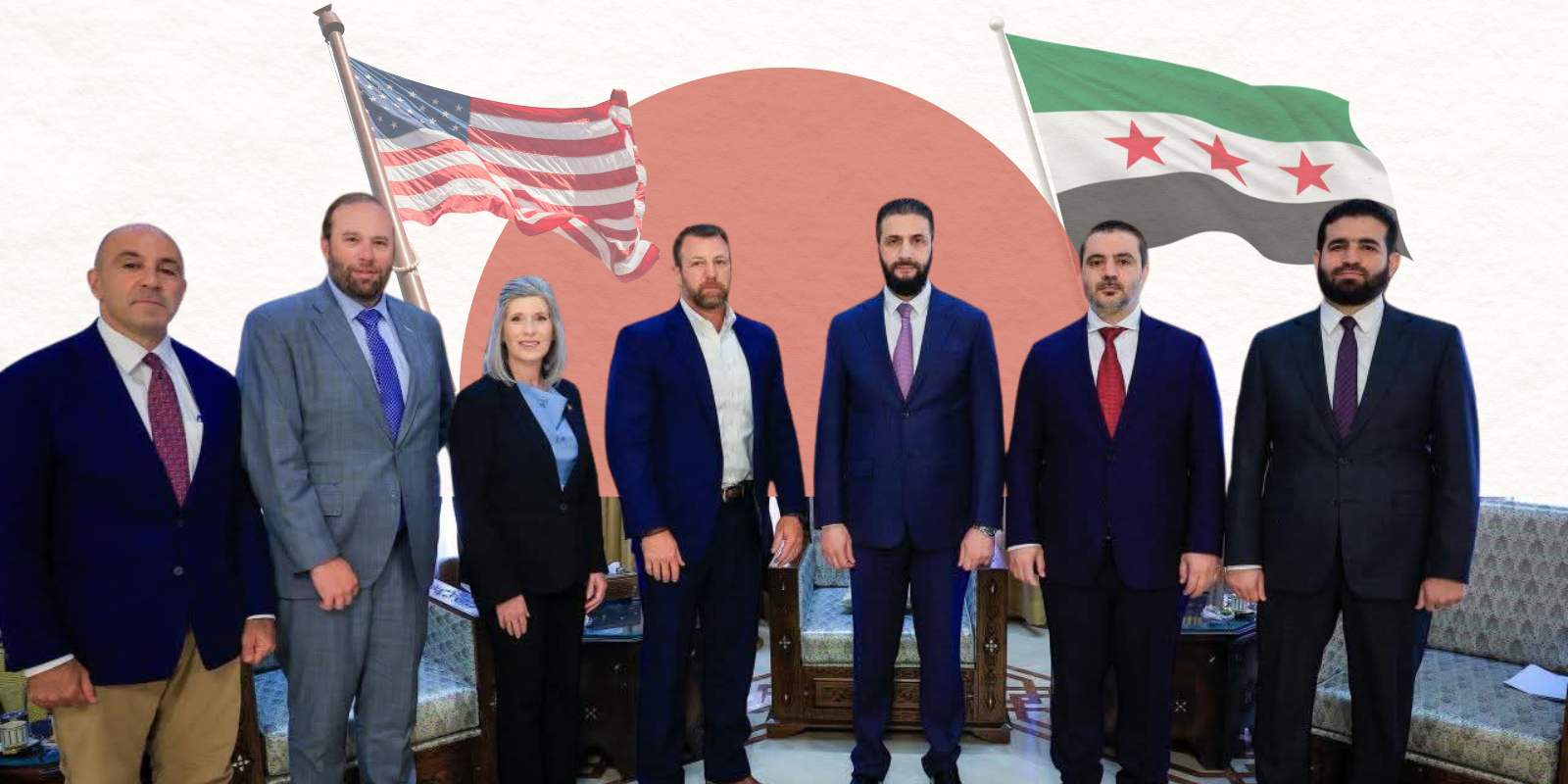
In recent months, a series of U.S. delegations have travelled to Syria to meet President Ahmad Al-Sharaa, the most recent being a bipartisan congressional group. Their stated goals were to assess humanitarian conditions and discuss security and regional issues. Observers argue that these visits go far beyond diplomatic protocol: they carry important signals and could directly affect regional power balances and the future of the Syrian conflict.
These developments follow a period of uncertainty in U.S. policy toward Syria. Rising sectarian violence in Suwayda and Israeli escalation in Damascus left Washington oscillating between sharp warnings to the Syrian government and occasional gestures of support. But with these visits, U.S. engagement seems to be moving out of ambiguity toward a more deliberate reassessment.
U.S. Visits and Conditions
In the latest trip, Syrian President Ahmad Al-Sharaa, joined by Foreign Minister Asaad Al-Shaibani and Interior Minister Anas Khattab, received a U.S. congressional delegation in Damascus. The group, which arrived from Amman after meeting with King Abdullah II, included Senators Markwayne Mullin and Joni Ernst, along with Representatives Jason Smith and Jimmy Panetta.
The visit followed a recent Pentagon report to Congress highlighting that Syria’s new military structure lacks cohesion, relying heavily on factions tied to extremist groups such as Hay’at Tahrir al-Sham (led by Syria’s current president Al-Sharaa) and remnants of Hurras al-Din.
Just days earlier, Congressman Abraham Hamadeh had met Al-Sharaa and Al-Shaibani in Damascus to discuss sensitive files: repatriating the remains of Kayla Mueller to her family in Arizona, creating a humanitarian corridor for Suwayda, exploring normalization with Israel and entry into the Abraham Accords, and ensuring the inclusion of all Syrian communities in shaping the country’s future.
Earlier this year, in April, Al-Sharaa hosted Congressman Cory Mills, the first U.S. lawmaker to visit Syria after the fall of the previous regime, as well as Representative Marlin Stutzman.
Meanwhile, on July 22, the House Financial Services Committee approved extending the Caesar Act sanctions for another two years, with the option to terminate them if the Syrian government meets specific conditions for two consecutive years, or by the end of 2029.
Those conditions include halting airstrikes on civilians, protecting religious and ethnic minorities, curbing Captagon production, allowing unrestricted humanitarian aid access, releasing all political prisoners, and opening detention centres to international monitors.
Read also: The Syrian Government Confusion in Managing Domestic Issues
Political Significance and U.S. Goals
Speaking to +963, retired ambassador and U.S. affairs expert Dr. Masoud Maalouf explained that congressional visits are directly tied to U.S. demands for lifting sanctions; especially ensuring the protection of minorities, after Washington strongly condemned the recent events in Suwayda.
He added: “The second major demand is rapprochement with Israel. Congress has not yet agreed to fully lift sanctions, particularly the Caesar Act, pending more tangible progress in relations with Israel and guarantees for minority rights.”
Dr. Arij Jabr, professor of political science, described these field visits as “pulse-taking missions,” allowing U.S. lawmakers to gauge whether Syria’s government has changed its behaviour after years of isolation. She emphasized that Washington is especially concerned with transnational crimes, from arms and drug smuggling to refugee flows.
“These visits don’t necessarily signal full normalization or diplomatic recognition,” she explained. “But they show that Syria remains under Washington’s microscope, and that the U.S. still seeks to counterbalance Russia and Iran’s influence.”
Syrian political activist Mohammad Fadel Fatoum, a member of the Tamasuk coalition, argued that Congress uses these visits to evaluate the effectiveness of U.S. policy: “Washington’s priority is preventing Iran’s return and limiting Russia’s role. That’s why these delegations coincide with envoy Thomas Barrack’s frequent trips to Lebanon, where he pushes the government to move toward Hezbollah’s disarmament.”
Fatoum also noted that Washington may want Damascus to play a regional role: tightening control along Lebanon’s borders to restrict Hezbollah’s supply lines, one of the implicit U.S. demands behind these visits.
Damascus’ Position
According to Fatoum, the Syrian government still aspires to restore full sovereignty across the country, north, south, and east, but faces major risks in doing so. “Because of the state’s fragile structure and limited capacity, Washington feels compelled to guide the government and prevent collapse, while ensuring that neither Iran regains influence nor Russia expands its footprint.”
He argued that U.S. delegations provide “instructions and evaluations” to keep the government afloat. For Damascus, U.S. support is crucial to maintain stability, negotiate ceasefires in the south, and navigate pressure from Suwayda unrest, the ongoing siege, and Israeli interventions that, while presented as humanitarian, serve strategic purposes.
“The core problem,” Fatoum concluded, “is that the Syrian government continues to act unilaterally, without internal consensus, leaving it dependent on outside powers with conflicting agendas. Its survival strategy is essentially to satisfy foreign demands.”
Read also: Syria After Change: A Race for Influence Amid a Power Vacuum
Possible Implications
Fatoum predicted that these visits will not quickly lead to sanctions relief: “Full lifting depends on the government’s practices, its internal structure, and the record of its officials. These remain major obstacles Washington won’t easily overlook.”
Maalouf, however, was more optimistic, noting that the U.S. has shown relief at Syria’s distancing from Iran and the disruption of Hezbollah’s supply routes. He also highlighted that Washington has not faced hostile rhetoric from Damascus, despite Israeli strikes, the occupation of Mount Hermon, and control of the Golan Heights.
Dr. Jabr suggested the visits may provide Congress with grounds to reconsider key sanctions regimes such as Caesar and Captagon. “If the government demonstrates transparency, justice, and respect for human rights, gradual relief is possible.”
She added that the visits send a clear message: Syria remains part of the U.S. strategic map, and partial engagement could encourage Arab and international actors to follow suit. That, in turn, may open doors to reconstruction and broader diplomatic openings.
“These visits,” Jabr concluded, “mark an important shift in Washington’s stance toward Syria. They signal an attempt to break the deadlock, reopen channels of communication, and reassess the evolving situation on the ground; without rushing into full normalization or recognition.”











