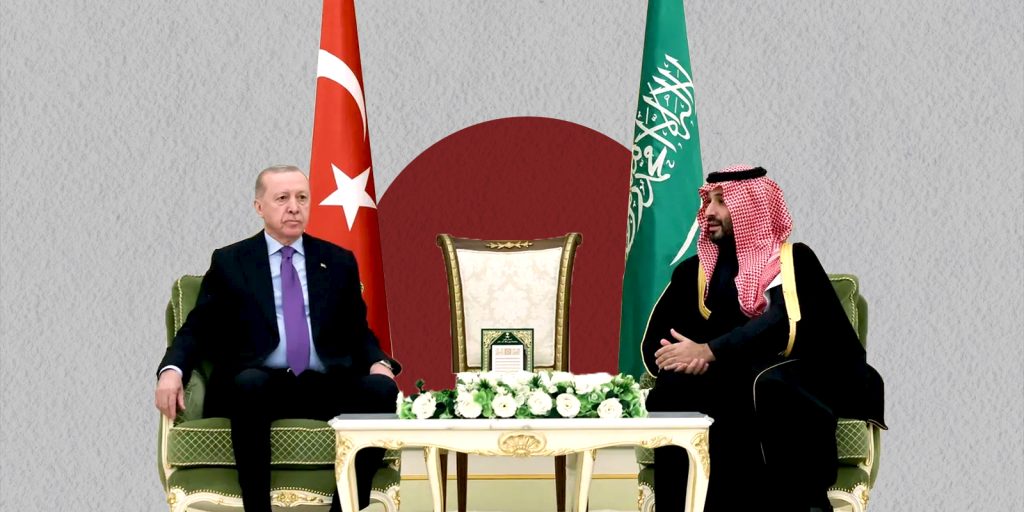
The visit of Turkish President Recep Tayyip Erdoğan to Egypt last Wednesday carries particular significance on multiple levels. On the one hand, it represents a pivotal moment in the trajectory of Egyptian–Turkish relations; on the other, it comes at an exceptionally sensitive regional juncture marked by overlapping crises and rapid transformations. Chief among these are the ongoing implementation of the ceasefire agreement in Gaza, escalating US pressure on Iran, shifting dynamics in Syria, and parallel developments in Libya, Sudan, and Somalia.
From Cairo’s perspective, Erdoğan’s visit is viewed as a step that can be built upon to address several shared concerns, most notably the files of Syria, Gaza, Libya, and the Horn of Africa. More broadly, the visit signals the possible emergence of a new phase of regional coordination – one premised on managing disagreements through dialogue, restoring balance, and supporting stability in a region long burdened by protracted conflicts and intensifying external interventions.
The joint statement issued following the second meeting of the Egyptian–Turkish High-Level Strategic Cooperation Council, held in Cairo on 4 February 2026, underscored both countries’ commitment to elevating their relations to a comprehensive strategic partnership. This partnership is envisaged as encompassing enhanced political, economic, and developmental cooperation, alongside intensified regional and international coordination on issues of mutual concern, foremost among them stability in the Middle East.
Regarding Syria, both sides reaffirmed their firm commitment to Syrian sovereignty, unity, and territorial integrity. They stressed the importance of supporting reconstruction efforts, strengthening state institutions, and launching an inclusive political process that is Syrian-owned and Syrian-led, with the participation of all components of Syrian society.
The two sides also condemned ongoing Israeli violations of Syrian sovereignty and emphasised the necessity of Israel’s adherence to the 1974 Disengagement Agreement, within the framework of a shared vision aimed at consolidating regional security and stability.
In a related context, President Erdoğan arrived in Riyadh last Tuesday on an official visit, during which he is scheduled to meet Crown Prince and Prime Minister Mohammed bin Salman to discuss bilateral relations. Formal talks are expected to address regional developments, prospects for expanding peace initiatives, and mechanisms for enhancing regional stability.
Coordination and shared interests
Commenting on these developments, Egyptian thinker Abdel Moneim Said noted that Saudi Arabia has, in recent months, taken the lead in convening joint Arab and Islamic summits as part of an expanding consultative process among Arab states and major Islamic powers.
According to Said, this consultation has been driven by key Arab states – most notably Saudi Arabia, Egypt, and the United Arab Emirates – in cooperation with influential Islamic countries such as Turkey, Pakistan, and Indonesia. He pointed out that this coordination has translated into joint action within the United Nations, particularly regarding recognition of the Palestinian state, as well as efforts to encourage US President Donald Trump to adopt a more active role in advancing peace in the region.
Said further observed that Trump’s visit to Saudi Arabia and the United Arab Emirates in May was attended by Syria’s transitional president Ahmed Al-Sharaa, an event he interprets as marking the beginning of renewed Arab support for Syria. This support, he argues, aims to assist in the establishment of an inclusive Syrian national state capable of accommodating all sects and social components, while entrenching the principle of equal citizenship for all Syrians.
Regarding Erdoğan’s visit to Cairo and Egypt’s emphasis on supporting stability in Syria through the inclusion of all societal components within a single political process, Said explained that the Syrian file constitutes a central pillar of extensive consultations among Egypt, Turkey, Saudi Arabia, and several Arab states. He added that Syria, alongside Libya, remains one of the two core files shaping Egyptian–Turkish relations, recalling that Ankara and Cairo have previously reached several understandings. In his assessment, the current trajectory points towards the gradual construction of a Syrian national state in which all citizens can coexist in peace, justice, and security.
Read also: Syria–Turkey Trade Gap: Record Turkish Exports and a Widening Syrian Deficit
Parameters of regional security
On whether Cairo might convey messages to the Syrian leadership via President Erdoğan concerning regional security parameters, Said clarified that such issues are typically managed through formal institutional channels. He noted that Egypt’s Ministry of Foreign Affairs maintains direct communication with its Syrian counterpart and keeps it informed of coordination with the Turkish side.
The primary objective, he stressed, is to avoid any direct confrontation between Syria and Turkey, and to encourage Ankara to engage with Syria as a fully sovereign state rather than as an open arena for conflict.
Erdoğan’s latest visit to Egypt – his second since February 2024 – thus carries significant implications for regional security discussions, particularly regarding mechanisms for reducing tensions in the Middle East. This is especially relevant to the question of stability in Syria, an issue on which Cairo has consistently reiterated its firm commitment to safeguarding Syrian stability and ensuring that all components of Syrian society are able to exercise their rights.
The visit also addressed other shared concerns, most notably Gaza and Libya, as reflected in the remarks of Egyptian President Abdel Fattah el-Sisi during the joint press conference held at Al-Ittihadiya Palace.
For his part, Erdoğan emphasised that regional stability is intrinsically linked to preserving Syria’s territorial unity and political sovereignty. He argued that a unified and secure Syria serves the interests of all neighbouring states and reaffirmed Turkey’s support for any efforts aimed at achieving peace and stability within the country.
Reframing the regional landscape
In an analytical reading of the tour, Turkish writer Islam Özkan argued that Erdoğan’s visits to Riyadh and Cairo at this juncture amount to a reconfiguration of the regional landscape. In his view, these are not merely conventional bilateral meetings, but rather a concerted attempt to form what might be described as a “stability bloc” in a region increasingly marked by political and security fluidity.
Özkan contends that the tour reflects a clear shift from confrontational bloc politics towards a more pragmatic, realist diplomacy. Regional actors – most notably Turkey, Saudi Arabia, and Egypt – are seeking to reclaim the Syrian file from the hands of major international powers, particularly the United States and Russia, and reintegrate it into a regional framework.
This approach, he argues, is intended to reaffirm the capacity of regional states to generate home-grown solutions to their problems without awaiting external approval. Notably, Turkish–Saudi–Egyptian coordination views Syrian stability as a means of recalibrating the regional balance of power, curbing Israeli influence and threats by reinforcing the regional and Arab character of the Syrian file and distancing it from externally imposed agendas.
At the same time, the implications of this visit for Syria can be understood through a logic of “mutual interests”, or what might be termed strategic trade-offs. Turkey seeks Arab political cover for its security concerns in northern Syria, while Riyadh and Cairo expect Ankara to demonstrate greater flexibility regarding recognition of Syrian state sovereignty and central institutions – an approach that could open the door to a comprehensive political settlement.
In this context, sustainable stability in Syria cannot be discussed without addressing reconstruction. The integration of Saudi capital with Turkish construction and logistical capacity, supported by Egyptian political backing, could create favourable conditions for launching early recovery projects. Such initiatives would constitute a necessary first step towards enabling safe and dignified voluntary return for refugees.
A further notable development is that Arab public opinion has ceased to be a passive recipient of policy trajectories and has instead become a form of constraining soft power. Broad popular consensus across the Arab world on Syria’s territorial unity acts as a safeguard against any arrangements that might lead to fragmentation, compelling decision-makers to prioritise Syrian sovereignty in all negotiations.
At the same time, Arab public sentiment remains focused on ending the prolonged humanitarian catastrophe, making the success of this diplomatic tour contingent upon its capacity to improve living conditions for Syrians both inside the country and in displacement. This, in turn, would provide governments with popular legitimacy to pursue normalisation or political settlement pathways.
The emphasis on trade and economic files during the tour cannot be separated from its broader political dimensions. Syrian stability would, in practical terms, enable the reopening of overland trade routes linking Turkey with the Gulf and Egypt, thereby enhancing regional economic integration.
In this sense, stability in Syria becomes not merely a political objective, but a direct economic and commercial interest for all three states. Coordination in the defence-industrial sphere may also contribute to the development of a regional security architecture capable of monitoring and securing Syrian borders through advanced technological means, reducing reliance on direct military escalation.
In conclusion, Özkan argues that the Ankara–Riyadh–Cairo triangle now constitutes one of the most significant centres of gravity in the Middle East. Should this coordination succeed, Syria could be transformed from an open arena for international power competition into a model of regionally driven cooperation, where Turkish security interests, Egyptian political vision, and Saudi economic weight converge within a more balanced and sustainable equation.