


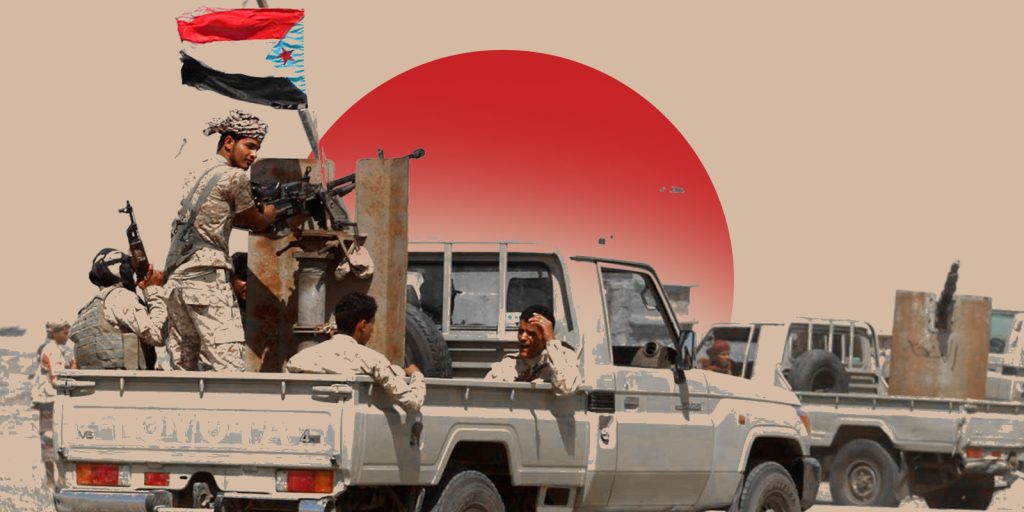
In recent weeks, Yemen has witnessed a renewed surge in military and political tensions, signaling a fresh rupture in a country already scarred by years of war and fragmentation. The escalation, unfolding simultaneously on the battlefield and within political institutions, has revived fundamental questions about Yemen’s future as a state, the unity of its territory, and the fragile balance of power within the internationally recognized government and its allies.
Roots of Escalation
In southern Yemen, the Southern Transitional Council (STC), backed by the United Arab Emirates, has launched a large-scale military operation in several governorates, branding it a campaign to “restore security and stability.” However, the move has triggered widespread concern over the possibility of renewed clashes and civilian casualties, particularly in a country already suffering from severe economic collapse and fragile security conditions.
Political analyst and writer Mubarak Al-Ati told +963 that these developments are not sudden or unexpected. Rather, he argues, they are deeply rooted in Yemen’s historical political and tribal divisions. “Yemen has long suffered from entrenched partisan and tribal conflicts,” he said, “which tend to resurface whenever political or security conditions allow.” According to Al-Ati, these divisions create a combustible environment that repeatedly ignites whenever state authority weakens.
At the same time, the STC has been expanding its military and administrative presence in southern and eastern governorates, including Hadramout and Al-Mahra. This expansion has raised alarm over the potential imposition of a new political reality that could entrench geographic and political fragmentation and revive long-standing fears of secession.
Read also: Islamic Governance in Syria: Lessons from Saudi Arabia and Turkey
Divisions Within the Legitimate Camp
Dr. Fares Al-Bayl, an academic and political researcher, told +963 that these moves cannot be separated from deep divisions within the camp of the internationally recognized government itself. He stressed that the inability to unify political and military visions has significantly undermined efforts to confront the primary challenge posed by the Houthi movement.
According to Al-Bayl, regional rivalries have increasingly spilled into Yemen’s internal arena, exacerbating fractures within the legitimacy camp. “Support for different actors and the divergence of regional agendas have directly weakened internal cohesion,” he explained, opening the door to side conflicts that have drained resources and distracted from the core battle against the Houthis.
Al-Ati echoed this assessment, describing the current escalation as the natural outcome of accumulated internal disputes, compounded by regional polarization. Yemen, he noted, often becomes an open arena for intersecting regional interests during moments of heightened tension, making internal reconciliation even more difficult.
Saudi Arabia’s Mediation Role
In response to the escalating tensions, political and diplomatic efforts have intensified to prevent a broader confrontation within the legitimacy camp. Al-Ati emphasized that the Yemeni government, backed by Saudi Arabia and the Arab Coalition, has sought to prioritize national interests over narrow factional disputes, despite limited leverage on the ground.
Saudi Arabia has emerged as a central actor in de-escalation efforts. Al-Bayl noted that Riyadh has taken a particularly firm stance against the STC’s expansion in Hadramout and Al-Mahra, governorates that hold significant strategic importance for Saudi national security. Any shift in their status, he warned, could have direct repercussions beyond Yemen’s borders.
Al-Ati highlighted Saudi Arabia’s success, to a considerable extent, in advancing a de-escalatory approach through the deployment of a military delegation led by Dr. Mohammed Al-Qahtani. The initiative helped narrow differences and reinforced calls for withdrawing armed forces from Hadramout and Al-Mahra. He explained that Saudi policy is rooted in a deep understanding of Yemen’s tribal and geographic fabric, and in the belief that local populations should manage and defend their own regions under the umbrella of an internationally recognized government.
Riyadh–Abu Dhabi Divergence and Southern Disputes
Nevertheless, Al-Bayl pointed out that the STC’s military expansion is perceived by some as an attempt to curtail Saudi influence, reflecting broader divergences between Riyadh and Abu Dhabi on certain regional files. These differences, he argued, inevitably reverberate inside Yemen, complicating coordination within the coalition.
While Al-Ati acknowledged that the relationship between the UAE and the STC is explicit and well known, he cautioned against exploiting Yemen’s fragile security environment to impose unilateral political outcomes. Such actions, he warned, ultimately benefit the Houthis by further fragmenting their opponents.
Al-Bayl added that Emirati backing for the STC’s secessionist agenda has, paradoxically, harmed the southern cause itself. While southern grievances are widely recognized across Yemen as legitimate, he stressed that this does not automatically translate into support for secession. Southern Yemen, he noted, is far from monolithic, with competing visions ranging from unity to federalism to independence. Recent developments in Hadramout and Shabwa, he argued, have demonstrated the existence of strong local forces rejecting exclusive representation and extreme separatism.
Read also: What Does Saudi Arabia Want from the New Syria?
Humanitarian and Political Stakes
Al-Ati insisted that decisions about the future of the south, including independence, should be left to Yemenis themselves after ending the Houthi rebellion and restoring state authority. Diverting government and military efforts into internal conflicts, he said, only dissipates resources and gives the Houthis greater room to manoeuvre.
These political tensions unfold against the backdrop of a deepening humanitarian and economic crisis. Yemen continues to suffer from currency depreciation, widespread poverty, food insecurity, and the collapse of basic services. Observers agree that any further military escalation would not remain a limited tactical development but would pose a direct threat to social stability and civilian livelihoods.
Al-Bayl warned that failure to resolve divisions within the legitimacy camp could lead to further fragmentation and potentially the collapse of what remains of the Yemeni state. Any future political settlement, he cautioned, would amount to little more than a temporary truce if it is not grounded in a comprehensive national project.
Al-Ati, for his part, emphasized that continued Saudi–Emirati coordination remains a cornerstone for Yemen’s stabilization and liberation from Houthi control. Such coordination, he argued, provides a protective framework against regional interference, particularly Iran’s support for the Houthis.
Ultimately, both analysts agree that Yemen stands at a critical juncture. Avoiding another descent into chaos will require genuine political consensus, serious engagement with the root causes of conflict, and a commitment to placing national interests above factional and regional calculations. Without that, Yemen risks entering an even deeper cycle of division and instability; one from which recovery will be increasingly difficult.











