
In the complex political landscape of the Middle East, visions of governance often clash over the role of Islam in the modern state. Syria, exhausted by war and deep social divisions, now faces a unique attempt to redefine its political identity through an emerging Islamic model. Interim leader Ahmad al-Sharaa spearheads this initiative under careful regional and international scrutiny.
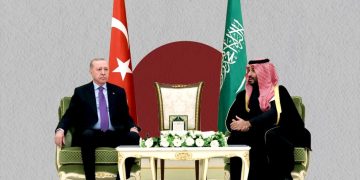
This model raises critical questions: can political Islam evolve from a fragmented revolutionary project into a unified civil state? Can Syria offer an alternative to the Islamic governance models observed in Saudi Arabia and Turkey, where the former gradually separates religious authority from political power, while the latter uses moderate Islam to consolidate regional influence?
A New Syrian Islamic Model
Syrian journalist Hazem Al-Atrash, based in France, tells +963: “Ahmad al-Sharaa presents a political Islamic model that seeks to transcend the sectarian divisions perpetuated by the former regime over 14 years.”
He emphasizes that national partnership must include all Syrians to ensure stability. The current transitional government treats citizens as a unified body under the law, distancing itself from the favouritism and corruption that characterised Assad’s rule.
Atrash notes that al-Sharaa’s project aims to balance a shared Islamic identity with the rights of diverse communities. This approach could serve as a bridge toward internal stability and regional reconciliation. Yet significant challenges remain: rebuilding state institutions, integrating armed factions into a national army, initiating reconciliation with minorities, and coordinating reconstruction efforts with regional and international partners.
He adds that al-Sharaa and his foreign minister, Asaad Al-Shaibani, enjoy broad international support. “State-building cannot rely on a single individual,” he says. “It requires collective participation that includes all sects.”
Read also: Syria’s Secularism Debate: Fears and Hopes
Between Political Islam and Moderate Secularism
Dr Marwan Shahadeh, an expert on Islamic movements, notes that al-Sharaa’s model differs from previous experiences. “He has learned from the mistakes of jihadist and political Islamic movements transitioning from revolutionary work to state governance,” he explains.
Shahadeh highlights al-Sharaa’s leadership of multiple factions, including Hay’at Tahrir al-Sham and Jaysh al-Fatah, which has given him practical experience in both civil and military administration, facilitating a smoother transition to statehood.
He stresses that Syria’s emerging state is neither a purely religious state nor fully secular. Instead, it represents a moderate religious identity with ample space for contemporary civil governance. Shahadeh suggests that this model could inspire other Islamic movements if successful, though it will face opposition from more hardline currents.
He also warns that Western federalist proposals could threaten Syria’s unity. The Saudi example is instructive: under Crown Prince Mohammed bin Salman, the kingdom moved toward a partial separation of political and religious authority, creating a more contemporary and open model.
The Saudi-Turkish Influence
Political analyst Kamiran Dillo observes that Islamic governance differs between Turkey and Saudi Arabia. Turkey remains constitutionally secular, but the Justice and Development Party uses moderate Islamic rhetoric to bolster President Erdogan’s influence, particularly regarding Syria.
In contrast, Saudi Arabia has undergone a major shift under Mohammed bin Salman, sidelining Wahhabi influence in favour of a “moderate” Islamic model similar to the UAE, balancing openness with religious identity.
Dillo notes that this divergence has evolved into a direct competition over Islamic leadership in Syria. Saudi Arabia supports the transitional government in Damascus to counter Iranian influence, though its stance may shift if Syria’s political balance remains under Turkish sway.
He warns that adopting an Islamic model aligned with the Muslim Brotherhood or jihadist groups risks failure, as seen in Egypt and Tunisia. Success, he argues, depends on a civil, democratic, and liberal framework underpinned by national dialogue and institution-building. Continued Turkish influence, he adds, will perpetuate division.
Read also: Syria’s Promoted Moderate Islam: Can It Ease Tensions?
Syria’s Path Forward
Analysts agree that al-Sharaa seeks to craft an Islamic national model that transcends divisions, balancing religious identity with civil governance. Saudi and Turkish experiences serve as contrasting benchmarks: one fostering moderate Islam that gradually separates religion from state authority, the other leveraging political Islam for regional influence.
Ultimately, Syria’s future hinges on its ability to escape external guardianship, build a social contract prioritizing the interests of its citizens, and secure internal legitimacy for the transitional phase, protecting it from division and failure.