


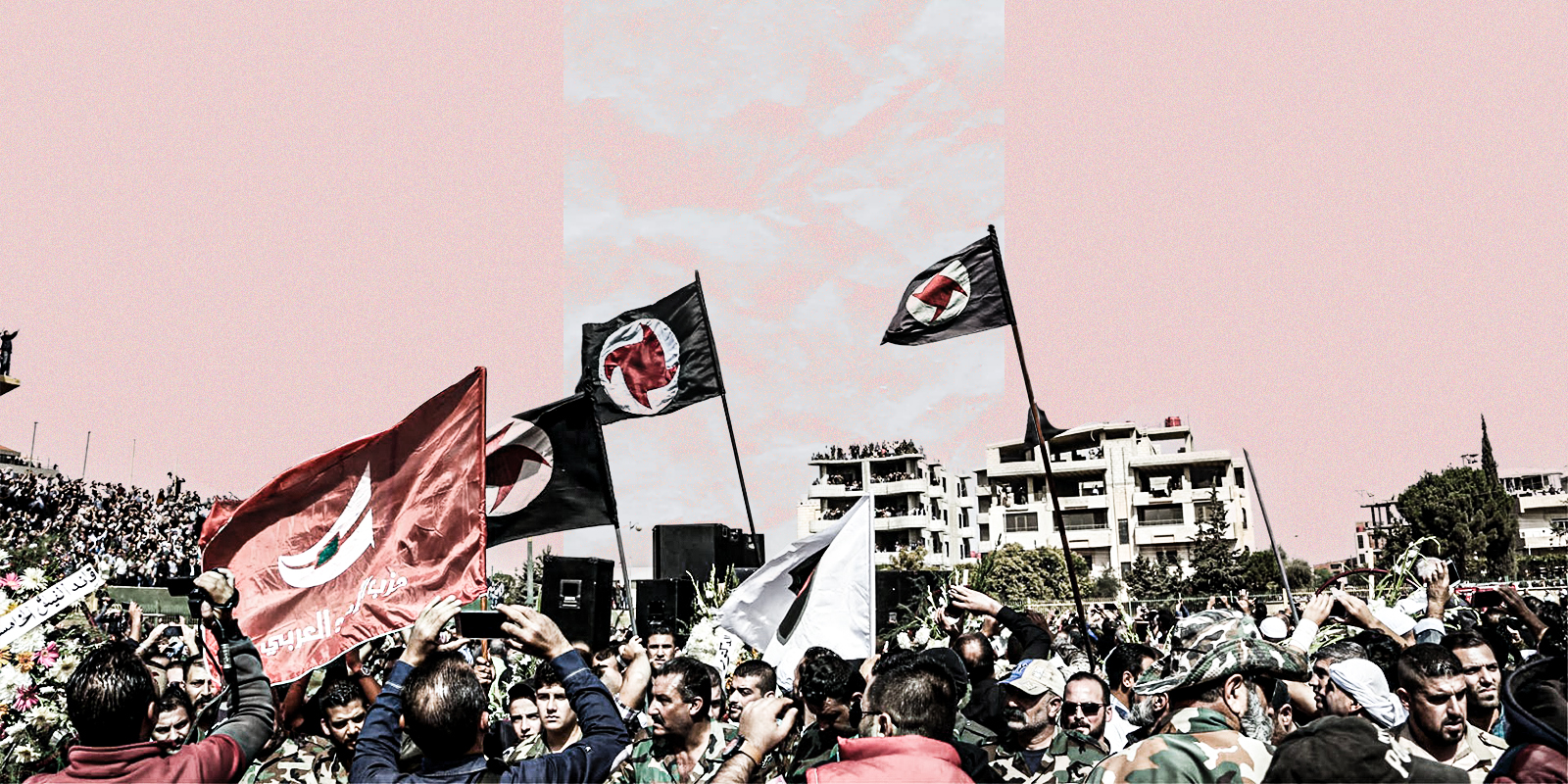
The redrawing of Middle Eastern states in the 1930s, and later the end of Western mandates, coincided with the emergence of political parties in countries such as Syria and Lebanon. These groups drew on diverse ideological foundations; nationalist, religious, and otherwise, benefiting from increased contact with the West and the rise of new social currents among the bourgeoisie and middle classes. Many of these movements sought to offer Syrians new forms of political participation while also inheriting the contradictions of the mandate era.
A Natural Response to Circumstances
Historians argue that nationalist and religious parties in Syria arose as a natural response to the political and social conditions of independence and the post-mandate period. They presented Syrians with varied political options yet carried within them seeds of fragmentation and division that would later become evident.
Read also: Syrian Figures Launch “National Bloc” to Promote Unity and Democracy
The Brotherhood, the Ba’ath, and the SSNP
Among the most influential parties to emerge in Syria in the 1930s and beyond were the Muslim Brotherhood, the Arab Ba’ath Party, the Arab Socialist Party, and the Syrian Social Nationalist Party (SSNP). These parties adopted either political Islam or Arab nationalist ideologies, often framing their programs around “Arab unity” and the Palestinian cause.
The Muslim Brotherhood began in Syria in 1939 as a branch of Hassan al-Banna’s Egyptian movement. Led by Mustafa al-Sibai, who had studied in Egypt, the group adopted political Islam and quickly spread in central and northern Syria. By 1946, it had become one of the most prominent political actors, appealing largely to conservative social classes wary of leftist currents. However, its influence remained concentrated in cities and their outskirts, with little reach into rural areas or the military. Its slogan, “The Islamic Solution,” mirrored the Egyptian call “Islam is the solution,” and its platform sought to end foreign dependence, challenge feudal alliances with the urban bourgeoisie, and improve access to education and land reform.
The SSNP, founded in 1932 by Lebanese émigré Antoun Saadeh, advocated “Greater Syria,” encompassing Lebanon, Syria, Palestine, and Jordan, and promoted secularism, central state authority, and a strong military. Its ideas resonated with minorities, students, the petty bourgeoisie, and segments of the army. By the 1940s and early 1950s, it had become one of the strongest parties in terms of organization and intellectual cadre, particularly among Alawites and in rural Homs and Hama.
The Arab Ba’ath Socialist Party, established in 1947 through the merger of Michel Aflaq’s Ba’ath Party and Akram al-Hawrani’s Arab Socialist Party, drew inspiration from earlier nationalist movements such as the League of National Action. Rooted in the middle class, it attracted civil servants, teachers, professionals, and industrialists. The Ba’ath’s growth was further propelled by strong support from Syrian military officers, who found in its ideology a vehicle for influence and eventual control of state power.
Critics argue that both nationalist and religious parties undermined the development of a unified Syrian national identity. The Ba’ath entrenched Arab nationalism at the expense of Syrian identity, while the Brotherhood pursued transnational Islamist goals without a clear national project. This left Syrian politics deeply fragmented.
Read also: Tarek Wahbi to +963: Damascus May Overlook Issues if SDF and Turkey Reach Agreement
Cross-Border Programs
Syrian political analyst Hossam Najjar, based in Poland, explains that “the Syrian Social Nationalist Party sought, through its idea of a single region and Greater Syria, to place everyone in one framework. For the party, division and isolation were seen as existential threats to the fragmented entities of the region, so its vision was integrative and regional in scope. By contrast, the Ba’ath Party’s foundations were entirely different: its principles relied on mobilizing ordinary people rather than elites, drawing workers and peasants against landlords and capitalists. This gave the Ba’ath strong popular momentum at a time when feudalism and capital dominated the country’s resources.”
Najjar added in comments to +963 that “these parties differed in their goals, ambitions, origins, and target groups. The French and British mandates may have indirectly influenced their ideologies, but while some parties may have been encouraged by colonial powers, this did not necessarily mean they were controlled or subordinate to them.”
Paths of Formation
Mohammad Al-Faqir, Deputy Head of the “New Syria” movement in Damascus, stressed in comments to +963 that “the emergence of nationalist and religious parties in Syria cannot be separated from the country’s broader political context during and after the mandate, and even during the late Ottoman period. By the late 19th century, the Ottoman Empire itself was shifting from a sultanate into a modern state. Within the dominance of notables and elites, these parties were not truly national movements. Their orientations were either local and factional, or transnational, without comprehensive programs for Syria as a whole.”
Al-Faqir argued that “these parties emerged as a reaction to the collapse of the Ottoman state, and to the conflicts between liberal and secular forces advocating independence and conservative Islamic forces aligning themselves with the Ottoman legacy. Many also opposed the new borders drawn after the empire’s fall. As a result, their programs and slogans were not rooted in Syria’s immediate political realities but projected across borders—for instance, the SSNP’s call for a ‘Syrian homeland’ extending from Sinai to northern Arabia, Iraq, and Mersin.”
Read also: Trigger Mechanism Live: Iran Between Negotiation or Peril
National vs. Transnational Agendas
These parties have been accused of exploiting Syrians’ nationalist and religious sentiments during the post-mandate era, amid campaigns aimed at reshaping identities and the growing prominence of the Palestinian cause. They adopted transnational slogans to attract mass support and seize power, but this often undermined their ability to develop coherent national programs.
Najjar further noted that “with the end of World War II and the rise of a bipolar world order, these parties had to adapt. Some became satellites of larger global powers, others split into rival wings (like the Ba’ath), some expanded internationally (like the Muslim Brotherhood), while others such as the SSNP gradually faded due to weak foundations and suppression by competing forces.”
Contradicting a Unified Syrian Identity
Scholarly assessments conclude that the objectives of these parties ultimately conflicted with the formation of a unified Syrian national identity within the borders established after independence. While they rejected the geopolitical framework imposed by the great powers, they failed to propose a viable alternative. Their ideologies functioned more as tools of mass mobilization and vehicles for power than as national projects. This contributed, albeit partially, to the political fragmentation that Syria experienced across later decades.











