


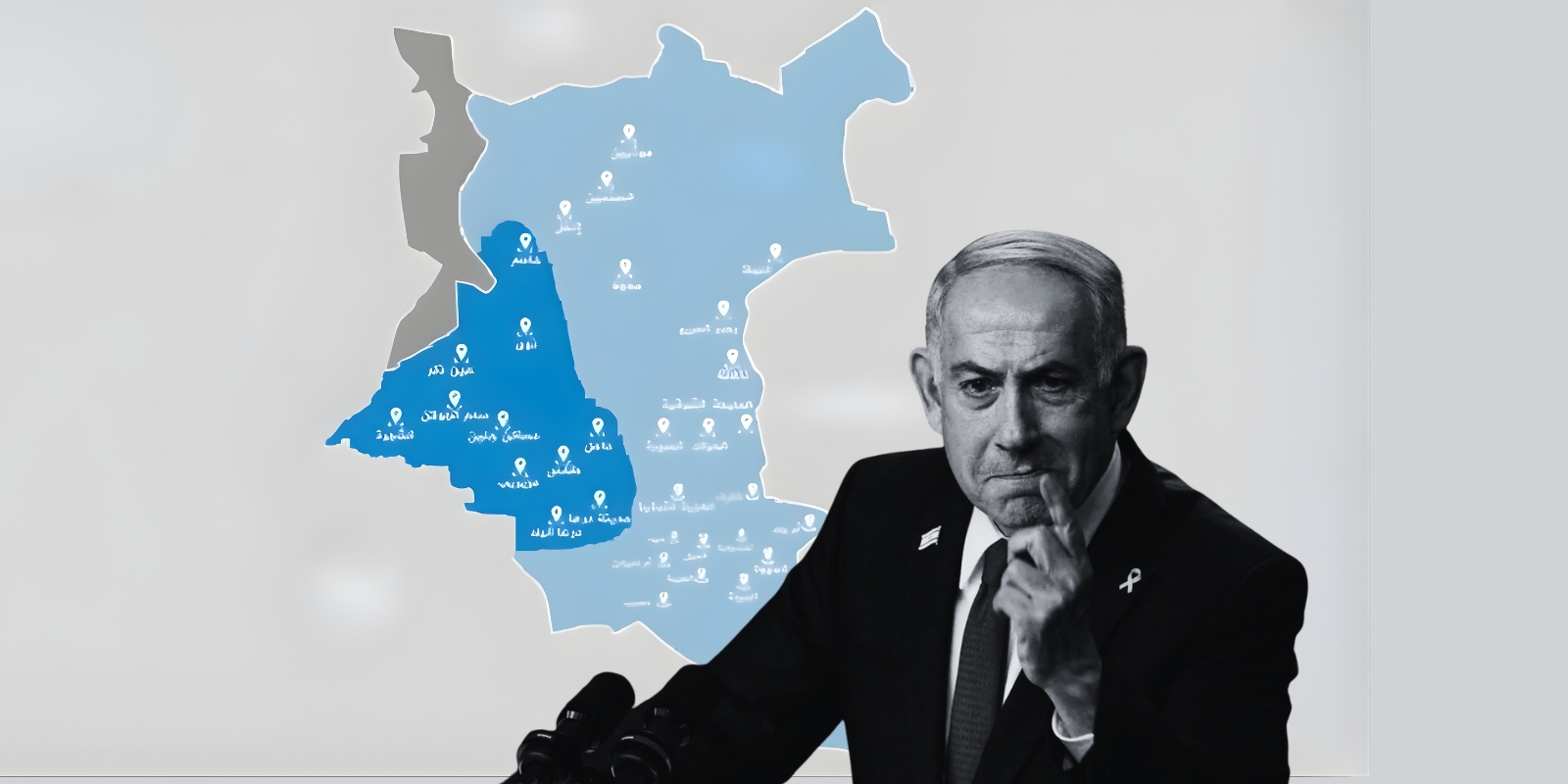
Tensions are escalating in southern Syria following Israeli Prime Minister Benjamin Netanyahu’s announcement that his forces will remain in the areas they recently occupied inside Syrian territory. The development comes amid complex regional dynamics, where security concerns intersect with diplomatic manoeuvres and ongoing American efforts to redraw the map of influence in a country battered by war and political change since the fall of Bashar al-Assad’s regime last December and the inauguration of interim president Ahmad al-Sharaa.
Analysts believe these moves go beyond deterrence and point to the consolidation of a new geopolitical reality that could reshape the balance of power across the entire region.
Israeli Incursions and Ground Consolidation
Local sources told +963 that Israeli military vehicles have begun bulldozing forested land in the Quneitra countryside of south-western Syria. Bulldozers uprooted trees in the village of Jabata al-Khashab and levelled about ten hectares of land.
Israeli patrols also advanced along the road between al-Samdaniyah al-Sharqiyah and Khan Arnabah, setting up a temporary checkpoint to search cars and civilians.
Political analyst and Arab affairs expert Talaat Taha told +963 that “these field movements are not mere security incursions but part of a broader plan to establish a permanent presence deep inside Syria.” He explained that “Israel has been expanding since al-Sharaa assumed office on 12 December, taking control of Mount Hermon and advancing to within 50 kilometres of Damascus, crossing the engagement lines and targeting key sites, including the presidential palace, as well as seizing Syria’s main water source.”
Taha added that this advance reveals “a clear intention to impose full control over the Golan Heights and to avoid withdrawal in the near future,” noting that “Tel Aviv aims to secure its position against any remaining Iranian or Russian influence in Syria, possibly paving the way for new regional alliances under evolving security arrangements.”
Read also: After Hamas: Israel’s Eyes Turn to Syria
Netanyahu: Protecting the Druze and Disarmament
In his latest statements, Netanyahu stressed that Israeli forces “will remain in the areas controlled in southern Syria and around Mount Hermon,” saying the goal was “to reach an agreement with the Syrian government to demilitarise south-western Syria and protect the Druze.”
He affirmed that his government “will not allow any attacks against the Druze,” claiming that “the Israeli presence aims to prevent security threats.”
Commenting on these remarks, Taha said they “conceal a plan to redraw Syria’s southern borders,” arguing that “Israel is using the pretext of protecting the Druze as a political and emotional cover to justify its military presence and expand its influence.”
He warned that “what is happening is an attempt to impose a new, one-sided security equation outside any previous truce or understanding.”
Damascus Rejects the Imposed Reality
In response, Syrian interim president Ahmad al-Sharaa criticised Israeli policy in his address to the UN General Assembly, saying it “contradicts the international community’s support for Syria and its people.” He warned that continued incursions “risk dragging the region into unpredictable conflicts.”
Syrian interim foreign minister Asaad al-Shaibani stated that Damascus was open to a “security agreement that addresses its concerns without compromising a single inch of its land,” referring to an indirect dialogue recently initiated with regional actors under American mediation.
Political analyst Hossam Taleb told +963 that “Syria insists on a full Israeli withdrawal while maintaining its legitimate rights, in line with the 1974 ceasefire agreement,” noting that “Israel is stalling to obstruct any settlement that would lead to withdrawal.”
Taleb explained that “the proposed security agreement between Syria and Israel essentially reflects an American and international desire for regional stability, which Syria does not oppose; provided it includes an Israeli pullback to positions held before 8 December 2024 and guarantees of its sovereign rights.”
American Moves
In a notable development, US envoy to Syria Thomas Barrack said Washington views Syria as “a real test for the new regional order,” adding that “the winds of reconciliation that began in Gaza must now blow northward towards Syria.”
Barrack confirmed that the US Senate voted to repeal the Caesar Act, saying that “the sanctions have strangled a nation seeking reconstruction.” He noted that Syria’s new government “has engaged in reconciliation and regional outreach with Saudi Arabia, Turkey, the UAE, Egypt, and Europe, and even entered border discussions with Israel.”
According to Taha, “the American initiative complements the Israeli escalation, forming a dual effort to reshape Syria’s power map,” arguing that “Washington provides Tel Aviv with political cover for its actions on the ground in exchange for Syria’s gradual inclusion in new security arrangements.”
Taleb added that “lifting sanctions and reopening dialogue channels could lay the groundwork for new understandings within a clear Arab–American–Syrian framework,” stressing that “Damascus is not a passive actor but an active partner in any settlement, backed by its alliances and strategic location.”
Read also: After Gaza Ceasefire: What’s Next for Syria–Israel Security Deal?
Suwayda: A Political Card in the Power Struggle
The Israeli escalation coincides with renewed unrest in the southern province of Suwayda, where Damascus accuses Tel Aviv of exploiting the internal situation to advance its political goals.
Taleb explained that “Israel is politically instrumentalising the events in Suwayda as part of a plan designed in Israel and implemented through local actors to undermine Syrian sovereignty.” He added that “some local figures, perhaps unwittingly, contributed to this manipulation by displaying Israeli flags and thanking officials in Tel Aviv; actions that have given Israel a pretext for its incursions and security violations inside Syria.”
He noted that “if the proposed security agreement were implemented within an Arab or Jordanian–American–Syrian framework, it could help rebuild trust between the Syrian state and the people of Suwayda and strengthen national unity.”
A New Security Equation in the Making
Military and political dynamics are intertwining in southern Syria, forming a complex picture of influence and negotiation. While Israel justifies its military presence with claims of “protecting the Druze” and “disarmament,” Damascus insists on full sovereignty, and Washington seeks to engineer a settlement to end open hostilities.
Taha warned that “the coming stage will see a tougher Israeli stance within Syrian territory, more aggressive than what occurred previously in southern Lebanon.” Meanwhile, Taleb argued that “Netanyahu is taking a dangerous gamble in southern Syria, as the chaos Israel is creating will only fuel further extremism and instability,” affirming that “Syria’s stability remains the cornerstone of the region’s security as a whole.”











