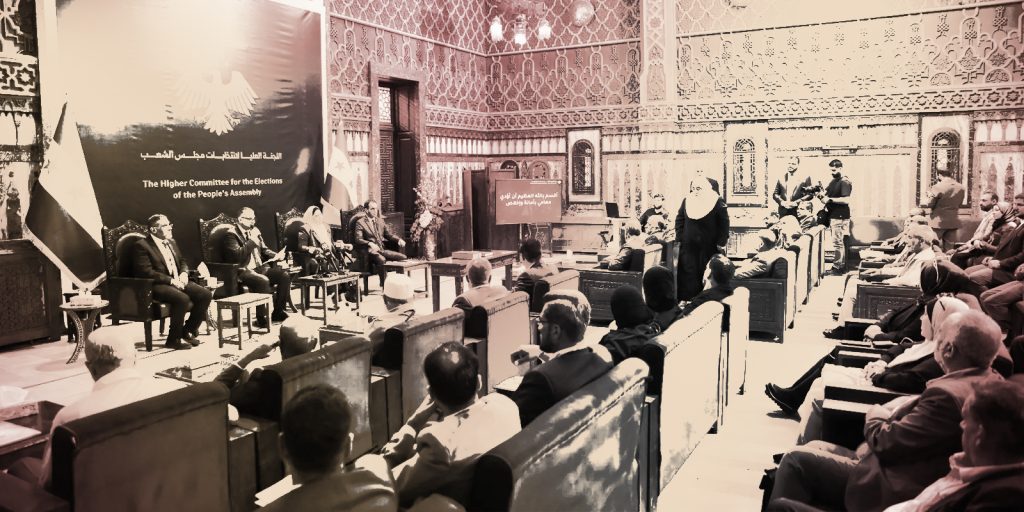
In Syria, the complex political landscape raises a central question: how legitimate is the interim authority and its newly established institutions amid an environment marked by political and social instability? At the heart of this question stands the new Syrian parliament, the first legislative body formed under the interim president Ahmad Al-Sharaa. Yet, any discussion of its legitimacy cannot be separated from how it was formed, nor from the role of religious discourse used to sustain power. This makes the current parliament a reflection of the contradictions between religion, politics, and society.
A Parliament Formed in the Shadows
The parliamentary elections were held indirectly, allowing the interim president to appoint one-third of members while controlling the selection of the remaining two-thirds through local councils with limited powers. Officially justified as a means to maintain “transitional stability,” the process has drawn sharp criticism over its lack of real representation.
Political analyst Hassan Alyan told +963 that the elections were “symbolic, not popular,” reflecting the regime’s attempt to create a “new symbolic state.” Some candidates reportedly received only a handful of votes. Alyan argues that appointing one-third of parliament violates democratic principles and recreates the old system of one-man rule, only “in a more dangerous form.”
Egyptian scholar Mostafa Amin Amer, an expert on extremist movements, told +963 that the current legislative format offers only “a legal façade” before the international community. “It does not grant real legitimacy or democratic authority,” he said, stressing that without genuine civil participation, Syria’s parliament remains far from a true elected body.
Similarly, Syrian legal scholar Aws Darwish described the parliament as “a purely appointed council” established through an unconstitutional decree. “The so-called constitutional declaration issued by Al-Sharaa’s system lacks any legitimate legal foundation,” he added.
Read also: Arab Role in Rebuilding Syria: Challenges of Stability and National Reconciliation
A Sensitive Transitional Phase
Dr Salah Qirata, professor of political science and international relations, offers a more balanced view, acknowledging that “the debate over the nature of the parliament is understandable, but it must be read within the context of the fragile transitional period Syria is going through.”
He tells +963 that the existence of a parliament is necessary to rebuild state institutions and give political life a legal framework. However, he emphasises that true legitimacy is measured by how well the parliament represents the people’s will and its ability to perform oversight and legislation freely and independently.
Qirata adds, “The parliament may be more of a symbol of continuity than a genuine expression of popular will if the electoral process remains limited or restricted by exceptional circumstances. Yet, it can still mark the start of a longer political path if there is a real intention to expand its powers and free it from executive control.”
He points out the use of religion to reinforce legitimacy, explaining two parallel dimensions: “First, when religious discourse is used to consolidate power, religion becomes an instrument of mobilisation and control, turning parliament into a platform for loyalty to the regime. Second, religion is part of Syria’s social fabric and can serve as a legitimate reference if reflected in genuine representation and traditions, rather than being used as a tool for authority.”
He concludes, “Real legitimacy is not gained through religious symbols or formal institutions alone but through representation, accountability, and justice. The practical measure of legitimacy lies in balancing internal performance with external recognition –a government that achieves both enjoys relative legitimacy, while one that fails in either remains weak, however strong its institutions may appear.”
Political communication scholar Dr Alaa Rajab adds a different view, suggesting that “what distinguishes today’s Syrian parliament is its dependence on popular will, as it emerged from social movements that challenged political realism and reclaimed local decision-making after years of foreign domination.”
Rajab argues that the current parliament marks a shift from the “fake parliaments” of the previous regime, which were “products of political power, not community will.” He adds, “There will be no internal conflict because all actors belong to the same political line. The parliament’s main role now is to help the authorities think, legislate, and manage the Syrian reality politically and legally.”
Regarding religion, Rajab believes “the current authority seeks to activate religion rather than exploit it. Exploitation poses a cultural danger, while activation represents reconciliation between the Syrian social fabric and political life. Parliament must work to prevent manipulation and instead promote a cultural and civil reconciliation.”
He concludes, “The realistic measure of legitimacy today is revolutionary legitimacy –but it cannot override the social and political principles for which the revolution began. The parliament’s role should be to assist the leadership in empowering this emancipatory authority through law and politics.”
Religion as a Pillar of Legitimacy
The interim constitution identifies Islamic Sharia as the main source of legislation, a move with both political and religious implications. The strict Islamic discourse adopted by the new authorities aims to attract the Sunni base, particularly in regions that form its strongest social support.
Amer explains that the system “seeks to legitimise its political actions through a religious framework imposed on state institutions.” He adds that this form of religious legitimacy is “mostly superficial, since many members were chosen for their strict religious interpretations rather than genuine representation of civil or social forces.”
Darwish argues that the current system represents “a model of authoritarian rule cloaked in religion,” where “the constitutional declaration serves as a political curtain that grants false legitimacy to an extremist organisation presenting itself as a state alternative.”
Al-Alyan warns that continued sectarian and inflammatory rhetoric “prevents the establishment of a democratic civil state that respects Syria’s diverse components.” He cites increasing verbal and sectarian attacks in sensitive areas, such as around Sayyida Zainab’s shrine, which deepen social division and weaken state cohesion.
Read also: Moscow and Damascus: A New Partnership Beyond the Assad Era
Fuelling Religious Sentiment as a Tool of Power
The interim authority uses religion as a political instrument to secure short-term internal stability, while simultaneously deepening long-term social divisions. Religious mobilisation is used to generate “emotional solidarity” against political and sectarian opponents, giving the system a forced legitimacy based on defending “Islamic identity” rather than democratic consent or national consensus.
Al-Alyan warns that this approach “creates a state of mobilisation against minorities and civil society, potentially driving the country into a devastating civil war that threatens Syria’s unity.”
Amer adds that this process “transforms legitimacy into a tool of religious and political monopoly, placing sectarian belonging above national identity and weakening the development of real democratic institutions.”
Darwish agrees, stating that “religious dominance is supported by an extremist organisational structure that reproduces exclusionary ideologies, leaving neither the parliament nor the regime capable of functioning as instruments of a civil state. Instead, they institutionalise authoritarian and extremist mindsets.”
Hay’at Tahrir al-Sham and International Legitimacy
The legitimacy crisis extends beyond Syria’s borders. The presence of members linked to Hay’at Tahrir al-Sham poses a challenge to international recognition of the interim parliament.
According to Al-Alyan, “HTS remains designated as a terrorist organisation by the international community, and any attempt to exempt Al-Sharaa from that classification is driven by political motives linked to Israel’s security, not genuine support for democratic change.”
Darwish states that “the current system, including parliament, represents an extension of ISIS and al-Qaeda, merely attempting to disguise authoritarianism under a formal structure.”
Amer adds that incorporating religious restrictions into laws without civil participation produces “a superficial legitimacy lacking democratic essence, keeping Syria trapped in domestic and international fragility.”
The Erosion of Citizenship
The rise of religious-based legitimacy has generated deep sectarian tension. Christian, Alawite, and Kurdish minorities feel excluded, while civil forces view the dominant Islamic model as an obstacle to democratic transformation.
Amer notes that marginalising core communities such as the Kurds in the north, the Druze in Suwayda, and the Alawites undermines citizenship and pluralism, increasing polarisation and weakening prospects for a modern civil state.
Al-Alyan agrees that the lack of genuine representation for minorities increases the risk of civil strife, while Darwish stresses that “religious dominance over parliament and governance perpetuates exclusion and blocks real political participation.”
Legitimacy Versus Democracy
The absence of direct elections remains the main flaw in Syria’s legislative legitimacy. Whether through presidential appointments or limited local councils, this system weakens the link between parliament and citizens, eroding accountability.
Al-Alyan argues that this is merely “a staged image of political transition for international consumption,” while Amer asserts that “the parliament legitimises executive actions but does not reflect the people’s will.” Darwish concurs, noting that the parliament “lacks even basic oversight mechanisms such as ministerial questioning or votes of no confidence, since all executive and judicial powers are concentrated in the president’s hands.”
Between Fragile Legitimacy and Potential Reform
Experts Al-Alyan, Amer, and Darwish agree that a system based on extremist religious authority and executive dominance will deepen division and could lead to broader civil conflict. The current parliament, they argue, sustains religious and political hegemony in form but not substance.
In contrast, Qirata and Rajab offer a more optimistic interpretation, suggesting the parliament could become a foundation for gradual reform if it gains independence, enhances oversight, and broadens popular participation.
For Qirata, “true legitimacy is earned through representation, accountability, and justice. Religion can remain a legitimate social reference, but only when it reflects community identity rather than serving as a tool of authority.”
Rajab concludes that, by building on popular will and community participation, parliament could help manage Syria’s reality politically, legally, and culturally, activating religion as a tool for reconciliation rather than sectarian mobilisation.
Thus, the new Syrian parliament stands as a model of complex and fragile legitimacy: a mechanism for sustaining power, as seen by Al-Alyan, Amer, and Darwish; and a possible beginning for transformation, as argued by Qirata and Rajab – if representation, oversight, and the balance between religion and politics are properly institutionalised.
In essence, legitimacy in Syria today is not absolute. It depends on balancing internal performance with external recognition, popular representation with political control, and faith with statehood. Without that balance, parliament remains a façade of politics, religion a cloak of authority – and the people still excluded from shaping their destiny.