


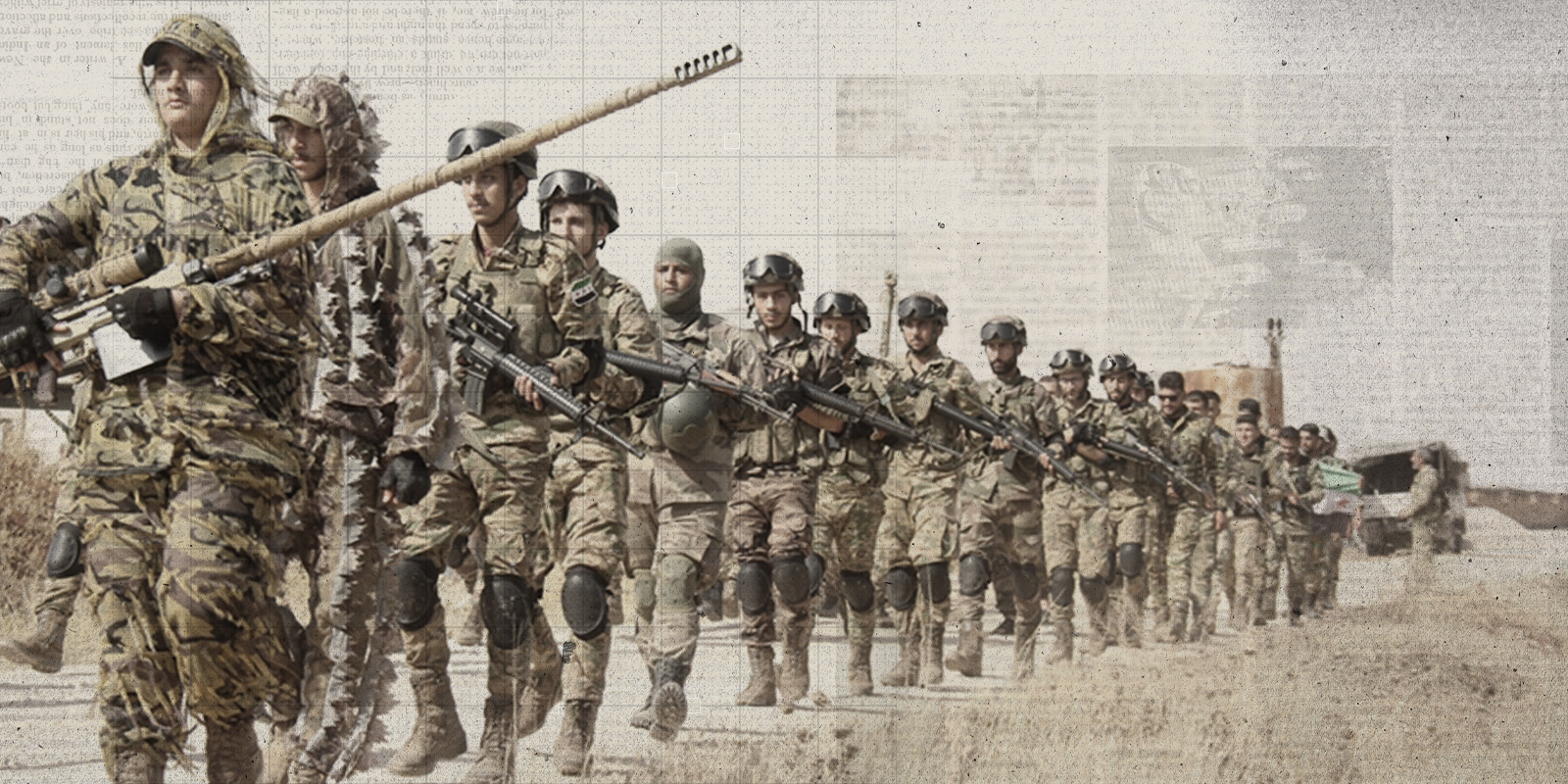
At the outset of Syria’s transitional phase in early 2025 under President Ahmad al-Sharaa, a critical question emerges: Can Syria build a national army that transcends sectarian divides and overcomes the fractures that fueled its protracted civil war?
A cross-sectarian army would mean establishing a truly national military institution built on the principles of citizenship and loyalty to the homeland alone. It would include Syrians from all communities, Sunnis, Alawites, Christians, Druze, Kurds, and others, without discrimination or quota-based allocations. Its declared purpose is to safeguard national unity and stability, free of sectarian or political allegiances.
In the current political context, al-Sharaa, following the overthrow of Bashar al-Assad’s regime, announced the dissolution of former armed factions and security agencies, calling instead for the creation of a new army based on voluntary enlistment rather than compulsory conscription. His transitional government also included figures from across Syria’s sectarian spectrum, a step described as the beginning of “moving beyond sectarian quota systems” and building a “new Syria.”
Read also: Syria After Change: A Race for Influence Amid a Power Vacuum
Obstacles to Building the Army
However, political analyst Dr. Michel al-Sham‘ai told +963 that al-Sharaa “will not be able to forge the necessary political and social alliances to support a national cross-sectarian army unless he completely abandons his previous ideological baggage,” describing the endeavor as “nearly impossible amid the multiplicity of Islamist factions.”
The process of building the new army relies on integrating former armed factions, negotiating with groups such as the Syrian Democratic Forces SFD, and opening volunteer enlistment to youth across all regions. Centers have also been set up to settle the status of former soldiers and retrain military cadres.
In this regard, academic and researcher Dr. Orabi Orabi explained to +963 that “the unified Syrian army is fundamentally based on voluntary service,” noting that old factions are being gradually integrated through the Ministry of Defense, while newly recruited units are directly assigned to specialized branches.
Orabi emphasized that “the standards do not discriminate against anyone, and minority recruits are fully welcome since the army is a unifying national institution.”
Nevertheless, challenges remain daunting: persistent sectarian and tribal loyalties within society, ideological rifts among factions, weakened logistical and military capacities after years of war, and constant regional and international pressures.
Syrian military expert Brig. Gen. Fayez al-Asmar stressed that “the project of building a professional, institutional Syrian army faces major obstacles, chief among them the challenge of fully integrating factions under the general command and severing their external affiliations.”
Speaking to +963, al-Asmar noted that reconstruction requires “rebuilding the military infrastructure across all branches, and, air, naval, cyber, and air defense, while also ensuring the inclusion of all sectarian and ethnic groups within the army’s structure, reflecting the principle that national defense is a collective responsibility.”
From a regional perspective, al-Sham‘ai argued that “no political system in Syria can succeed unless it aligns with the country’s ethno-geographic fabric,” suggesting that the solution lies in “a federal system at minimum, or a confederal arrangement at maximum, allowing for the formation of a strong federal army that mirrors internal balances.”
He added that such a model “could transform sectarianism from a cause of conflict into a driver of constructive competition among regions within a new federal republic.”
President al-Sharaa has repeatedly underscored that the new army will be a voluntary institution founded on national equality, describing its transcendence of sectarianism as a decisive step in rebuilding the state.
Also read: Syrian Gov and Kurdish SDF: Experts Warn March 10 Agreement Faces Major Challenges
Conditions for Success
Observers argue that the success of this project requires two parallel tracks: “a clear political will from the leadership, and social and institutional reforms that restore trust among Syrians and address the legacy of civil strife.”
But al-Sham‘ai warns that “the persistence of sectarian quota systems will leave any government incapable of implementing genuine reforms. Worse, it will marginalize segments of society and foster resentments ripe for future explosions.”
He stresses the need for “a coherent political framework, potentially an ethno-geographic federalism, to correct the army’s foundational path and broaden national participation within it.”
Meanwhile, Brig. Gen. al-Asmar highlighted the necessity of “reopening military academies and graduating new cohorts of officers and non-commissioned officers,” adding that “restoring academic officers and defected officers to core leadership positions is key to building the army’s true nucleus.”
For his part, Orabi pointed out that “the process of integrating factions usually takes a decade or more in post-conflict states, but in Syria it could be compressed into just one or two years, depending on the circumstances.”
Based on expert assessments, forming a cross-sectarian army in Syria is undeniably difficult. Yet it remains a pivotal wager in the transitional phase. Its success will ultimately depend on the new government’s capacity to turn rhetoric into tangible action, transforming the military into a unifying national institution for all Syrians, despite the internal and external pressures that make the path forward exceedingly complex.











