


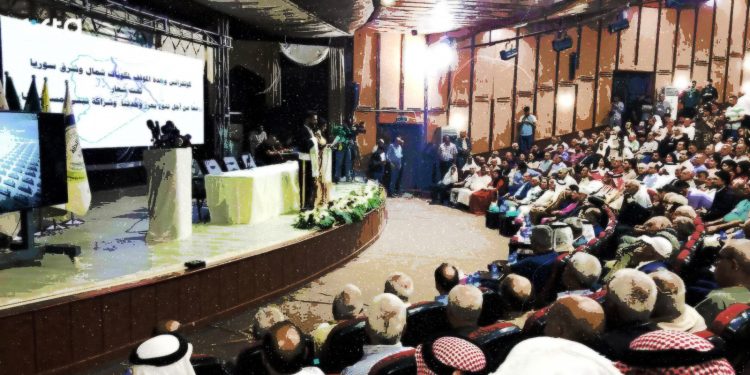
The recent “Unity of Position for the Components of North and East Syria” conference in Hasakah has revived long-standing questions about the strained relationship between Syria’s local communities and the central government. At the heart of the debate lies a fundamental question: can Syrians find common ground on the shape of their state and the path of the political process?
While the gathering called for a democratic constitution that ensures pluralism and broad participation, Damascus insisted that such issues cannot be settled through piecemeal understandings but only within the framework of a national project that preserves the unity of the state. The contrast in tone raises the question: did the Hasakah conference open a door to wider dialogue, or did it simply underscore the growing gulf between the two sides?
A Call for a Democratic Constitution
The one-day conference, held at Hasakah’s Cultural Centre, brought together more than 400 participants including political figures, representatives of the Autonomous Administration, local community leaders, and religious clerics. It carried the slogan: “Together for diversity that strengthens our unity, and partnership that builds our future.”
In its final declaration, the conference called for drafting a new democratic constitution and launching a transitional justice process. Organizers argued that the current constitutional framework does not reflect the aspirations of Syrians, and that any transition requires fair representation of all communities.
Read also: Northeast Syria’s Unity of position Conference and Its Impact
The statement stressed the need to entrench ethnic, cultural, and religious diversity within Syria’s political and administrative structures, while revisiting administrative divisions to reflect demographic realities and local identities. Participants also called for a comprehensive Syrian national conference that would bring together all political and democratic forces to forge a shared national identity.
Speakers emphasized the importance of unity. Hussein Othman, co-chair of the Executive Council of the Autonomous Administration, urged Syrians to confront sectarianism and division, hailing the cooperation among Kurds, Arabs, Assyrians, Turkmen, and Circassians as the “true guarantee of national achievements.”
Ilham Ahmed, co-chair of the Foreign Relations Department of the Autonomous Administration, warned against the dangers of “monolithic thinking,” insisting that political pluralism must underpin a modern, inclusive Syria. She also called for constitutional safeguards for women’s rights and active participation in governance.
Prominent religious figures also voiced support. Alawite cleric Ghazal Ghazal urged the creation of a secular, decentralized (or even federal) state that protects the rights of all components. Druze spiritual leader Hikmat al-Hijri described the conference as “not a new path but a reaffirmation of the unity of Syria’s communities.”
The next day, the Syrian government sharply rejected the initiative and suspended its participation in planned meetings with the Syrian Democratic Forces (SDF) in Paris. Damascus accused the Hasakah gathering of violating the March 10 agreement between President Ahmad Al-Sharaa and SDF commander Mazloum Abdi, and of attempting to “internationalize” the Syrian file.
A government source told +963 that while citizens have the right to meet peacefully and discuss politics, “this must happen within the framework of a unifying national project that preserves Syria’s unity, sovereignty, and identity.” He insisted that the form of the Syrian state “cannot be determined by factional understandings but only through a permanent constitution approved by popular referendum.”
Damascus further warned that the Hasakah conference undermined ongoing negotiations, declaring that “the Syrian people will reject any partition projects.”
Read also: Are We Fooling Ourselves? The Syrian Illusion After Assad
Analysts: Fear, Distrust, and Missed Opportunities
Political analyst Hazem Dakel argues that the conference reflected a climate of fear and mistrust, especially after recent violence in Suwayda in the south. He described the gathering as part of a trend toward an “alliance of minorities” amid the failure of a truly national project.
According to Dakel, Damascus’s response carried three messages: dismissing the conference’s legitimacy, framing it as unlawful and externally driven, and drawing parallels with past partition attempts, while still leaving the door to dialogue open, but only on government terms. He warned that demonizing the event could backfire, pushing groups toward isolation or outside support, and urged Damascus to seize the opportunity for a genuine reconciliation process.
Writer and political commentator Jiwan Youssef, meanwhile, said the conference delivered a clear message: “an authoritarian, one-color system will not be accepted.” He credited the SDF with rallying diverse communities around opposition to Damascus’s unilateral approach, despite internal divisions.
Youssef criticized the government’s reaction as “reckless and juvenile,” arguing that it exposed the state’s inability to engage in dialogue with dissenting actors.
For political analyst Alaa al-Asfari, however, the solution still lies in a “true national partnership among Syrians”, but not through separation, federalism, or autonomy. He warned that persistent divisions could push Syria toward “bloody borders” and fragmented cantons, inviting regional meddling. The alternative, he said, is a modern civil state that respects diversity and averts national disintegration.
Whether the Hasakah conference proves to be a step toward broader dialogue or another episode in Syria’s fractured political saga remains uncertain. What is clear, however, is that it has once again laid bare the profound disagreements over the country’s future; disagreements that will shape not only the political process but also the very meaning of Syrian unity in the years to come.











