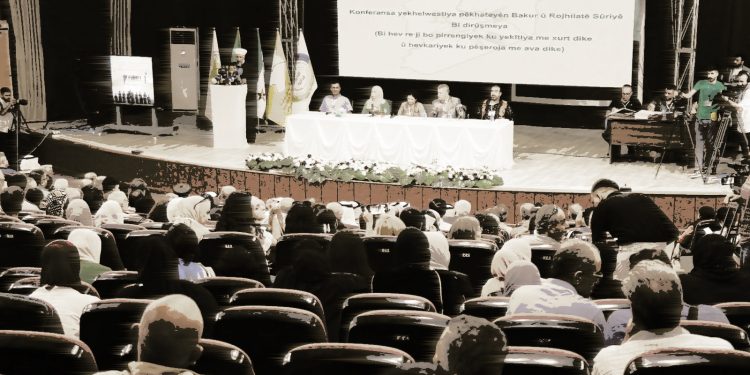
Last week, the city of Hasakah in northeastern Syria hosted the “Unity of Position for the Components of North and East Syria” conference, bringing together more than 400 participants. Among them were Sheikh Hikmat al-Hijri, the spiritual leader of the Druze community; Ghazal Ghazal, head of the Alawite Islamic Council; and Ilham Ahmed, co-chair of the Foreign Relations Department in the Autonomous Administration of North and East Syria.
The conference tackled the future of Syria’s political process, the urgent need for a democratic constitution, and the launch of a transitional justice path. The gathering sparked mixed reactions: some saw it as a necessary step toward a national dialogue to address Syria’s overlapping crises, while others dismissed it as ill-timed given the fragile security situation and the tentative beginnings of recovery in the transition period.
The conference took place under exceptional circumstances. It followed recent military operations and violent unrest in Suwayda province in the south, after Syrian defence and security forces entered the area. Rights groups reported widespread violations against civilians, fuelling calls for an inclusive national dialogue that brings together Syrians of all communities and political leanings, with the aim of halting violence and opening the door to power-sharing through a broader political process.
Final statement: Constitution and justice
In their final statement, participants stressed that the current constitutional declaration does not meet the aspirations of Syrians and must be revised to ensure fair representation for all components during the transition. They emphasized that national reconciliation requires a genuine transitional justice process built on truth-seeking, accountability, reparations, and guarantees of non-repetition.
They also underlined that a sustainable solution lies in drafting a democratic constitution that strengthens cultural, ethnic, and religious diversity, while laying the foundations for a decentralized state that allows all groups to take part in political and administrative life. The statement called for reconsidering existing administrative divisions to reflect Syria’s demographic and cultural realities, and for holding an inclusive national conference where all democratic and national forces can define a shared Syrian identity.
Government rejection
The Syrian government rejected the conference outright. A source told state TV channel al-Ikhbariya that it “constitutes a clear breach of the March 10 agreement between President Ahmad Al-Shaaa and the commander of the Syrian Democratic Forces (SDF) Mazloum Abdi, and an attempt to internationalize the Syrian file.”
The source insisted that the shape of the state can only be decided by a permanent constitution approved through a national referendum; not by “factional deals.” He added that while Syrians have the right to peaceful assembly and dialogue, this must be done within the framework of a national project that safeguards Syria’s unity, sovereignty, and independence. Religious and ethnic groups, he said, are free to organize and express their views, but only under national law, without resorting to arms or imposing their vision on the future of the state.
Analysts divided
Syrian political analyst Darwish Khalifa, based in Turkey, argued that SDF’s call for the conference, along with the participation of Sheikh Hikmat al-Hijri, who has previously coordinated with Israel, and Alawite figure Ghazal Ghazal, provoked Damascus into issuing a strong rejection.
He warned that repeating such conferences, whether inside or outside Syria, could give international actors the impression of a deeply divided Syrian society, discouraging them from investing in or supporting a “new Syria.”
On the other hand, Walid Jouli, head of public relations at the Euphrates Centre for Studies, described the gathering as a “national initiative” aimed at clarifying the positions of Syria’s diverse communities on the country’s future. He said the collapse of Bashar al-Assad’s regime had created a new political landscape, but Damascus’ unilateral approach, through moves like the constitutional declaration and the formation of a government without consensus, undermined national partnership and deepened mistrust.
Read also: https://963media.com/en/15/08/2025/are-we-fooling-ourselves-the-syrian-illusion-after-assad/
Link to March 10 agreement
The Hasakah conference came shortly after the government announced it would withdraw from scheduled talks with the SDF in Paris. Yet, a delegation from the Autonomous Administration, led by Ilham Ahmed, visited Damascus soon after and reportedly held “very positive” discussions with government officials about continuing implementation of the March 10 agreement.
That agreement, signed by President Ahmad Al-Sharaa and SDF commander Mazloum Abdi, outlined eight key steps, including the integration of civil and military institutions in northeastern Syria, such as Qamishli airport, border crossings, and oil and gas fields, into the Syrian state. While progress has been slow, both sides reaffirmed their commitment to the deal.
Khalifa believes the Hasakah meeting is unlikely to derail the March 10 agreement because it was reached under U.S. sponsorship, and Washington remains intent on preventing a resurgence of chaos or extremist groups linked to Iran.
For his part, Jouli said the Hasakah conference was a chance to reaffirm a shared vision of a future Syrian state: decentralized, democratic, pluralistic, and inclusive. He argued that it marked a step toward a comprehensive national dialogue and showed that a return to one-man rule, the system that drove Syria into crisis, is no longer viable.