


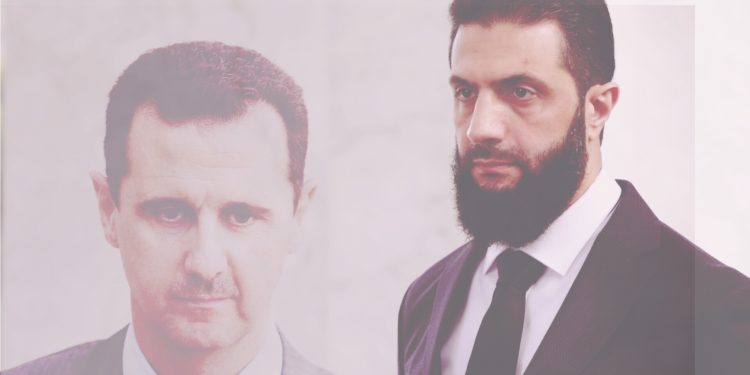
With the fall of Bashar al-Assad’s reign, many Syrians felt a surge of joy. It was the euphoria of believing that decades of repression and fear were finally ending. Or maybe, it was pure vengeance, the satisfaction of watching a man they saw as the embodiment of tyranny brought low.
The belief that a new regime would fix Syria’s broken state. Rather an illusion, a comforting one, but dangerously naïve. Yet for a certain faction, the joy had little to do with freedom or justice. Instead, it was about the transfer of power into their own hands. In their own words, they now saw themselves as “the rightful masters of this geography.”
That language, laden with ownership and entitlement, hinted at a dangerous truth: this was not about building a pluralistic future, but about replacing one form of domination with another. Few wanted to speak aloud what was already clear to those looking closely, that Syrian society was deeply fractured, and no self-anointed group with a presumed “heavenly mandate” could magically heal it.
The idea that a former holy belligerent, someone forged in the fires of religious militancy, could lead the Syrians toward prosperity and justice by uniting them under a single identity was more fantasy than political strategy. In truth, the vision rested not on consensus, but on subjugation, it was not about mending divisions, but enforcing obedience.
From the very start of the Syrian conflict, much of the struggle was less about democracy and more about legitimacy, about who had the right to rule. It was not that tyranny was unacceptable in principle; rather, the wrong person was exercising it. Many would have tolerated the same repressive apparatus had it been controlled by “one of their own.”
The man at the center of Syria’s tragedy, Bashar al-Assad, was in many ways the accidental president. The heir to his father’s authoritarian system, he inherited an elaborate machinery of fear, intelligence agencies, militias, and a propaganda apparatus that penetrated every corner of society. His greatest “achievement” was not reform or stability, but the preservation of that apparatus, even as the country around him collapsed.
Detached from the everyday realities of his people, Assad presided over a slow-motion implosion. What he convinced some, maybe even himself as calculated resistance was, in fact, the steady march toward social and economic ruin. By clinging to power at all costs, he ensured that Syria’s fractures deepened beyond easy repair.
And yet, the post-Assad era has not promised much better. A society already torn along sectarian, ethnic, and ideological lines cannot be rebuilt by replacing one inflexible ruler with another. Especially not when public discourse remains so devoid of intellectual rigor, so unwilling to grapple with the country’s diversity.
The hard truth is that Syria’s problem is not only its rulers, it is the absence of a shared vision that allows its various communities to coexist freely. In the absence of such a vision, power inevitably becomes a zero-sum game. One group’s gain is another’s loss, and the notion of a common Syrian identity becomes hollow rhetoric.
Conflict actors frequently lack viable governance programs, emphasizing regime removal over state-building and catering to foreign patrons over domestic reconciliation. Inflexible ideologies obstruct inclusive futures. Imposed “unity” is untenable; authentic national cohesion requires the reconstruction of deliberately degraded institutions, trust, rule of law, shared frameworks, necessitating a rejection of absolutist control paradigms.
Unity cannot be commanded; it must be built on trust, shared institutions, and the rule of law. In Syria, these foundations have been deliberately eroded for decades. Rebuilding them will require more than the fall of a single man, it will require dismantling the mindset that equates political victory with absolute control.
The danger now is that Syrians will trade one illusion for another. They may tell themselves that the next leader, the next faction, the next foreign-backed government will finally deliver peace and prosperity. But without a commitment to genuine pluralism and the free functioning of all groups within society, such hopes will collapse into the same cycles of repression and revenge.
In this light, the question “Are we fooling ourselves?” is not rhetorical but it is urgent. If Syrians cannot break from the patterns of domination and exclusion that have defined their modern history, then the sacrifices will have been in vain.
The tragedy extends beyond Assad’s rule; it lies in post-dictator visions replicating the very system overthrown. Until this changes, Syria remains trapped in its dream.
Perhaps a different structure could work, one that’s less rigid and better fits today’s complex world. It would need a central authority acting in a highly practical way, free from the burden of old conflicts or the need to appear stronger than it really is. This approach might ease current tensions, but it wouldn’t solve the core problem. The deeper, harder solution lies in slowly letting go of a deeply held belief: the idea that true power comes from dominating others, where ancient urges still promise greatness through controlling those seen as different. Only when this old mindset starts to fade could a new future begin to appear.
*The views expressed in this article do not necessarily represent those of +963 Media Association .











