


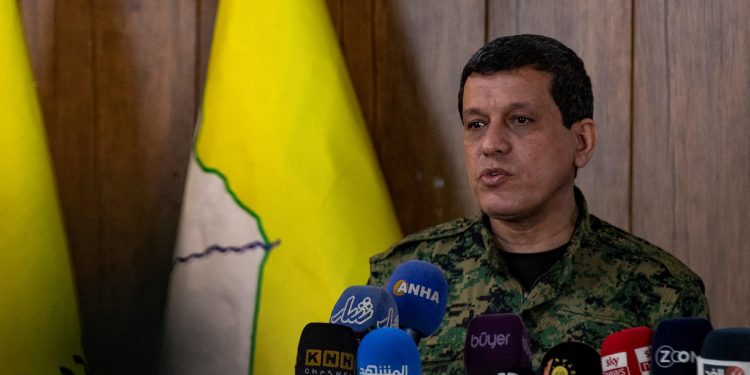
Hasakah, Syria— The top commander of the Kurdish-led Syrian Democratic Forces (SDF), Mazloum Abdi, said negotiations are underway with the Syrian government to establish a form of local governance in the country’s northeast, a region predominantly controlled by the SDF since the early years of the civil war.
In an interview published Saturday by Al-Monitor, Abdi revealed that while some Kurdish political parties remain committed to the idea of a federal Syria, the SDF is engaging with Damascus to reach a broader political arrangement.
“Our red line is centralized authority in Damascus,” Abdi said. “We want to preserve the SDF’s identity within a unified Syrian army. We do not seek two separate armies or a military within a military, that is not our objective.”
The Syrian Democratic Forces, backed by the U.S.-led coalition during the fight against Islamic State, have long governed much of northeastern Syria through the Autonomous Administration of North and East Syria (AANES). However, recent months have seen increasing signs of rapprochement between the Kurdish-led administration and the Syrian government.
Transitional Authority Engaged, Turkey’s Influence Waning
Abdi, in the meeting in Damascus with Ahmed al-Shara, the head of Syria’s transitional authority, discussed the integrating of SDF-run institutions into state structures. Al-Shara reportedly asked the SDF to relinquish control of Arab-majority areas such as Raqqa and Deir ez-Zor, but did not present it as a precondition for talks.
“Shara did not object to the continued presence of Arab fighters within the SDF,” Abdi noted, describing the meeting as “respectful and constructive.” He added that the agreement with the transitional authority had helped ease prior Turkish objections to the SDF and contributed to a noticeable softening in Ankara’s rhetoric.
Turkey has long viewed the SDF as an extension of the Kurdistan Workers’ Party (PKK), which it considers a terrorist organization. Ankara has launched multiple military operations into Syria to prevent what it calls a “terror corridor” along its border.
“There is now a gradual Turkish acceptance of integrating our forces into Syrian institutions,” Abdi said. “That is a significant and welcome development.”
U.S. Role and Local Arrangements
While the United States was not directly involved in the agreement, Abdi said Washington provided logistical support to facilitate travel to Damascus and has expressed backing for the broader goals of the negotiations. “The U.S. supports regional stability, which aligns with this agreement,” Abdi stated.
Abdi emphasized that a recent security arrangement in the Aleppo neighborhoods of Sheikh Maqsoud and Ashrafieh, areas under Kurdish control, is only temporary and would be superseded by any comprehensive agreement with Damascus.
In another deal, the SDF agreed to withdraw from positions near the Tishrin Dam in eastern Syria, allowing government troops to take up positions as a buffer zone between the SDF and Turkish-backed factions, in a bid to reduce front-line tensions.
Clashes in the Coastal Region
Abdi also commented on recent violence in Syria’s coastal areas — traditionally a regime stronghold and home to the Alawite minority. He said that during talks, President Shara blamed “remnants of the former regime” for stirring unrest and attempting to derail the political transition. Al-Shara said that security forces were deployed to restore order, but they came under attack, prompting retaliatory operations that spiraled into broader violence.
Abdi emphasized the need to distinguish between the Alawite community, which is an integral part of Syria’s social fabric, and elements of the old regime seeking to sabotage the new process.
Follow-Up Talks and Humanitarian Concerns
On Saturday, Abdi also met with a joint committee tasked with implementing the terms of the recent agreement between the SDF and the transitional authority. The meeting, held in Hasakah, included senior SDF commander Rojhat Afrin and transitional authority representatives Hussein al-Salama and Mohammad Qanatri.
According to an SDF statement, the talks focused on completing the integration process, reducing tensions, and ensuring that key infrastructure, such as the Tishrin Dam, is shielded from further military activity.
The parties also discussed forming a committee to facilitate the return of internally displaced persons and refugees to areas affected by over a decade of war.











