


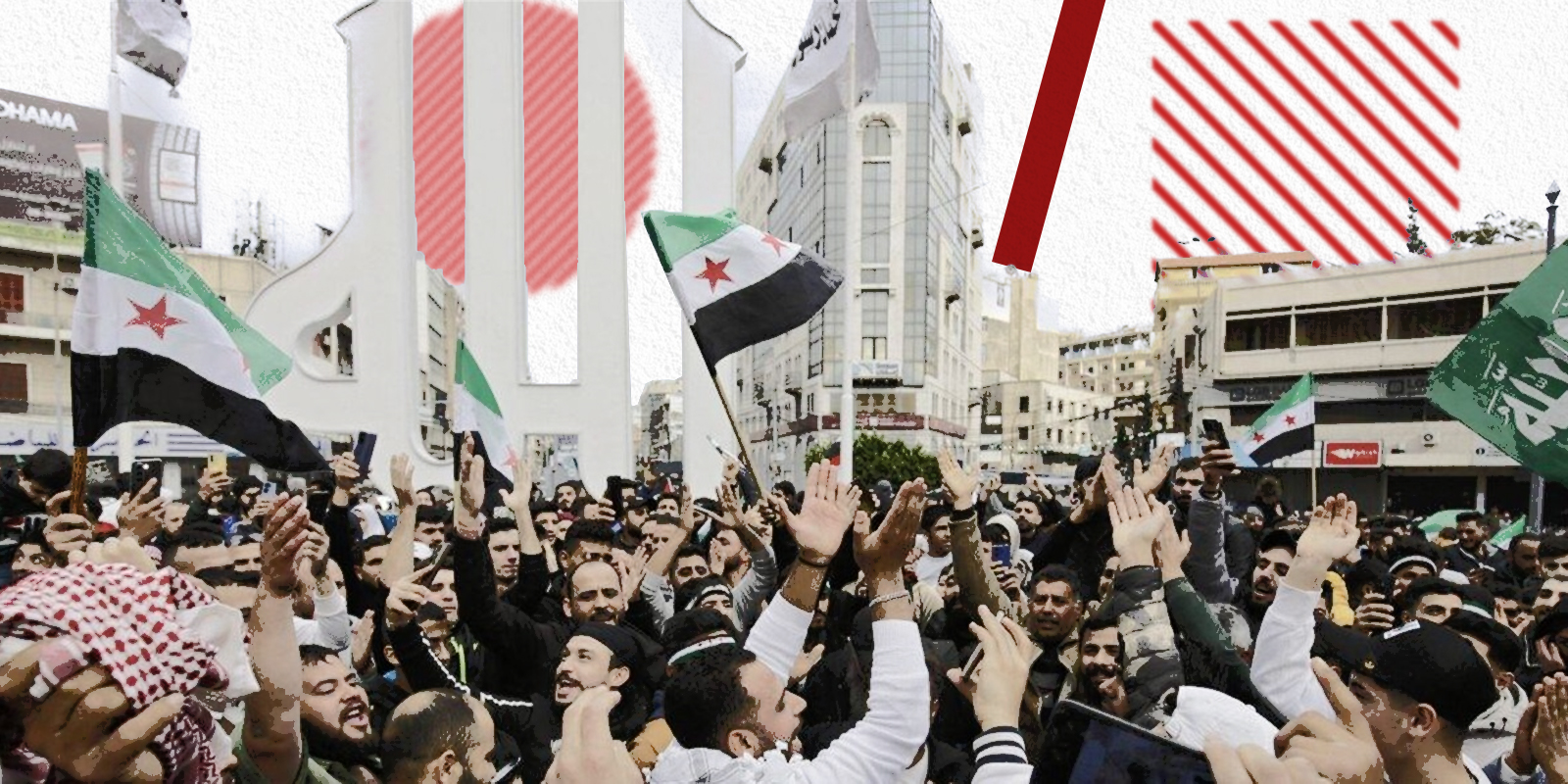
It was not in vain that Syria’s new ruling authority experienced this contradiction between the form and the essence of the politics it produces. For example, it staged a grand celebration to announce the country’s new “visual identity,” devoting time, effort, and entire institutions to it, turning it into a major national issue. At the same time, however, it passed an urgent “constitutional declaration,” which was nothing more than a distilled version of the Ba’athist constitution that had dominated the country for nearly two-thirds of a century, treating it as a trivial, obvious, and meaningless matter.
This event, like many other actions and occasions, reveals much about the identity of the current regime and the ideology sustaining it. It is not a new or different system compared to its predecessors, except in image and appearance. In substance it is identical, particularly in its nucleus, the imagination of power about itself and about the world around it.
With a closer look, one can say that the political current that proudly called itself Banu Umayyah (Umayyad dynasty) was merely reviving the founding myth from which the Ba’ath Party itself had once emerged. Upon that intellectual and spiritual foundation, the Ba’ath built its entire discourse, program, and behavior. Both ideologies, the former Ba’athist and the current Umayyad, consider Damascus, by no coincidence, the founding stronghold of each. Both perceived this geography as holding a superior uniqueness, elevated above any other. For the Ba’athists, it was the source of the eternal message for the Arab nation, whose sovereignty over others could only be realized through the construction of the nation state. For the new rulers, it is the recovery of the glory of the state that created the first empire in the history of this nation, the Umayyad state.
In both tendencies, and in every other political creed that has emerged in this geography, the essential Syrian political ideology reveals itself as a latent nucleus revolving around this concept: that the regional surroundings, and perhaps the world, as merely a peripheral margin to the center formed by the Levant. The proof of this essentialism lies in the consensus among different political forces in submitting to it, despite their differences and even their rivalries. The Syrian Muslim Brotherhood, the Ba’athists, Syrian nationalists, even communists and liberals, all shared this hidden conviction as the inner core of their worldview. It was a proselytizing nationalism, deeply self-assured and convinced of the special historical status of this geography.
Read also: Does a Deep State Exist in Syria? History, Power, and the Transitional Era
In its formative stage, on the eve of the Ottoman Empire’s collapse and in opposition to it, this nationalist tendency was the ideological source of what became known as the “Great Arab Revolt.” Arab associations centered in the cities of the Levant, especially the four historic interior ones, Damascus, Homs, Hama, and Aleppo, were the first theoretical foundation of this political vision of the self and the surrounding world.
These early nationalist associations and organizations were also centered around the same core idea, though they were armed with rhetoric about rationality, modernity, scientific progress, and social secularization, due to their opposition to the Ottoman political actor, rooted in a highly conservative political Islam. Yet their political contradiction with the Ottomans rested on an indignant refusal to dissolve the greater whole into the smaller part, rejecting the reduction of the Arab Muslim nation into the Ottoman present.
Later, beginning in the second quarter of the twentieth century, with the Ottoman trigger gone, a strain of militarized nationalist fascism took hold of that political self. Political organizations formed in the Levantine space were influenced, on one hand, by the global rise of fascist nationalism, which had found much popularity among Syrian political elites of various affiliations. On the other hand, it was a result of their anti-colonial struggle, which fostered an unwavering loyalty to violence and militarism. Syria, which experienced numerous military coups and even some democratic and electoral experiments, saw its coup leaders united in this tendency, while the politicians and parties of its democratic phase were never ideologically different in their allegiance to that same spirit and political creed.
The second wave of nationalism became captive to one of the most brutal dictatorships. Yet it did not produce any truly opposing counter-ideology. The two Assads, father and son, crushed their political opponents on sectarian and political grounds, not on ideological ones. The Syrian political, intellectual, and ideological arena never witnessed real debates or confrontations between different forces. One could hardly find substantive intellectual or philosophical differences between the Syrian Communist Party led by pro-regime Khaled Bakdash and that led by dissident Riyad al-Turk. Nor was there any meaningful distinction between the Arab Socialist Union led by opposition figure Jamal al-Atassi and the one led by pro-regime Safwan al-Qudsi.
At present, this tendency seems to be evolving into its final stage, an Islamic one, rooted in the same mechanisms and visions of the self as a source of radiance and the external world as an alien entity. However, this time it comes with a complete abandonment of the modernist values that had accompanied the first and second nationalist waves. The Islamic nationalism now being prepared for Syria seeks to align itself with its Turkish counterpart.











