


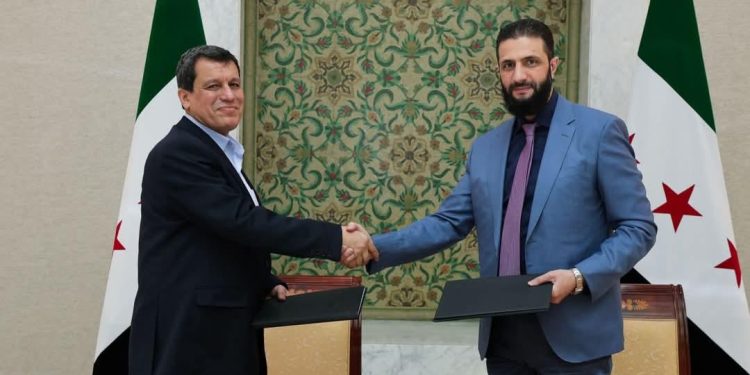
Damascus, Syria – The Syrian presidency issued a statement on Sunday addressing developments related to the agreement signed with the Syrian Democratic Forces (SDF) on March 10.
The presidency described the agreement as a “positive step” toward easing tensions and advancing a comprehensive national solution. However, it criticized recent statements by SDF officials advocating for federalism, calling them “a clear contradiction” to the agreement’s principles.
Related: Kurdish Unity Conference Calls for Democratic, Decentralized Syria
The statement stressed that Syria’s territorial unity is a “red line” and rejected any attempts to impose “separatist realities” or create autonomous regions without broad national consensus. It warned that unilateral moves toward federalism or self-administration threaten the country’s social fabric and undermine prospects for a political settlement.
The Syrian presidency voiced concern over what it described as dangerous demographic changes in areas controlled by the Syrian Democratic Forces (SDF), warning that such actions risk fracturing Syria’s social fabric and undermining prospects for a national solution. It also criticized the disruption of state institutions, the restriction of citizen services, and the monopolization of national resources outside state control.
The presidency accused the SDF leadership of monopolizing decision-making in northeastern Syria, home to Arabs, Kurds, Christians, and others, stressing that true stability requires inclusive governance and fair representation for all communities.
Reaffirming that the rights of the Kurds would be preserved within a unified Syrian state, the presidency rejected foreign intervention or external “guardianship” over the country’s affairs.
Read also: French Foreign Minister Meets SDF Commander, Kurdish Official in Iraqi Kurdistan
It called on the SDF to adhere to the spirit and letter of the March 10 agreement, prioritizing national interests over external agendas. The statement reiterated that any solution to Syria’s conflict must be Syrian led, protect the country’s sovereignty, and resist any form of foreign domination.
The agreement, signed by SDF commander Mazloum Abdi and transitional president Ahmad al-Shar’a, outlined eight key provisions, including the integration of SDF military and civil institutions into the Syrian state structure, control over oil and gas fields, a ceasefire, the return of displaced Syrians, protection of Kurdish rights under a new constitution, and cooperation in fighting remnants of the Assad regime. The deal set a deadline for implementation by the end of the year.











