


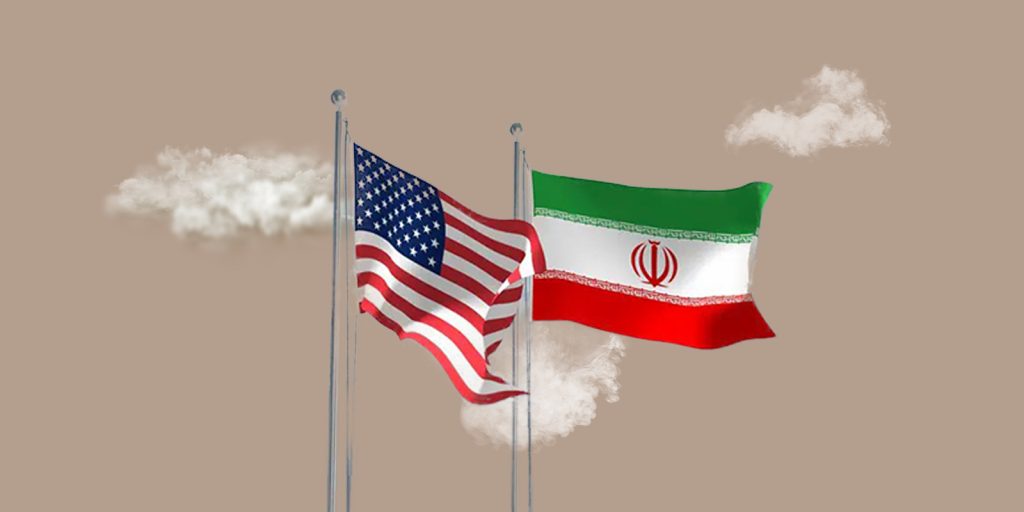
Relations between the United States and Iran are entering one of their most volatile phases in years, amid a convergence of internal unrest in Iran and an unprecedented escalation in political and security rhetoric between the two sides. As protests spread across Iranian cities, Washington has raised the tone of its warnings towards Tehran, while Iranian leaders have responded with increasingly uncompromising positions, accompanied by wide-ranging military preparations. These have included explicit threats and repeated warnings of a regional war whose consequences, Iranian officials claim, would surpass those of any previous confrontation.
This escalation appears neither accidental nor temporary. Rather, it reflects a broader effort to redefine the nature, scope, and objectives of the confrontation at a moment of heightened regional and international sensitivity.
A Structural, Not Tactical, Conflict
The current escalation unfolds within a long-standing American strategic framework, most recently codified in the US National Defence Strategy (NDS) issued in January 2026. That document reclassified Iran as a ‘permanent strategic challenge’, reinforcing earlier assessments outlined in a report by the Jewish Institute for National Security of America (JINSA) published in October 2025. Both documents advocate the use of military power within a policy of maximum pressure aimed at weakening the Iranian regime and preventing it from rebuilding its capabilities.
Viewed through this lens, Washington’s current posture can be understood as a calibrated escalation intended to contain the post–‘Twelve Days War’ phase, at a time when Tehran is attempting to restore its missile and cyber capacities while maintaining ambiguity over its nuclear programme.
According to Iranian affairs researcher Abdulrahman Al-Haidari, the United States has deployed significant naval forces to the Gulf and the wider Middle East, including aircraft carrier strike groups, as part of what Washington describes as a deterrence strategy towards Tehran. Speaking to +963, Al-Haidari argues that the nature of the Iranian political system itself makes it difficult to view the confrontation as situational or transient.
In his assessment, Iran’s governing structure is rooted in coercive expansionism, crisis exportation, and systematic repression of both domestic and non-Persian populations. These characteristics, he argues, render the US–Iran conflict structural rather than episodic.
Al-Haidari traces this entrenched hostility back to the seizure of the US embassy in Tehran in 1979, through the bombing of US Marines in Beirut, repeated attacks on American interests and allies across the region, and even alleged attempts to assassinate US presidents. Taken together, these episodes demonstrate that the confrontation is deeply embedded and not confined to any single political phase.
From this perspective, the growing American military presence in the Gulf should not be interpreted as mere posturing or temporary deterrence. Instead, Al-Haidari contends, it reflects Washington’s treatment of the Iranian file as a major strategic issue affecting US national security, international standing, and long-term Middle Eastern policy.
Warnings Ignored
Al-Haidari notes that the US president has issued multiple direct warnings to Tehran in recent years, particularly following the killing of Qassem Soleimani, which he describes as a severe blow to Iran’s regional expansionist architecture. He also highlights the 2025 strikes on Iranian nuclear facilities as a clear warning signal to the regime. According to Al-Haidari, Tehran failed to respond meaningfully to any of these messages.
At the same time, Iran has rapidly lost several of its regional instruments, from Syria to Hezbollah and other allied actors that long formed the backbone of its influence across the Middle East. Domestically, Al-Haidari argues, the regime crossed all remaining red lines by committing large-scale violence against peaceful protesters. Human rights organisations have documented significant numbers of deaths within just two weeks of demonstrations, despite explicit warnings from US President Donald Trump against targeting civilians.
Read also: From Tehran’s Bazaar to Universities: Iran’s Rising Wave of Anger
A Crisis of Credibility
For Al-Haidari, the continuation of Iran’s repressive policies presents the international community with a stark challenge, placing Washington in a particularly acute credibility dilemma. Any retreat or reliance on rhetorical condemnation alone, he argues, would be interpreted as tacit approval for further repression. Such a stance would damage US credibility not only among Iranians, but also in the eyes of oppressed populations globally.
He maintains that the American military presence in the Middle East signals a commitment to supporting populations inside Iran, emphasising that the regime now represents more than an internal threat. In his view, it has become a strategic obstacle to regional stability and development, posing direct risks to energy routes, maritime corridors, and international investment.
Al-Haidari further argues that notions of containing, reforming, or merely deterring the Iranian regime are no longer realistic. Decades of engagement, he says, demonstrate that the system does not adapt its behaviour but rather reproduces its crises in increasingly violent forms.
From this standpoint, he concludes that the logical – albeit undeclared – option is the dismantling of the regime itself, particularly amid reports suggesting that Supreme Leader Ali Khamenei has been placed at the top of a US target list. The scale of military mobilisation and the tone of political messaging, he argues, indicate that any future American strike would form part of a broader effort to reshape the regional balance of power rather than serve as a limited punitive action.
In this context, Axios quoted President Donald Trump as stating that the United States has a massive military fleet positioned near Iran, describing it as larger than Venezuela’s entire navy. At the same time, Trump insisted that diplomacy remains an available option, noting that Iran has repeatedly expressed interest in reaching an agreement and has contacted him on multiple occasions seeking dialogue.
US officials told Axios that any prospective agreement would need to include the removal of enriched uranium, strict limitations on Iran’s long-range missile programme, and a fundamental shift in Tehran’s policy of supporting allied armed groups across the region.
Aircraft Carriers Between Deterrence and Coercion
Major General (ret.) Sayed Ghoneim argues that the key question concerns how to interpret the deployment of US aircraft carriers to the Middle East. Is this a deterrent signal aimed at preventing Iranian action, or a form of coercive pressure designed to force behavioural change?
In comments to +963, Ghoneim stresses the importance of distinguishing clearly between deterrence and pressure. Deterrence, he explains, is based on shaping an adversary’s expectations in order to prevent action altogether – sending the message that initiating a hostile act would not be worth the cost. In such cases, there is no prior decision to strike; the choice remains with the adversary.
Pressure, or coercion, by contrast, seeks to shape behaviour by imposing escalating costs. Here, the adversary has already adopted a course of action that contradicts imposed conditions and refuses to reverse it. Pressure is intended to compel change before escalation to direct force.
Ghoneim notes that coercion differs fundamentally from deterrence in that it involves the real and immediate imposition of costs. The message is no longer ‘do not attempt this’, but rather ‘stop what you are doing, or conditions will worsen’. In such scenarios, a prior decision to use force often exists, and the initiative lies with the coercing party.
From this perspective, Ghoneim concludes that Washington’s deployment of aircraft carriers constitutes an act of coercive pressure rather than simple deterrence. Its objective, he argues, is to alter Iranian behaviour and impose American political and military conditions, with the planned use of force remaining a credible and integral component of that strategy.











