


By Tariq Aziza
The army is a fundamental pillar of the state’s independence, sovereignty, and stability, serving as the guarantor of its security and safety, and as the defender of its borders. Its importance goes beyond the military dimension, as it also symbolizes national unity and holds an esteemed place in the people’s collective consciousness. Yet, this image stands in stark contrast to the record of the “Syrian Army,” whose negative roles across different phases of Syria’s history overshadow its limited exceptions in the Arab-Israeli wars, such as the 1948 Palestine War, the 1973 October War, the War of Attrition, and the 1982 Lebanon War.
Rather than contributing to national unity, the Syrian Army became a party to political divisions. Instead of safeguarding the people and defending sovereignty, it repressed Syrians and compromised the country’s independence, as its officers became entangled in ideology and power struggles. The institution set a record for the number of military coups, justified under patriotic pretexts that masked the ambitions of opportunistic officers and the manipulation of competing foreign powers seeking influence in Syria.
Read also: Beyond the Centre’s Control: Damascus Clashes with Emerging Voices of Plurality
One of the paradoxes of “national rule” after independence was President Shukri al-Quwatli’s reliance on Army Chief Husni al-Za’im to suppress anti-government protests. Yet, al-Za’im himself later staged Syria’s first coup on March 31, 1949, toppling al-Quwatli with CIA backing. Only months later, his rule was ended by another coup, this time led by his ally Sami al-Hinnawi with Iraqi support. When opposition to Adib al-Shishakli’s military dictatorship intensified, especially in Sweida province, the army was dispatched to punish its inhabitants. His regime eventually fell to a coup led by Sweida’s own son, Colonel Amin Abu Assaf, who handed power to a civilian authority under Hashim al-Atassi in February 1954.
Democratic life had barely regained vitality when the Syrian Army once again disrupted stability and undermined independence. Senior officers pushed for union with Egypt in 1958 through a bloodless coup, forcing the civilian government into submission. Yet Arab unity slogans masked a struggle for power, and the army suffered greatly under the United Arab Republic: command shifted to Egyptian officers, and nearly half of Syria’s officer corps was dismissed for political reasons.
Just as the union was forged by the military, it was undone by a coup in September 1961. The ensuing political turmoil paved the way for Ba’athist officers to seize power on March 8, 1963, purging their Nasserist and independent counterparts. Internal Ba’athist rivalries soon erupted, leading to further purges and power reshuffling through coups in 1966 and 1970, the latter consolidating Hafez al-Assad’s grip on power.
The regime’s repeated purges of the officer corps left Syria with few senior qualified commanders by the time of the June 1967 War, severely weakening the army’s ability to resist and contributing to its defeat.
The Ba’athists enshrined their dominance in the 1969 “Provisional Constitution,” Article 7 of which declared the Ba’ath “the leading party in the state and society,” while Article 10 tasked the armed forces with “protecting the goals of the unifying socialist revolution.” This effectively turned the army into an “ideological army,” saturated with Ba’athist dogma.
After monopolizing power, Hafez al-Assad strengthened the security apparatus and, through it, tightened his control over the state and army. For Assad, loyalty outweighed competence. He created elite units tasked with protecting the regime and the capital city, such as the Defense Companies and the Republican Guard, which enjoyed superior equipment, privileges, and carefully selected recruits. Loyalist commanders were installed at the head of other key divisions, and they did not hesitate to shell and storm Syrian cities, brutalizing civilians, and committing massacres in Aleppo, Idlib, and Hama during the Islamist insurgency of the early 1980s.
From the mid-1970s onward, Assad deployed the army to bolster Syria’s regional role, coordinating with global powers. The army intervened in Lebanon’s civil war, turning Lebanon into a bargaining chip in negotiations over regional issues, including the Palestinian cause. This, however, left a corrosive legacy: despite its pan-Arab slogans, the Syrian Army found itself fighting Palestinians and Arab nationalists, mired in a dirty civil war. After its end in 1990, the army functioned as an occupying force in Lebanon until it was driven out under U.S. pressure in 2005, despised and humiliated.
Following Hafez al-Assad’s death and the succession of his son Bashar, the regime took on an even more overtly dynastic character. Corruption multiplied, and the army was fragmented into military fiefdoms plagued by sectarianism and devoid of national identity. Its doctrine became one of loyalty to Assad and protection of his regime alone, an orientation laid bare in the war waged against the people after the 2011 uprising. As brutal repression escalated, defections of officers and soldiers gave birth to the “Free Officers Brigade” and subsequently the “Free Syrian Army,” followed by the proliferation of armed factions, particularly foreign-backed Islamist groups.
As opposition gains mounted, Assad turned to Iran, which deployed Shiite militias and mobilized thousands of Syrians into the National Defense Forces. When Iranian support proved insufficient, Russia intervened militarily in 2015 to prevent the regime’s collapse. While Iran deepened the army’s militia character, Moscow sought to salvage what remained of the institution under its oversight. Thanks to their support, the regime recaptured much opposition territory, but its “victory” was fragile, as the army remained fractured, undisciplined, and incapable of sustained combat.
The distinction between militias and army units all but vanished, while looting and drug trafficking flourished, most notoriously within the 4th Division. In late November 2024, when Hay’at Tahrir al-Sham launched the “Deterrence of Aggression” offensive, Aleppo, Hama, and Homs fell within days, virtually without resistance. Regime forces collapsed, and Russia refrained from intervention amid regional and international negotiations over Assad’s fate. Assad fled the country, and opposition forces entered Damascus on December 8, announcing the regime’s downfall, as Assad’s disoriented soldiers discarded their uniforms and weapons. In the days that followed, Israeli airstrikes targeted what little remained of Syria’s military capabilities, leaving the country effectively without an army.
Also read: Are We Fooling Ourselves? The Syrian Illusion After Assad
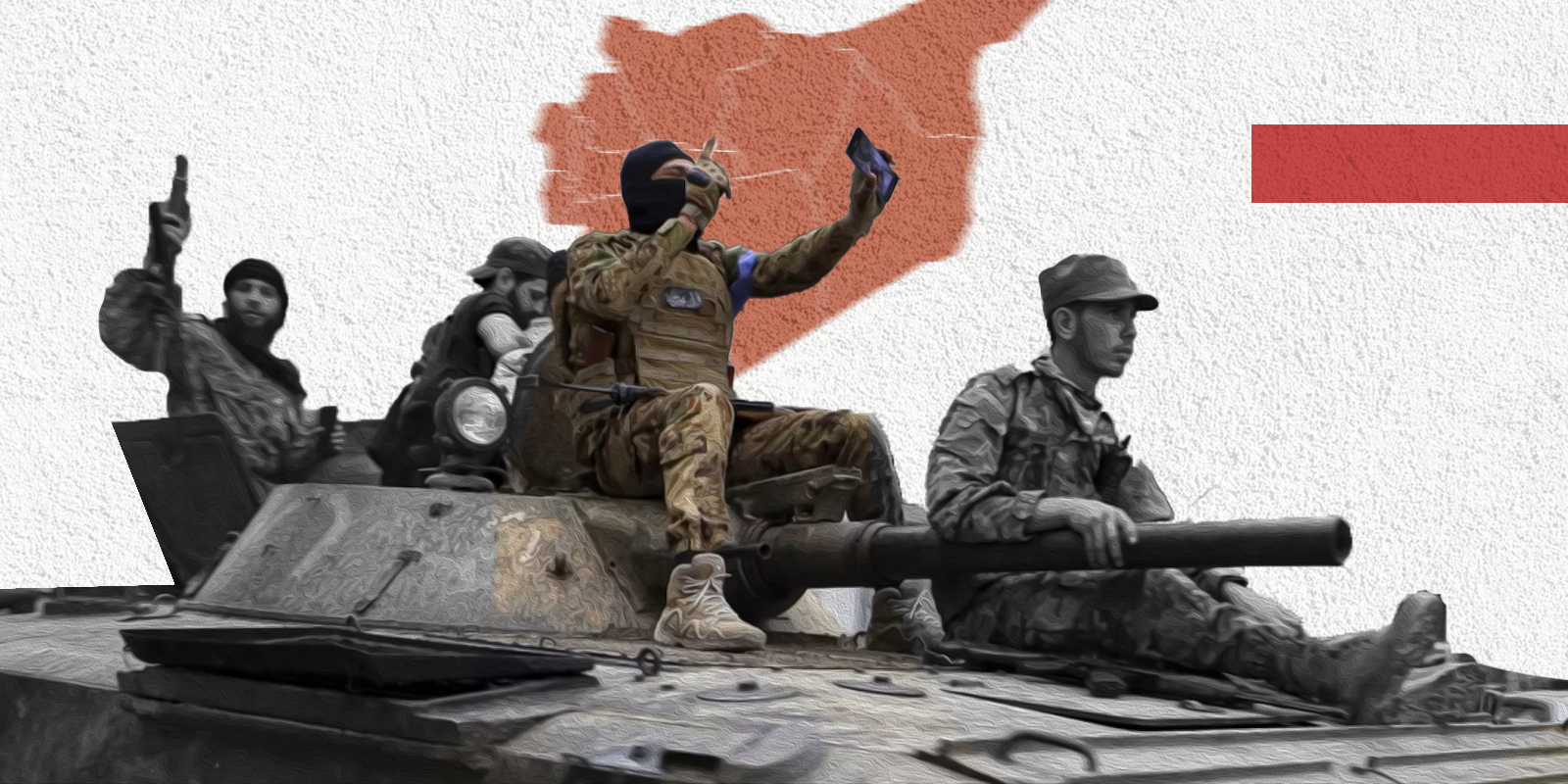
On January 29, 2025, Hay’at Tahrir al-Sham convened representatives of most armed factions in Damascus’s presidential palace, holding what was called the “Victory Conference.” There, its leader, Ahmad al-Sharaa (formerly Abu Muhammad al-Jolani), was declared president of Syria, while the Ba’ath Party, security agencies, and the Syrian Army were formally dissolved, with promises to rebuild a “new Syrian army on national foundations.”
Yet this was little more than a rebranding of existing factions, including those once aligned with Turkey under the “Syrian National Army,” as well as groups with foreign jihadist fighters. Their commanders were granted military ranks and leadership posts over their own factions, now renumbered as army divisions. Former defected officers represented only a tiny fraction of the new leadership.
Video footage from training facilities revealed overtly sectarian and religious indoctrination of recruits in the “new Syrian army,” contradicting the claim of building on “national foundations.” The consequences soon emerged in sectarian massacres in the coast and in Sweida, with perpetrators linked to the Ministry of Defense.
In a country as diverse as Syria, with its multiple religions, sects, and ethnicities, a truly national army cannot exist without being founded on the principles of citizenship, professionalism, and neutrality, free from religious or sectarian agendas. If the “new army” remains merely a nominal structure of extremist factions with foreign ties, it will lack national legitimacy and serve only as an authoritarian tool that deepens divisions, rather than guaranteeing national cohesion and civil peace. The rebuilding of a genuine military institution in Syria can only succeed through the enshrinement of a unifying national identity above narrow affiliations, an army whose loyalty lies with the nation, protecting all citizens, rather than acting as a regime’s instrument of repression in the Assadist mold.
*The views expressed in this article do not necessarily represent those of +963 Media Association .











