


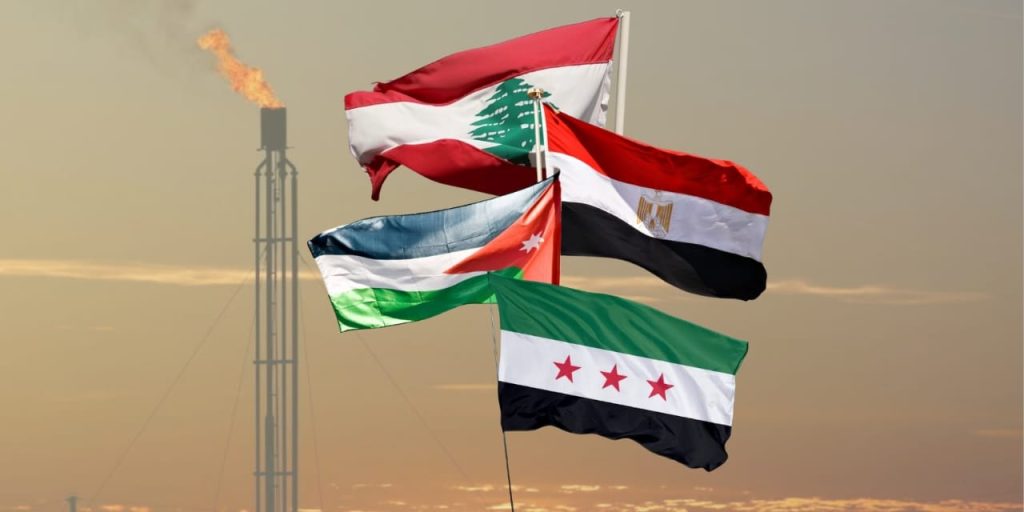
Attention in Beirut, Damascus and several regional capitals is turning towards an anticipated four-party meeting bringing together Lebanon, Syria, Egypt and Jordan, expected to take place in February. The meeting signals the return of energy to the forefront of political and economic priorities – not merely as a technical response to Lebanon’s electricity crisis, but as an entry point for redefining regional relations with Syria in the post-Bashar al-Assad era.
Lebanese ministerial sources indicate that preparations for the meeting are advancing on several tracks. Chief among these is renewed coordination over the transfer of Egyptian gas and Jordanian electricity to Lebanon via Syrian territory, alongside a comprehensive review of agreements signed under the former Syrian regime.
According to these sources, the lifting of sanctions associated with the Caesar Act following the regime’s collapse has reopened this file, which for years represented one of the principal obstacles to regional energy connectivity projects.
Energy as a Lebanese priority; and a low-cost political corridor
Behind this diplomatic movement lies Lebanon’s pressing need to improve electricity supply after years of near-total sectoral collapse. A ministerial source closely following the energy portfolio told “Asharq Al-Awsat” that the meeting will review technical reports prepared by specialised delegations, addressing the cost of rehabilitating sections of the Arab Gas Pipeline inside Lebanon, as well as assessing the readiness of Syrian infrastructure in preparation for sustainably resuming energy transfers.
In this context, writer and political activist Ali al-Amin Sweid argues in comments to +963 that choosing energy as the first regional file to be reactivated with Syria after the fall of the former regime is not a purely technical decision, but rather a calculated and low-risk political choice.
In his view, this approach allows engagement with the new authorities in Damascus without prematurely settling the question of full political legitimacy. It can also be marketed internationally as a humanitarian necessity aimed at preventing further collapse – particularly in Lebanon.
Sweid further notes that energy functions more as a “testing instrument” than a long-term commitment. It can be regulated or suspended at any moment, enabling regional actors to assess the new Syrian authority’s ability to honour agreements, control territory and secure transit routes, without extending what he describes as “free trust”.
Read also: Is Syria’s Coastal Crisis Driven by Security, Economy, or Politics?
Revisiting past agreements
Beyond its technical dimension, the meeting carries a political and legal aspect centred on a comprehensive review of earlier agreements, particularly those concluded with the ousted regime.
Lebanese ministerial sources explain that this review reflects shifting political and regional realities, and aims to improve terms related to transit fees, payment mechanisms and oversight structures.
Sweid goes further, suggesting that announcing renegotiation sends a clear message separating current agreements from the legacy of the former regime. From the perspective of international law, he argues, such a step could be legitimate if circumstances have fundamentally changed. However, he cautions that the absence of consensus with other parties could turn renegotiation into a contractual breach, potentially undermining the credibility of Syria’s new authorities.
Syria between functional integration and limited openness
From a broader angle, writer and political analyst Ahmad al-Zein situates the four-party meeting within a wider international context led by the United States. In comments to +963, al-Zein argues that Washington seeks to reintegrate Syria into its Arab surroundings through the dual gateways of energy and reconstruction, as part of a broader vision to recalibrate influence in the Middle East.
He notes that the US administration recognises that Syria’s reconstruction cannot proceed without Lebanon, positioning the energy file as a key entry point for reopening Lebanese–Syrian relations on new foundations.
While al-Zein believes the meeting could mark the beginning of four-party cooperation extending beyond energy into Syrian reconstruction and the rehabilitation of damaged Lebanese border villages, Sweid offers a more restrained assessment. What is taking place, he argues, does not amount to full rehabilitation of Syria, but rather to a form of limited “functional integration”. Under this approach, Damascus is incorporated into specific roles that serve regional stability, without recognition as a fully sovereign, normalised state. Cooperation remains capped, closely monitored, and governed by strict conditions.
Economically, Sweid estimates that Syria would be the third beneficiary of the project, after Lebanon as the primary recipient and Jordan as the principal transit state. Expected revenues from transit fees could range between 10 and 20 million dollars annually, despite the relatively short stretch of pipeline crossing Syrian territory.
Read also: Syria’s Economy After Caesar: A Numbers-Driven Assessment
The Syrian perspective: separating files and shifting priorities
Conversely, political analyst Hussam Najjar points out in comments to +963 that the energy file itself is not new. Related agreements were signed years ago, he notes, but stalled for practical reasons linked to volumes, transfer mechanisms and the balance of benefits.
While Najjar acknowledges the renewed importance of the file – particularly for Lebanon – he stresses the necessity of separating it from unresolved political issues between Beirut and Damascus. He argues that the Syrian state currently prioritises other files it deems more urgent, including Syrian detainees in Lebanon, refugees, and former regime officers. Damascus, he suggests, approaches each issue independently, guided by a perceived need to protect internal stability – especially following the return of oil and gas fields to state control.
According to Najjar, energy transfers are no longer a Syrian priority to the same extent that they represent a Lebanese necessity. This imbalance tilts leverage towards Beirut, even as Damascus seeks to position itself as a pivotal intermediary – a “swing factor” – across multiple files, within a relationship framed by mutual intent and behavioural restraint.
Developments and numbers on the ground
In practical terms, Egypt began on 11 January pumping approximately 50 million cubic feet of natural gas per day to Lebanon via the Arab Gas Pipeline, after delivering a similar quantity to Syria. Bloomberg has also reported that Cairo reached an agreement with Damascus and Beirut to receive liquefied natural gas shipments for both countries through the regasification vessel stationed at Jordan’s Aqaba port, with supplies expected to reach around 100 million cubic feet per day during the winter months.
These developments come as Syria’s electricity sector faces profound challenges. Official estimates suggest the country requires approximately five years to achieve full electricity stability, amid a deficit exceeding 80 per cent of current demand.











