


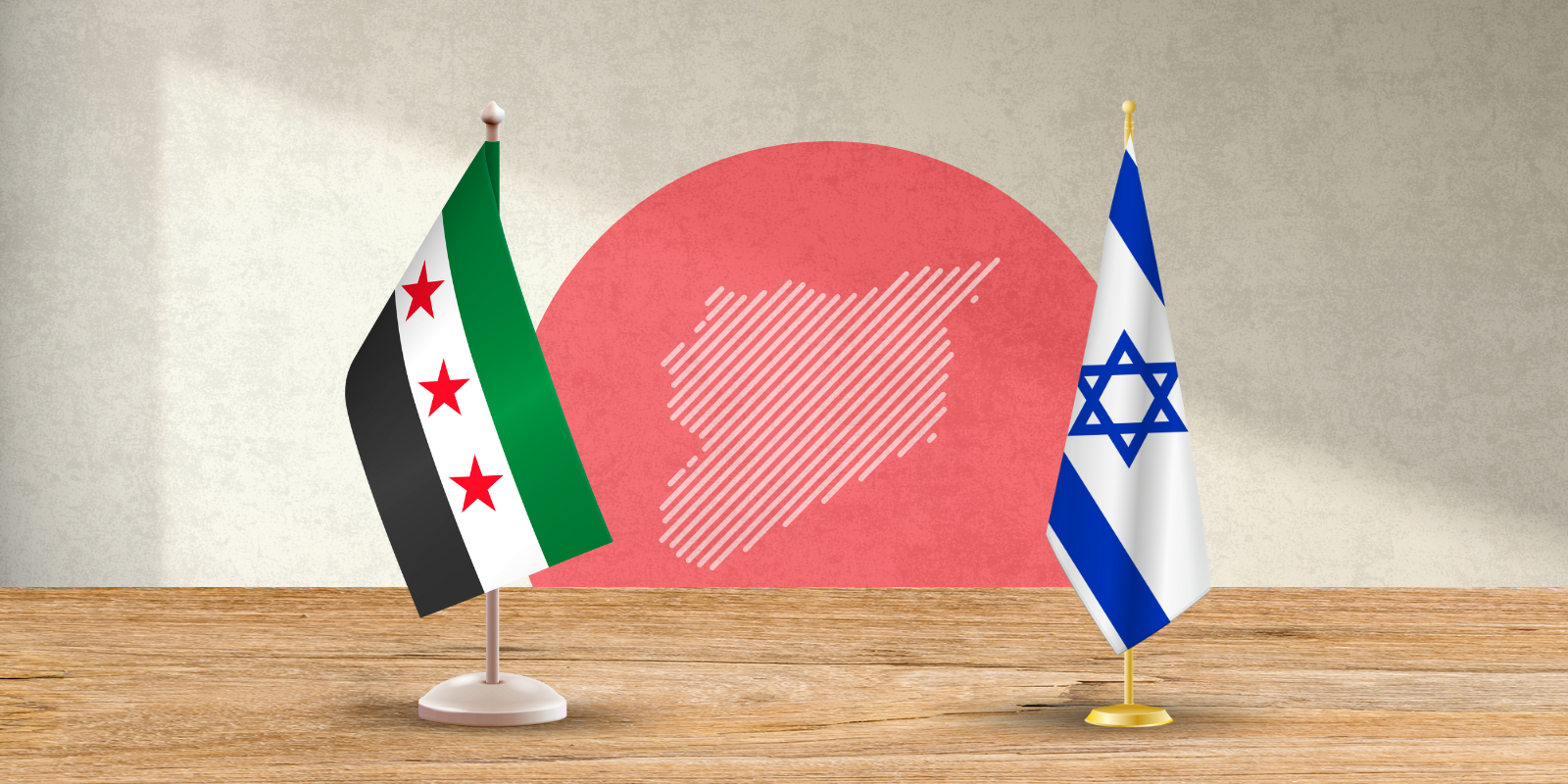
The Syrian state news agency (SANA) disclosed last Tuesday that Foreign Minister Assad Al-Shaibani and General Intelligence Chief Hussein Salameh conducted discussions with an Israeli delegation headed by Minister of Strategic Affairs Ron Dermer in Paris, focusing on border security and the situation in southern Syria, particularly Suwayda province. Notably, this is the first official Syrian announcement of talks with Israel in decades, potentially signaling a move toward normalizing relations beyond mere understandings or de-escalation agreements concerning border areas.
De-escalation Understandings
SANA stated that “the discussions focused on de-escalation, non-interference in Syrian internal affairs, reaching understandings that support regional stability, monitoring the ceasefire in Suwayda, and reactivating the 1974 Disengagement Agreement between Syria and Israel.” The agency noted that “these discussions are taking place with U.S. mediation, as part of diplomatic efforts to enhance security and stability in Syria while preserving the unity and territorial integrity of the country.”
Syrian state TV channel Al-Ikhbariya quoted a government source saying that “Foreign Minister Assad Al-Shaibani and Head of General Intelligence Hussein Salameh held a meeting with Israeli Minister of Strategic Affairs Ron Dermer in Paris.” The source added that “both sides affirmed their commitment to Syria’s territorial integrity and rejected any projects aimed at partitioning it, noting that Suwayda is an integral part of Syria and that the Druze community is an authentic component of the Syrian social fabric.”
The source also noted that “the discussions addressed humanitarian conditions in southern Syria, agreeing on the need to increase aid to the people of Suwayda and the Bedouin to alleviate harsh living conditions, and to establish a clear mechanism for reactivating the 1974 ceasefire agreement, ensuring Israeli forces do not penetrate Syrian territory, creating a more stable environment, and reaffirming both sides’ commitment to de-escalation in southern Syria to prevent open conflict.”
Read also: The Syrian Government Confusion in Managing Domestic Issues
Israel’s Role in Syria
The Syrian government’s announcement, the first of its kind in over 25 years, highlights new dynamics in dealing with southern Syria and portrays Israel as a key player in regional security arrangements, especially in the south. It also sends multiple messages internally, regionally, and internationally regarding Israel’s role and the situation in southern Syrian areas that have a unique status since the founding of modern Syria.
Syrian political analyst Abbas Sharifa, based in Damascus, noted that “the official Syrian announcement about talks with Israel is meant to reinforce the Syrian narrative regarding these meetings, amid Israeli and U.S. narratives that may be incomplete.” He told 963+ that “the Syrian state confined the negotiations strictly to security matters, rejecting any scenario that would give Israel a pretext to intervene in Syria’s internal affairs. The discussions revolved around the 1974 Disengagement Agreement, as it is legally, politically, and practically the only framework available, given that the current government is transitional and lacks a popularly elected parliament to approve a normalization deal.”
Suwayda: A Secondary Issue
Sharifa added, “The Suwayda file was not discussed as a political issue between Syria and Israel but as a security matter. The province is part of the Syrian state and an internal Syrian concern. Israel is not fundamentally attached to Suwayda but uses it as leverage on the Damascus government. Tel Aviv does not want to bear the political, economic, or military burden of the province; the agreement is with Damascus, but Suwayda is used as part of that framework.”
Lebanese-based political writer Ahmad al-Ayoubi stated, “It is clear that Syrian authorities are pursuing transparency. This announcement is not about normalization with Israel but about informing public opinion regarding ongoing developments, especially during the state-building phase.” He emphasized that the Damascus-Tel Aviv relationship remains influenced by Turkey, Saudi Arabia, and Qatar, with a general trend toward de-escalating confrontations in Syria.
Al-Ayoubi noted that Syrian officials were awaiting progress on the Suwayda file, and the negotiations are likely to affirm two key points: Syria’s commitment to avoid conflict with neighbours and to restore sovereignty over Suwayda while Israeli forces withdraw under these terms.
Lebanese political analyst Imran Zahawi observed that “Damascus links these indirect negotiations with Israel to the implementation of the 1974 Disengagement Agreement, including cessation of hostilities and UN supervision over a demilitarized zone between the two sides. The official Syrian announcement aligns with this approach, showing that authorities are not shy about engaging with Israel.”
Read also: The Syrian Government Confusion in Managing Domestic Issues
Humanitarian Corridor to Suwayda
Concurrently with the Shaibani-Dermer meeting, attended by U.S. envoy to Syria Thomas Barrack, Barrack also met with the spiritual leader of the Druze community in Israel, Muwaffaq Tarif. Barrack posted on X (formerly Twitter) that the meeting was “warm and informative”, discussing conditions in Suwayda “and how to bring together the interests of all parties, de-escalate tensions, and build understanding”. While Tarif confirmed that he requested the U.S. envoy to maintain the ceasefire in Suwayda, end the siege, and open a Druze-to-Druze corridor from Israel into the province, denying reports of Israeli troops entering the area.
Israeli channel i24 reported on Wednesday, citing an unnamed Syrian source, that “the meetings in Paris aimed to resolve the Syria-Israel crisis over Suwayda,” clarifying that “normalization between Damascus and Tel Aviv remains distant, but there is a foundation for security cooperation, with an agreement expected to be presented to the United Nations in September.”
In mid-July, media reports revealed a meeting between Syrian and Israeli officials in Baku, Azerbaijan, to discuss de-escalation and security in southern Syria, followed by the Shaibani-Dermer meeting in Paris with U.S. envoy Barrack, whose details were not officially disclosed by Syria.
The spiritual leadership of the Druze community in Syria, represented by Sheikh Hikmat al-Hijri, along with Suwayda residents, have called for opening a humanitarian corridor from Israel to the province amid a severe blockade imposed by the Ministry of Defense and internal security forces, amid a humanitarian crisis and acute shortages of basic supplies.
In mid-July, the southern province witnessed military operations and violence following the entry of Syrian defence and interior forces, resulting in hundreds of casualties, with reports of human rights violations including executions, torture, and destruction of property. The government recently announced the formation of a committee to investigate these events.











