


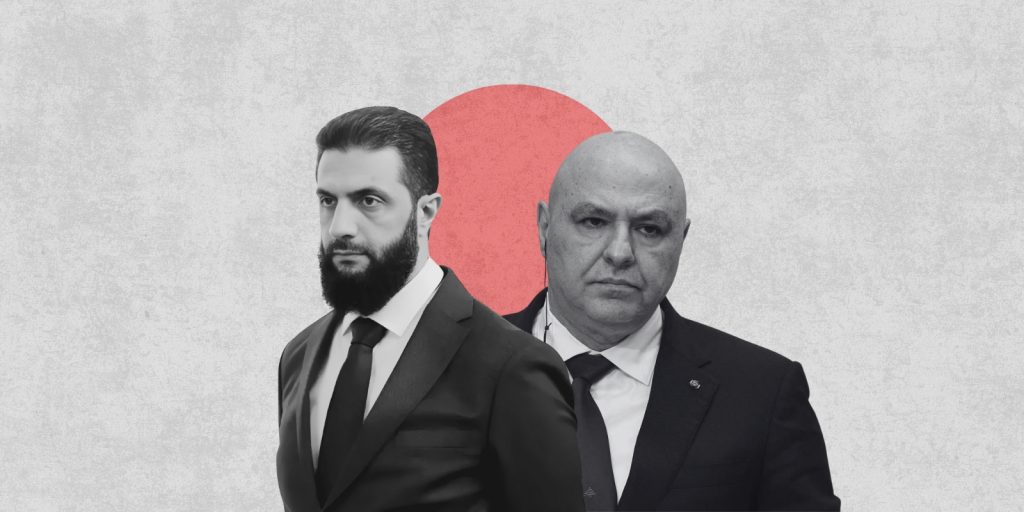
Syrian–Lebanese relations remain stuck at the intersection of a bloody history and the pressing challenges of the present. While Syria’s new leadership has taken steps in recent months to reach out to neighbours – through visits and talks with Iraq, Turkey, Jordan, and even Israeli officials – Lebanon has been conspicuously absent from this outreach. That absence is more than a diplomatic detail; it signals the complexity of a relationship too heavy to be reset with a handshake or a protocol visit.
The recent meeting between Lebanese President Joseph Aoun and Syria’s interim President Ahmad al-Sharaa at the Arab League summit did little to shift the status quo. Relations remain confined to joint committees, polished statements, and ritualistic diplomatic language. Core issues remain unresolved: unmarked borders since independence; Syrian Islamist detainees in Lebanese prisons; the fate of Lebanese disappeared in Syria; the refugee crisis; and the lasting wounds of the Syrian war.
The border itself has never been just a line on a map. Since the French Mandate in the 1920s, it has been drawn more by wars and partial deals than by cartographers. Over time, it became a corridor for smuggling, a battleground for militias, and a vital supply line – especially for Hezbollah, which built a cross-border network extending from security influence to a parallel economy.
Today, there is renewed talk of a Saudi-brokered agreement to demarcate the border. But obstacles loom: the intertwined geography, overlapping villages, and above all, the unresolved Shebaa Farms issue. Are they Syrian territory under Israeli occupation? Lebanese land awaiting Syrian recognition? Or irretrievably lost to Israel? This dispute is not just about soil; it cuts to the legitimacy of Lebanese resistance against Israel itself.
Read also: No State Under Two Powers: Lebanon’s Struggle Against Hezbollah’s Grip
Another sensitive file involves Syrian Islamist detainees in Lebanon. Damascus sees them as extensions of regional conflicts and political bargaining chips, not criminal cases. Beirut insists they committed crimes on its soil and must face justice under Lebanese law. The divergence underscores the lack of trust – every legal case becomes a test of sovereignty.
Meanwhile, the unresolved fate of Lebanese forcibly disappeared in Syria remains a national wound. For decades, families have waited for answers about loved ones detained or abducted during Syria’s military presence in Lebanon. Official meetings reopen the file, but no concrete progress is made. This underscores the psychological dimension of the relationship: Lebanon remembers Syria not just as a neighbour, but as a former occupier that left scars and unanswered questions.
The refugee crisis adds another layer. Lebanon, hosting hundreds of thousands of Syrians, views their prolonged presence as a social and economic burden that threatens its fragile demographic balance. Damascus, however, treats their return as a security and political calculation – wary of uncontrolled repatriation that could trigger new instability.
The September 15 meeting between Aoun and al-Sharaa touched on the “comfort” in Damascus over limited group returns, but the gesture was symbolic rather than substantive. Refugee repatriation is tied to internal Syrian balances and international debates about reconstruction and the political process, not just logistics.
No discussion of bilateral ties is complete without Hezbollah’s role in the Syrian war. The group not only fought alongside Syria’s former regime but became linked to atrocities and destruction that scarred popular memory on both sides. With new leadership in Damascus, the resentment lingers. For many Syrians, Hezbollah’s involvement was a form of masked occupation; for many Lebanese, it dragged the country into isolation and strained Arab ties. Though the party remains a border power, its legacy in Syria is inseparable from any future political or security dialogue.
The paradox is clear: geography, history, and economics make coordination unavoidable, but politics, culture, and blood make it almost impossible. Syria may open doors in Baghdad, Ankara, Amman, or even Tel Aviv; Beirut remains a harder threshold. Not because Lebanon is uniquely complex, but because it mirrors everything Damascus would rather forget: occupation, war, prisoners, and tangled borders.
The last meeting between Aoun and al-Sharaa, despite diplomatic talk of “cooperation” and “coordination,” did not alter that reality. Committees were formed and visits planned, but the absence of a shared strategic vision and the unwillingness to confront the toughest issues remain.
The essential question now: Do Syria and Lebanon have the political courage to approach these files with a fresh spirit? Or will relations circle endlessly in a cycle of empty communiqués and stagnant committees? Does Syria’s leadership truly want normalized ties, or merely a compliant backyard? And can Lebanon – with its divisions and fragile state – set its own agenda with Damascus?
These are not just technical or temporary questions; they strike at the heart of relations between two nations that share everything yet clash over nearly all of it. The answers will shape not only bilateral ties, but regional balances and the ability of both Damascus and Beirut to escape the shadow of the past and shape a different present.











