


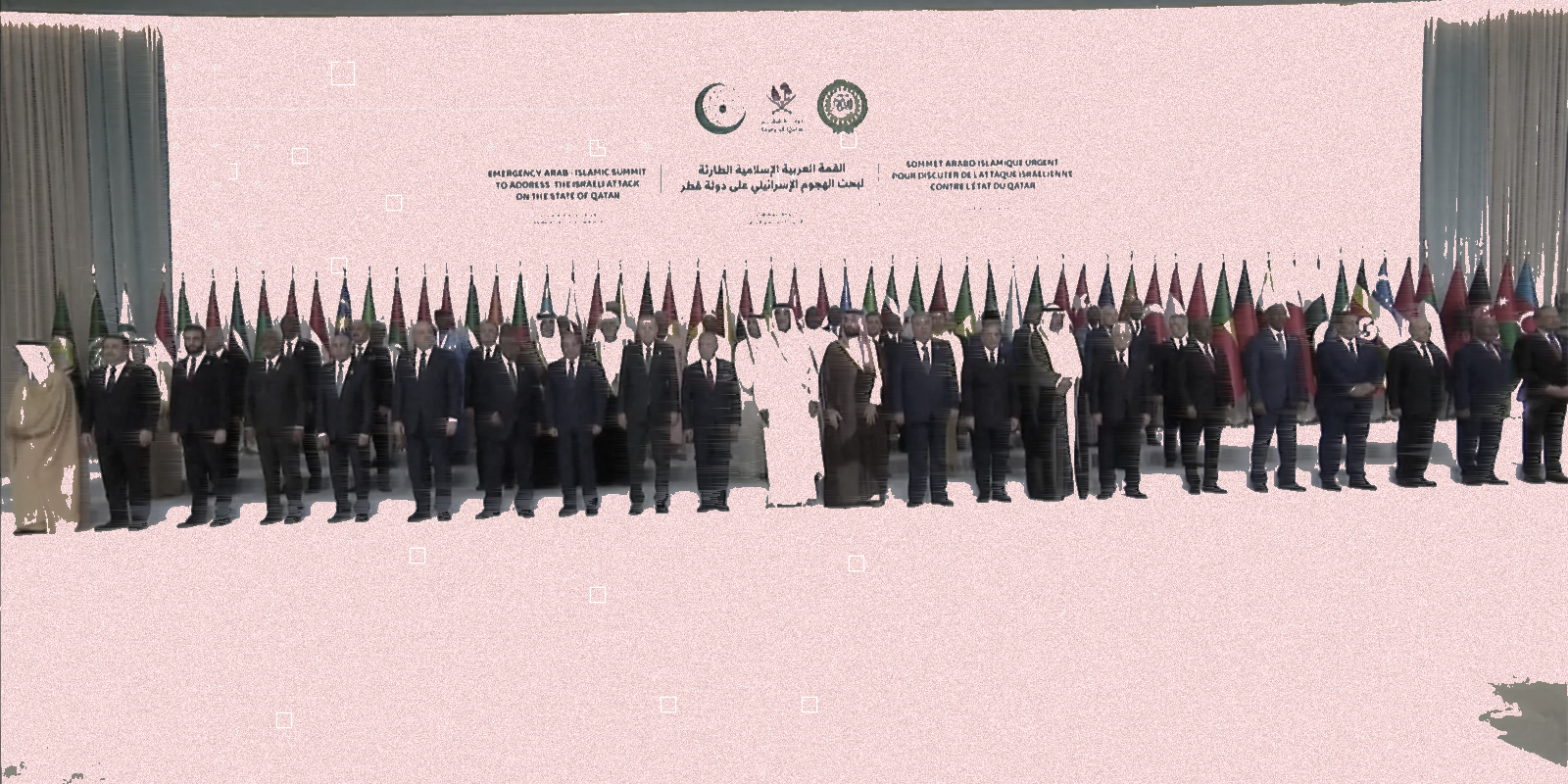
Amid escalating regional tensions, Doha hosted an extraordinary Arab-Islamic summit in response to a dangerous development: an Israeli attack targeting Hamas officials on Qatari soil. This assault marked a serious precedent that violated state sovereignty and exposed both regional and global security to severe risks.
The question now is: amid Arab divisions and conflicting regional agendas, will this summit be just another round of emergency meetings limited to condemnations; or can it become a genuine turning point toward an active and influential Arab-Islamic stance?
Emergency Summit and Final Statement
The summit concluded in Doha with a final communiqué strongly condemning the attack on Hamas offices in the Qatari capital, describing it as “an assault on a neutral mediation venue that undermines international peace efforts.”
The statement reaffirmed full solidarity with Qatar and support for whatever measures it takes in response; emphasized backing for Qatari, Egyptian, and U.S. mediation efforts to halt the Gaza war; and condemned Israel’s repeated threats of further strikes against Qatar.
Participants rejected any Israeli attempts to forcibly displace Palestinians under any pretext, underlining the importance of collective security and the shared destiny of Arab and Islamic nations. The communiqué also denounced Israel’s schemes to impose new realities in the region.
Held Monday in Doha, the summit gathered leaders and officials from across the Arab and Islamic world to discuss responses to the unprecedented Israeli strike against Hamas representatives inside the Gulf state.
Opening the session, Qatari Emir Sheikh Tamim bin Hamad Al Thani described the assault as “a treacherous act that shocked the world and killed several people, including a Qatari national,” calling it “a cowardly terrorist attack.” He reminded participants that Qatar had acted as a mediator for two years to end the war in Gaza and secure the release of hostages.
A preparatory meeting of foreign ministers from 57 Arab and Islamic countries the day before produced a draft resolution warning that the Israeli strike in Doha, along with other hostile actions, threatened efforts at normalization with the Arab world.
On the eve of the summit, Palestinian factions issued a statement urging Arab and Islamic leaders to adopt “decisive measures” and employ “Arab leverage,” including activating the joint defence pact, using the oil weapon, and imposing comprehensive Arab sanctions on Israel.
International reactions, however, were muted; major powers merely called for “restraint,” while Israel officially ignored the summit’s outcome. Large segments of Arab and Islamic public opinion expressed anger at what they saw as “official complacency,” demanding stronger, bolder action.
The Summit’s Aims
Dr. Areej Jabr, a professor of political science, said the emergency summit underscored Arab-Islamic unity in the face of an Israeli strike that touched both Arab and regional security. She explained that Israel’s geopolitical ambitions, especially its “Greater Israel” project, placed the entire region on a knife’s edge.
Speaking to +963, she added that the summit was a response to “official Arab anger after an attack on Doha, a capital known for its diplomatic neutrality and balanced mediation. Targeting the mediator and killing negotiators reflects an attempt to derail peace efforts and sabotage de-escalation.”
Jabr argued that the summit also exposed Arab awareness of the international community’s double standards and was a bid to prove that Arabs can craft a unified stance rather than remain passive recipients of events.
Dr. Ghazi Faisal, director of the Iraqi Center for Strategic Studies, added that the summit aimed to build “a collective positions among more than 57 states; creating pressure on the UN and Security Council, which bear responsibility for global peace and security amid systematic destruction in the Middle East since October 7, 2023”.
Symbolism or Real Shift?
Was the Doha summit merely symbolic, or a real turning point? Dr. Faisal called it “a qualitative step, addressing one of the gravest issues threatening stability in the Middle East.” Beyond the immediate Israeli strike, the summit also re-cantered the Palestinian cause as the region’s core issue, building regional and international awareness of Palestinians’ right to self-determination.
However, Jabr offered a different view. She described the summit as “a symbolic political message rather than a strategic shift,” predicting Israel would escalate further, having tested Arab and Islamic inability to adopt deterrent measures. In her view, summits often serve more to manage anger than to enact real change.
She stressed that while leaders pledge commitments in summit communiqués, Arab states lack enforcement tools: “No joint military alliance; no economic sanctions; no effective deterrent arms.”
Still, Jabr argued that convening the summit during an era of normalization with Israel was important, signaling red lines such as suspending or freezing ties, and reassessing agreements like the Abraham Accords, independent of U.S. or international pressure.
Read also: https://963media.com/en/10/09/2025/israeli-airstrikes-on-syria-field-escalation-or-diplomatic-moves/
After the Summit: Arab-Israeli Relations and Negotiations
According to Jabr, the summit generated awareness that the entire region is under threat; creating a need to activate legal, political, and diplomatic paths at the UN, including a Security Council push under Chapter VII and an emergency General Assembly session to suspend recognition of Israel and halt its assault on Palestine.
“The real question,” she said, “is whether Doha will chart a new roadmap for Arab relations with Israel.” Positions remain split: some countries cling to normalization due to security or economic ties; others may freeze but not cut relations, while a third group weighs reassessing commitments altogether.
This uncertainty, Jabr explained, leaves the Arab stance closer to diplomatic escalation than to practical measures capable of isolating Israel. She warned that Israel’s far-right government would exploit the moment to push its “Greater Israel” vision, impose new deterrence equations, and escalate against Palestinians while threatening Turkey and Egypt.
Both Jabr and Faisal agreed that Hamas-Israel negotiations would continue under Qatari, Egyptian, and American mediation despite the attack. “Talks are seen as essential to prevent regional explosion,” Jabr noted, though Israel uses them as cover for field operations while Hamas clings to them to ease Gaza’s humanitarian crisis and block displacement.
Faisal added that Israel’s military and intelligence superiority makes further strikes on Hamas leaders likely, whether inside or outside Gaza. He also suggested some Arab states, wary of escalation, may prefer maintaining minimal ties with Israel rather than risk direct confrontation.
“The real challenge for the Doha summit,” Faisal concluded, “is to translate its outcomes into practical steps; to pressure the international community to enforce the UN’s two-state solution, stop Israel’s military operations, and implement de-escalation initiatives, including those proposed by former U.S. President Donald Trump.”











