


By Wael Sawah
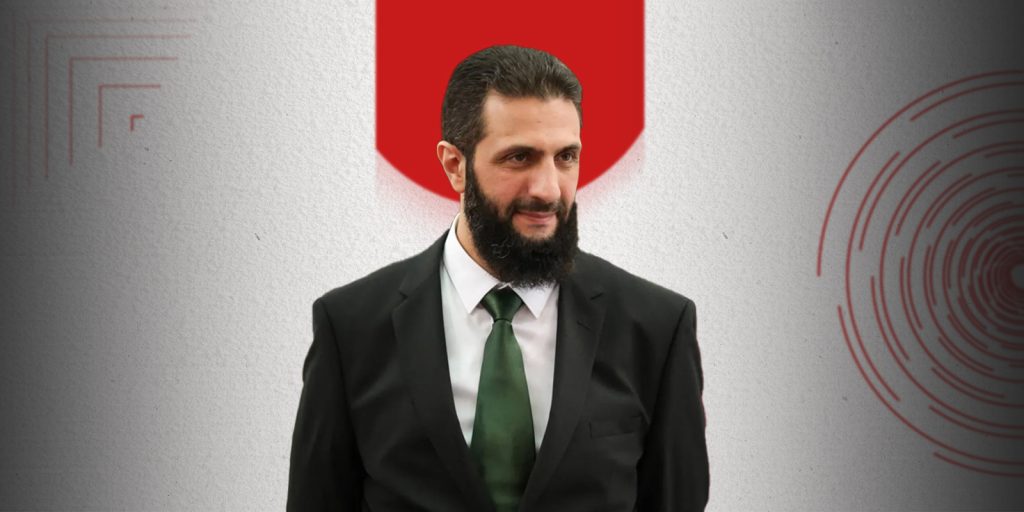
In the shadowy corridors of global diplomacy, few figures have drawn as much intrigue and caution as Ahmad al-Shara, transitional president of Syria and former jihadist commander. Once a disciple of al-Qaeda and a founding figure of Jabhat al-Nusra, al-Shara now navigates the precarious terrain of post-Assad Syria. His startling transformation, from militant insurgent to political leader, has unsettled both allies and adversaries. Yet, it is his latest overture toward Israel that marks perhaps the most consequential and controversial chapter of his political journey.
A Past That Casts a Long Shadow
Born in Saudi Arabia in 1982 to a Syrian family originally from the Golan Heights, al-Shara’s early path was far removed from statesmanship. He joined al-Qaeda in Iraq in 2003 and later established its Syrian branch in 2012 under the name Jabhat al-Nusra. Despite rebranding to Hay’at Tahrir al-Sham and officially severing ties with al-Qaeda, his long association with extremist ideologies brought him international sanctions and a deeply controversial reputation.
Read also: Sanctions End, Opportunity Begins
However, in December 2024, it was this same man who led the final push that toppled the Assad regime. In a dramatic twist, he emerged not as a Muslim leader but as a suit-clad statesman, advocating for inclusivity, rule of law, and international cooperation. To many, his meteoric rise seemed almost surreal.
Since then, events have moved swiftly. The former jihadist has flown to Paris aboard a U.S.-chartered plane, visited the UAE and Bahrain, and, most notably, initiated backchannel talks with Israel.
The new Syrian government appears to be investing its limited capacity squarely in foreign policy. Burdened with a collapsed economy, fragmented institutions, and the absence of basic services, the government has opted to redefine Syria’s position in the regional and international order.
What al-Shara inherited was not a functioning state but the wreckage of one. Assad’s departure left the treasury looted and the country in ruins. With few levers of domestic power, foreign policy has become Syria’s most viable asset. High-profile meetings, with President Trump, President Macron, and quiet overtures to Tel Aviv, signal that diplomacy, not internal governance, is the government’s primary arena of action.
Legitimacy Abroad to Secure Legitimacy at Home
Al-Shara’s administration knows its domestic legitimacy remains tenuous, especially given the extremist past of many of its key figures. That makes international recognition, from France’s openness to recent U.S. engagement, a critical tool to bolster his standing inside Syria. For al-Shara, foreign diplomacy is not just about securing allies; it’s about shaping the internal political landscape.
Despite limited resources and deep internal divisions, al-Shara is pushing bold foreign policy agendas, from outreach to Israel and the Gulf to negotiating sanctions relief. The means may be modest, but the ambitions are anything but.
Read also: Reuters: Syria Plans to Print a New Currency in Germany and the UAE
Israel: The Gateway to the West?
In mid-April, U.S. President Donald Trump reportedly sent a letter to al-Shara listing eight “confidence-building steps” that Syria must take to qualify for sanctions relief. Delivered in Brussels by a mid-level U.S. official, the list spans a range of security issues: cooperation on locating missing American citizens, resolution of chemical weapons files, and joint counterterrorism efforts, including access to camps like al-Hol and coordination against groups like Hezbollah and the Iranian Revolutionary Guard Corps.
Conspicuously absent from the demands: democratic reforms, human rights, or political inclusion. The message was clear, for Washington, two priorities reign supreme: fighting terrorism and securing Israel.
Al-Shara seems to have read the memo. In pursuit of economic recovery and international legitimacy, he is engaging Israel not as a historical enemy, but as a key to Western acceptance. Reports indicate that his government has made discreet overtures to Tel Aviv, proposing de-escalation measures and signaling readiness for diplomatic engagement, a seismic shift for Damascus, long entrenched in Iran’s anti-Israel axis.
Sanctions Relief in Exchange for Repositioning
As part of these efforts, al-Shara’s administration reportedly offered to ease tensions with Israel in return for partial sanctions relief. These overtures are part of a broader charm offensive toward the Trump administration, including energy cooperation, privileged U.S. access to Syria’s oil and gas sectors, and even a symbolic proposal to build a Trump Tower in Damascus.
Though Israeli officials have remained silent, the seriousness of these initiatives is difficult to dismiss. Syria, under al-Shara, is repositioning itself as a potentially neutral player in the regional power game, distancing from Iranian proxies and exploring confidence-building steps with former foes, including Israel.
Yet this bold pragmatism has not gone unchallenged. Washington has made clear that symbolic moves won’t suffice. Israel remains wary, remembering al-Shara’s earlier hardline rhetoric and his leadership of a group that once openly espoused anti-Israel ideology. Still, the strategic logic behind his overtures could prompt cautious Israeli openness, especially amid Iran’s waning influence in Syria.
Read also: Until “Trump’s Promise”: This Is How Washington Punished Damascus
A Turning Point: U.S. Sanctions Lifted
In a major diplomatic pivot, President Trump announced on a Tuesday in Riyadh that the United States would lift all sanctions on Syria, a watershed moment with the potential to reshape the post-war landscape and unlock regional and international investment.
The surprise declaration came during an economic forum in the Saudi capital, earning a standing ovation from Gulf royals, business leaders, and political dignitaries. Standing before massive Saudi and American flags, Trump proclaimed: “ I will be ordering the cessation of sanctions against Syria” before adding with a grin, “ Oh, what I do for the crown prince,” drawing laughter from the crowd.
The announcement followed extensive consultations with Saudi Crown Prince Mohammed bin Salman and Turkish President Recep Tayyip Erdoğan — both longtime supporters of the Syrian opposition. MBS sweetened the deal with a promise to increase Saudi investment in the U.S. to $1 trillion during Trump’s second term.
In Damascus, the news sparked street celebrations. Syrians waved national and Saudi flags, chanted revolutionary slogans, and expressed hope for long-awaited economic relief. Syrian Foreign Minister Asad Hasan al-Shibani hailed the move as “a new beginning for reconstruction” and thanked Saudi leadership for its “wisdom and foresight”, pointedly omitting direct mention of Washington.
From Resistance Axis to Realignment?
If Syria truly pivots from the Iranian orbit toward a more neutral, or even pro-Western, stance, it would mark one of the most dramatic geopolitical shifts in the Middle East since the Camp David Accords. For Israel, a post-Assad Syria no longer aligned with Hezbollah or the IRGC could significantly reduce a long-standing northern threat. For al-Shara, normalization with Israel might be the ultimate test of his ability to transcend a militant past and secure international legitimacy.
Still, the path ahead is fraught. As one U.S. official bluntly put it: “Replacing a dictator with a former extremist isn’t exactly a comforting thought.” For Israel, any serious engagement with Damascus will demand not just security assurances, but ideological ones.
Al-Shara has made clear he no longer seeks to rule Syria through a jihadist lens. But to gain lasting credibility, particularly with Western and Israeli audiences, he must go beyond rhetoric. He will need to institutionalize reform, protecting minorities, embracing pluralism, and renouncing extremism, not only in speeches but in law and governance.
Whether his outreach to Israel is genuine or tactical remains to be seen. Either way, the mere fact that such outreach is taking place signals a tectonic shift in Syria’s regional posture. Whether history remembers al-Shara as a reformed radical or a shrewd opportunist will depend less on what he says, and more on what he dares to make permanent.
In the end, prioritizing foreign relations at this stage is not a political luxury but a strategic necessity for al-Shara’s government. He understands that rebuilding the country from within requires acceptance from abroad, that economic recovery is impossible without lifting sanctions, and that true authority is only solidified through recognition by global powers.
Yet however important this outward engagement may be, it cannot substitute for genuine internal reform. National reconciliation and institutional rebuilding remain essential. Only through such efforts can al-Shara become a leader for all Syrians, not just a clever regional actor taking advantage of a moment of geopolitical vacuum.











