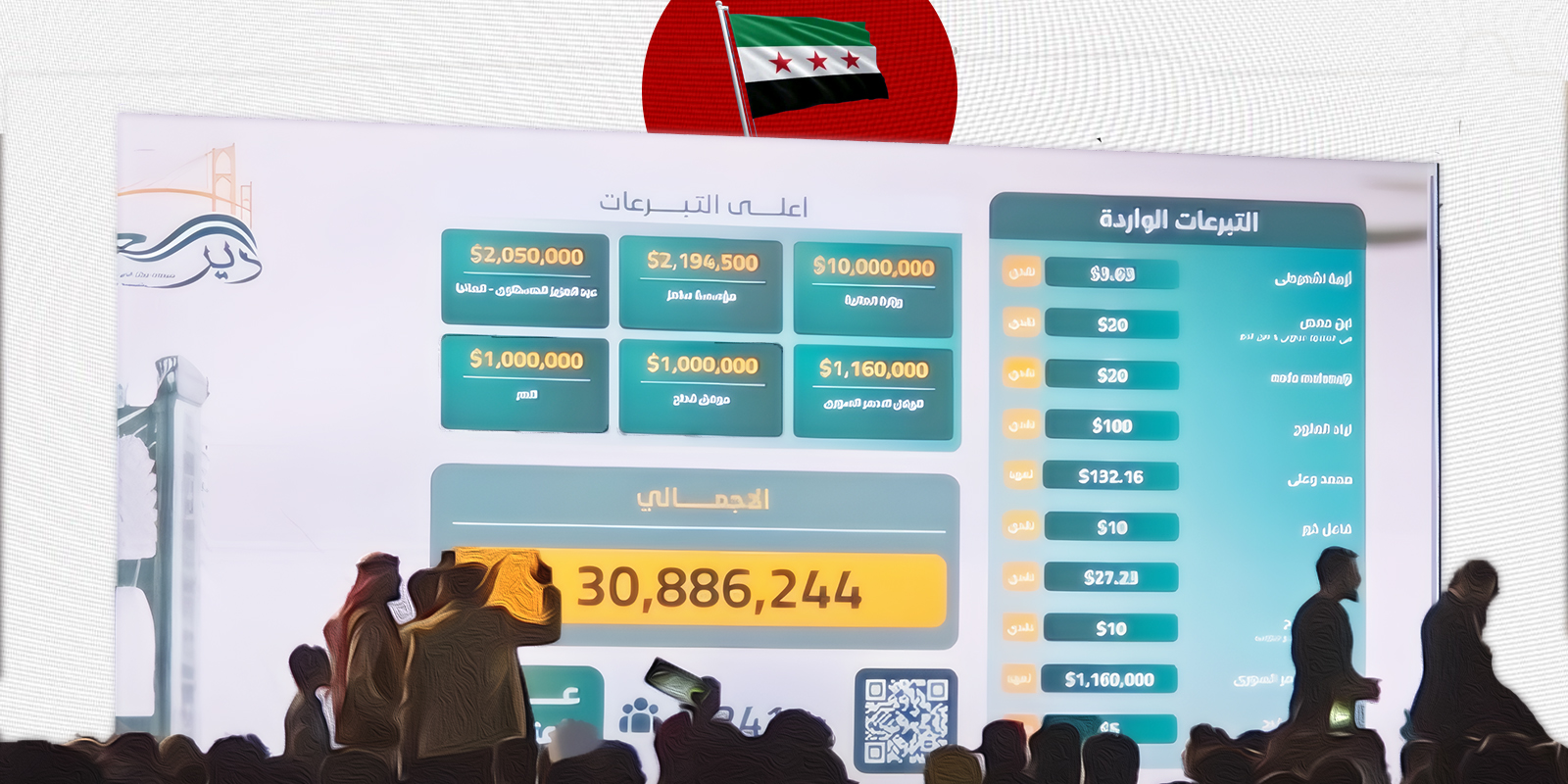
Syrian governorates are witnessing a notable rise in fundraising campaigns under humanitarian and developmental titles, most prominently “Absheri Horan,” “Wednesday of Homs” and the “Deir Al-Ezz Campaign.” The Syrian Interim Authorities supported this trend by establishing the Development Fund through a presidential decree aimed at enhancing solidarity and organizing initiatives. Within less than an hour, the fund collected more than 61 million dollars from around 589 donors. “Abshiri Horan” alone raised 37 million dollars in a single week, while “Wednesday of Homs” gathered around 12 million dollars. These figures reflect the community’s ability to mobilize quickly, though they remain modest when compared with the reconstruction needs estimated at tens of billions.
However, this phenomenon raises fundamental questions about the true objectives of these campaigns. Are they intended to compensate for the absence of international support or to establish reliance on domestic financing? Debate also surrounds issues of transparency, oversight, fair distribution, and how funds are managed within the fund while connecting them to Syrian expatriate communities abroad. Observers fear they may devolve into scattered initiatives lacking national coordination or meaningful impact, posing challenges to the future of sustainable development and reconstruction. At stake is whether these campaigns will evolve into a new local “socioeconomic experiment” or remain temporary stopgap measures.
Economic expert Dr. Mohammad Al-Omar told 963+: “For more than a decade, Syria has been experiencing a suffocating economic crisis alongside widespread destruction of infrastructure and a decline in basic services. In the absence of a clear international reconstruction plan, local communities have been forced to search for alternative solutions. This is how grassroots fundraising campaigns emerged, as communities across towns and villages increasingly turned to self-reliance to address economic and humanitarian challenges.”
Al-Omar notes that grassroots initiatives in Syria have shifted from individual efforts to collective movements capable of raising millions of dollars rapidly, reflecting growing awareness of the importance of community solidarity and domestic solutions in the absence of international reconstruction support. Yet he stresses that such efforts cannot replace comprehensive projects. He cites the experience of the “Northern Syria Development Fund” (2020), which raised 6.2 million dollars in 2023 for small and medium projects in agriculture, industry, and services. Expanding this model on a broader scale, he explains, faces a fundamental challenge: the gap between local resources and the massive needs of rebuilding national infrastructure.
Read also: What Does Saudi Arabia Want from the New Syria?
Why now? The economic background driving local initiatives
Economics academic Mahmoud Al-Aboud told 963+: “Fundraising campaigns in Syria emerge against the backdrop of ongoing economic collapse since 2011, marked by a sharp decline in GDP, the state’s diminished capacity, and the erosion of infrastructure. This created a huge financing gap for reconstruction and essential services.”
He links these initiatives to a political choice by the government to minimize external debt by relying on domestic financing, and to the practical reality of the absence of an international reconstruction plan. Local fundraising thus becomes a cumulative solution for Syrians. While valuable in strengthening national cohesion, their impact remains limited, covering only a fraction of larger needs. Success, Al-Aboud emphasizes, hinges on transparency and professional management; otherwise, campaigns risk devolving into unequal distribution of resources sustained only by initial enthusiasm, without addressing structural crises.
Expert perspectives: between benefits and risks
Economic content creator Khalil Azzam observes a split in opinion regarding Syria’s local fundraising campaigns. Supporters see them as a way to accelerate small and medium service projects, strengthen social cohesion, foster community ownership, and avoid conditional external loans that could burden future generations. Critics warn, however, that local funding is far too limited for the country’s massive infrastructure needs. Azzam told 963+ that concerns also persist over transparency, accountability, and equitable geographic distribution.
Official media highlight these campaigns as grassroots civil society movements enabling citizens to directly contribute to repairing schools, health centers, and water networks without waiting for international aid.
Researchers, however, underline the risks: limited resources compared with major reconstruction needs, absence of transparency and oversight that could divert funds, potential harm to state credibility with international donors, and risks of uneven geographic distribution threatening national cohesion. These dynamics reflect the international vacuum in reconstruction support, where financing remains cautious and complex. Local initiatives are therefore complementary but insufficient for addressing the magnitude of Syria’s challenges.
Have international experiences in local fundraising succeeded?
Economic researcher Zubeir Fadel told 963+ that lessons from regional post-conflict countries such as Lebanon and Iraq highlight the risks of this model, particularly its tendency to reinforce vested interests at the expense of the public good.
In Lebanon, following the civil war (1975–1990), reconstruction efforts in the 1990s began with the Council for Development and Reconstruction. The absence of large-scale international financing pushed local fundraising and diaspora support. While local funds helped restore some basic services, the state’s reliance on massive external loans through the Paris donor conferences led to crippling debt. Internal financing alone proved insufficient.
In Iraq after 2003, similar challenges arose. International reconstruction programs, especially the US-led effort, failed to meet overwhelming needs, prompting local initiatives such as governorate-level reconstruction funds financed by the central government and local communities. These contributed to small-scale service projects, schools, roads, water facilities, but could not close the broader infrastructure gap and remained constrained by corruption and weak oversight.
Fadel notes: “The common denominator is that local campaigns were helpful for small and medium projects, such as schools, health centers, and local roads, but were never enough to rebuild national infrastructure such as electricity, ports, airports, and water networks. Success depended on governance and transparency. When independent monitoring mechanisms were in place, outcomes improved. Ultimately, however, external support in the form of grants or loans was indispensable for comprehensive reconstruction.”
He concludes that international reconstruction experience underscores three essential elements for the success of any central funding mechanism: sustainable and sufficient resources, independent governance and transparency mechanisms such as external oversight and public reporting, and institutional capacity for planning and project management. The absence of any of these leaves funds vulnerable to criticism and failure.
According to Fadel, Syria’s domestic fundraising campaigns appear more as urgent responses to circumstances than as deliberate strategic choices. The sums raised showcase society’s solidarity but also reveal the limitations of popular efforts in addressing Syria’s immense reconstruction needs. While many celebrate the spirit of initiative behind these campaigns, the open question remains: will they evolve into sustainable and transparent tools within a national reconstruction framework, or remain temporary stopgaps until regional and international actors step in?
Voices from the field: why do people donate?
With the surge of grassroots fundraising in Syria, questions arise over what motivates people to contribute. Is it trust in local initiatives, a sense of responsibility, or the absence of alternatives?
Ahmad Al-Khatib, a government employee in Damascus, told 963+: “I donate because I trust the organizers. I know some personally and see that funds reach those in need quickly. That matters more than any official channel. It is our duty to help our families and neighbors, since we all face the same hardships.”
Rana Al-Ali, a teacher from Homs, said: “For me, it is a moral responsibility. I cannot see my neighbors suffer without contributing, even a small amount. If we do not stand together, no one else will.”
Mahmoud Al-Salem, a merchant from Daraa, stressed: “There are no real alternatives. The state is slow, and international relief is nearly absent. Local campaigns are the only solution.”
Abu Mahmoud, a supporter of “Abshiri Horan,” explained to 963+: “We felt that if we did not act ourselves, no one would. People donated whatever they could, from farmers to traders to expatriates. That made the difference.”
Leila Ibrahim, a Syrian in Germany, added: “My donation is a way to stay connected with my family at home. I feel I remain part of the community even from afar. Donating is the least I can do.”
Khaled Abdo, a Syrian businessman in the Arab Gulf, prefers donating to small local initiatives “because they are clearer and more transparent than some larger organizations. I see results in photos and reports, and I consider it an ethical duty toward my country.”
Nisreen Al-Hassan, a university student in Turkey, donates out of emotion. “Exile is difficult, and I feel powerless. But when I contribute, even a little, I feel I am fulfilling my duty to my homeland.”
Across both domestic and expatriate voices, three themes repeat: trust, responsibility, and lack of alternatives. Donors see local campaigns as the most effective outlet for solidarity and the closest way to provide help amid absent official or international solutions.
Read also: Financing New Syria: Regional Players and Overlapping Agendas
Preliminary recommendations
Lawyer Khaled Al-Ahmad shared several recommendations with 963+ to ensure the success and continuity of these campaigns as a developmental channel for the national economy and to guarantee that donations reach their intended beneficiaries. These include publishing detailed project and allocation lists through an open database showing each project’s budget, implementing agency, and completion timeline. Transparency, he argues, strengthens trust among donors and potential benefactors. He also calls for creating independent oversight bodies with participation from both local and international organizations to minimize risks of diversion and corruption, linking campaigns to medium and long-term development plans to avoid duplication and fragmentation, and pursuing carefully managed international engagement instead of complete reliance on domestic financing. Transparency initiatives, he adds, could build bridges with regional and international donors who require governance guarantees.
Domestic fundraising campaigns in Syria have shifted from temporary charitable initiatives into a broader social and economic phenomenon with humanitarian and political dimensions. They address gaps that neither the state nor international organizations can fill. Yet they raise pressing questions about sustainability, transparency, and whether they can be transformed into organized instruments within a comprehensive national reconstruction framework. Will they mature into long-term institutional mechanisms governed by transparency and planning, or remain temporary responses to a prolonged economic and humanitarian vacuum? And will they remain grassroots initiatives, or evolve into the foundation of a local revival project capable of leading the country toward recovery?