


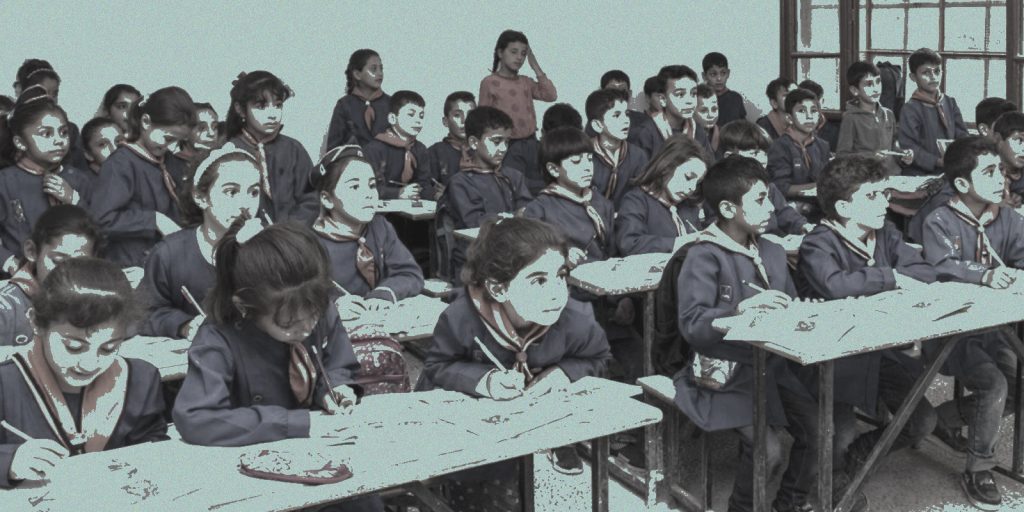
In a country still mending the wounds of a long war and seeking to define the features of a modern, inclusive state, a new debate has emerged over the future of education in Syria. After years of political and social fragmentation, signs have begun to appear of a growing tendency toward the “Islamization of schools,” meaning the introduction of strict religious and ideological content into curricula and educational institutions.
This shift, while seen by some as a step toward “values correction,” is viewed by others as a sign of society’s surrender to religious indoctrination and its retreat from defending education as a space for free thought and rational knowledge. At the moment when schools turn from places of learning into platforms for religious indoctrination, society faces an existential test: will the school remain the guardian of civic collective intellect, or will it become a tool for deepening division and reinforcing loyalties?
In this sense, the Islamization of schools does not appear merely as an educational policy, but as a reflection of the balance of power within society between those who defend a civic identity and those who seek to confine it within rigid religious frameworks.
Curriculum Transformations: From Ba’athism to Religion
At the beginning of the 2025/2026 academic year, the Ministry of Education in the Syrian Interim Government announced sweeping curriculum reforms. These included the removal of the “National Education” course, replacing it with “Islamic or Christian Religious Education,” which was added to the overall score of the high school certificate.
Minister Nadhir al-Qadri described the move as a “correction of the educational path,” while educational and human rights organizations considered it a transition from politicization to Islamization, a replacement of an authoritarian discourse with an ideological one that threatens intellectual pluralism.
The changes also included the removal of certain religious lessons, the alteration of moral content, and the erasure of historical symbols such as Zenobia and the Arameans. This reignited debate over the identity of education in Syria: should it be national and civic, or a new ideological tool?
Read also: What Education Should Syrian Children Receive at Schools?
Schools Between Loyalty and Identity
Educational systems in Syria today vary according to political control. In areas under the Autonomous Administration, local-language curricula are taught, while in regions governed by the Interim Government, the newly “revised” religious-oriented curricula have been adopted. Other areas continue to use older or locally edited curricula.
According to educational researchers, this diversity not only reinforces geographical fragmentation but also legitimizes intellectual and social separation among generations. Students in each region grow up with a different narrative of homeland, history, and religion.
The Islamization of Education and the Surrender of Society
Analysts argue that the “Islamization of schools” represents a dangerous regression from the notion of education as a national civic project. When education is reduced to a single religious dimension, it becomes a tool for shaping a submissive rather than critical collective consciousness. This trend reflects society’s surrender to the voice of ideology and its abandonment of the school as a free and independent institution. A society that allows knowledge to be monopolized in the name of religion or belief is effectively renouncing diversity and freedom, placing itself on a path toward internal division.
In this context, Syrian academic and researcher Dr. Talal Mustafa, based in France, stated in an interview with +963 that religious education in Syria must be distinguished between teaching religion as a moral and intellectual value and the Islamization of education as a political tool. He noted that the Syrian regime, under both Assad senior and junior, “used religious discourse for political purposes, whether to confront the Muslim Brotherhood in the 1980s or to contain public anger after 2011 by supporting religious institutes and faith-based organizations.”
Mustafa emphasized that having a subject for religious education in schools is natural and necessary, as is the case in European countries, “provided it is taught objectively and neutrally, and contributes to strengthening social and moral values rather than reinforcing sectarian or political divisions.”
He warned that prioritizing religious or sectarian identity in curricula leads to “the weakening of the concept of inclusive citizenship and the production of sectarian awareness among new generations, which threatens social coexistence and perpetuates division instead of building a civic consciousness founded on equality and rights for all citizens.”
Social and Cultural Implications
According to local educational reports, the outcomes of this orientation have begun to surface in several forms: “rising school dropout rates in certain areas due to parental fears of new ideological influences, a decline in scientific and critical education in favor of intensive religious studies, deepening sectarian and denominational divisions within a multi-identity society, and reduced educational participation of women and girls as a result of growing conservative religious discourse.”
Taken together, these indicators threaten to unravel the social fabric and turn schools into arenas of conflict rather than spaces for encounter and coexistence.
The Political Dimension of Education
Observers view the struggle over curricula as, at its core, a struggle over power and identity. Whereas curricula were once tools used by the Ba’ath Party to instill loyalty to the regime, they have now become arenas for competing religious and political movements.
In this context, researcher on regional security and terrorism Ahmad Sultan stated in an interview with +963 that there is a crucial distinction between Islamization and the imposition of a single religious sect or interpretation on society. He explained that Islam as a religion differs from the ideological conceptions some attempt to impose in its name.
Sultan said, “The Syrian people consist of diverse ethnic, sectarian, and religious components. Some are not Muslim, while others have their own intellectual orientations. Therefore, no single sect or uniform vision can be imposed on all Syrians.” He stressed that the current phase “requires a state-based approach, not that of a group or a party.”
He added that “Hay’at Tahrir al-Sham (HTS) must realize, as President Ahmad al-Sharaa stated, that the era of revolution has ended and the era of state-building has begun. The state is what encompasses all identities and embraces everyone without exclusion or discrimination.”
Sultan and Mustafa agree that imposing a strict religiously oriented educational system contradicts the idea of a shared national identity, but they differ in focus: Mustafa warns against the politicization of religion within schools, while Sultan emphasizes that “religious actors must understand that the state is the framework that unites all identities, and that imposing a rigid religious vision will produce negative outcomes at a time when Syrians most need unity, not division.”
Sultan explained that balanced religious education should aim at understanding, cultural enrichment, and respect for others’ differences, away from spreading hatred or fueling sectarian tensions. The danger of ideological Islamization lies in transforming religion into a political or intellectual tool serving a specific faction.
Read also: Who Has the Right to Issue Fatwas? Legislative Authority in Democratic Islam
In clear alignment with Mustafa’s position, Sultan affirmed that “religious values and intellectual pluralism can coexist in education and society,” noting that a proper understanding of Islam can provide a foundation for such pluralism. However, he cautioned against “framing religion in a rigid ideological mold imposed by force on everyone,” as that contradicts the essence of Islam, which is based on freedom and the rejection of coercion in belief.
The Path Toward an Inclusive Civic Education
From comparing the two perspectives, it becomes evident that Dr. Talal Mustafa and Ahmad Sultan agree on the need to insulate education from political or sectarian exploitation and to ensure that curricula promote citizenship and diversity rather than narrow religious loyalty. Mustafa focuses on the internal structure of the educational system and the mechanisms of curriculum design, while Sultan highlights the necessity of state neutrality toward religions and sects to preserve a unifying national identity.
Educational experts stress that protecting education from religious and political manipulation is a national priority. Building a cohesive society can only be achieved through curricula grounded in the values of citizenship, rationality, and tolerance, free from polarization, with civil society participation in shaping educational policies, and by restoring the school’s role as a space for dialogue and knowledge rather than an arena for ideological confrontation.
Thus, the “Islamization of schools” is not merely an educational issue but a mirror of Syria’s internal struggle. While some seek to reshape collective consciousness according to a single religious vision, others defend the school as the last bastion of free thought. Between these two paths lies the fate of an entire generation: education as a path to liberation and progress, or indoctrination as submission to the power of ideology.
As Mustafa emphasizes, liberating curricula from political and religious indoctrination and focusing on the values of science, citizenship, diversity, and pluralism could help rebuild social trust in post-war Syria.
Sultan concludes by warning that “fears of some forces evolving into a Sunni version of the ‘Guardianship of the Islamic Jurist’ model or a rigid religious state are legitimate,” calling on the transitional authority to respect Syria’s diversity and act in the spirit of an inclusive state that protects all citizens without discrimination.











