

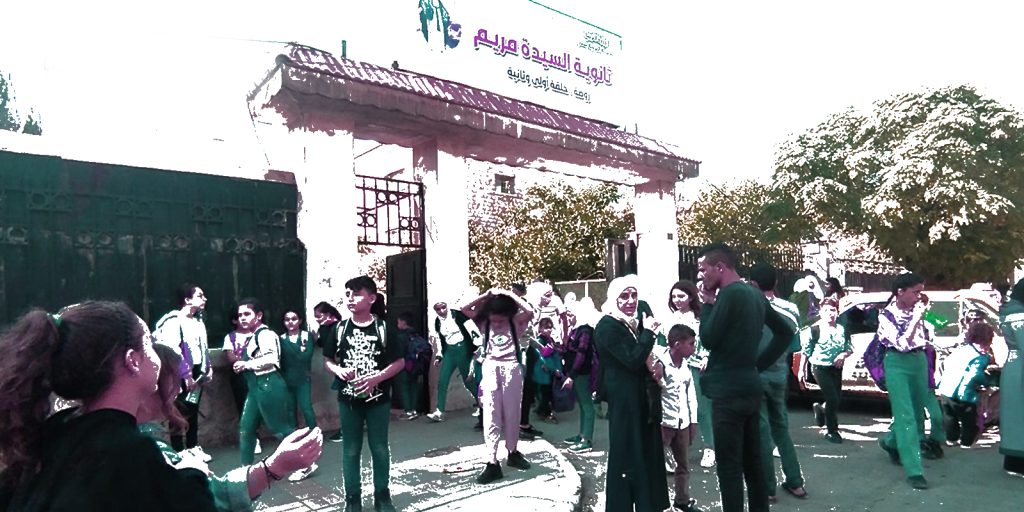
In Syria’s modern history, particularly after independence in 1946, the country witnessed numerous transformations in the education sector, an area considered vital in building society, especially after decades of colonial rule that left behind the need to reshape and reformulate curricula consistent with Syria’s history, diversity, and civilisation.
Educational reforms began as successive Syrian governments, between 1946 and 1960, sought to establish a national education system that would strengthen national identity and reduce the effects of the colonial era. Efforts were focused on expanding primary education in cities and villages, combating illiteracy, and reinforcing the principle of free education. However, these goals collided with a series of challenges, including political instability caused by repeated coups, which disrupted the continuity of long-term educational plans. Added to this were the widening educational gaps between urban and rural areas, a shortage of qualified teaching staff, and limited school facilities and equipment.
The most sensitive and critical phase came in the 1960s, when fundamental challenges emerged in building Syria’s education system. Over the following decades, education became a propaganda tool in the hands of the Arab Socialist Baath Party. Political slogans replaced critical thinking, as the ideology of Arab nationalism, socialism, and total loyalty to the president was entrenched. This was carried through curricula that, from primary to secondary stages, included “Nationalism” as a subject teaching Baath history, while schools and textbooks were filled with the regime’s images and symbols; the Baath flag, the president’s portraits, and party slogans.
After the fall of Bashar al-Assad’s regime, the Ministry of Education in the Syrian Transitional Government issued a decree setting the official curricula for the 2025–2026 academic year. The decision mandated the removal of all references and symbols linked to the Assad regime, especially in subjects such as Social Studies, Islamic Education, History, and Geography, while abolishing “National Education” entirely from the curriculum. This raised questions as to whether these changes are sufficient to move away from ideological education and build a system that represents all Syrians; regardless of sect or ethnicity. Hence the question: What kind of curricula should our children study in schools?
Mohammad Qadri, a Social Studies teacher in Damascus, told +963 that “this academic year marks a turning point in the curricula taught over fifty years of Baath Party rule. Rebuilding education as a vital institution within society is essential, and though difficult at first, it is not impossible.”
Read also: Who Has the Right to Issue Fatwas? Legislative Authority in Democratic Islam
“In the past, education in Syria relied on memorising political and nationalist slogans rather than understanding the subjects themselves. Teachers and professors were evaluated based on party loyalty and ideology rather than scientific competence. As a result, schools ceased to be true educational environments, while universities turned into factories producing graduates with paper qualifications but little relevance to the job market,” he added.
Qadri emphasised “the importance and necessity of removing political content from curricula, moving away from rote learning in the new education system, and ending repressive disciplinary methods such as corporal punishment and humiliation that were once common.”
For her part, lawyer Suheila al-Jabri, the mother of a preparatory school student in Daraa, stated that “curricula should move away from rote memorisation and towards digitalisation, something we hope to see soon.” She added in her remarks to +963: “The recent curriculum amendments are positive, but I believe education must also distance itself from both nationalist and religious biases, focusing instead on objective and balanced content.”
Journalist Mohammad Amin highlighted “the importance of respecting Syria’s ethnic and religious diversity across its geography when it comes to curricula, schools, and languages, something that was prohibited during the rule of Hafez and Bashar al-Assad. Recognising this diversity preserves equality among all citizens, as every community has the right to learn its own history and language.”
Amin concluded his statement to +963 saying that “it is possible to reach an agreement on unifying all educational curricula, which have multiplied since the 2011 popular uprising, in line with the principles and standards of UNESCO. This is essential to build peace and sustainable development in the country.”