


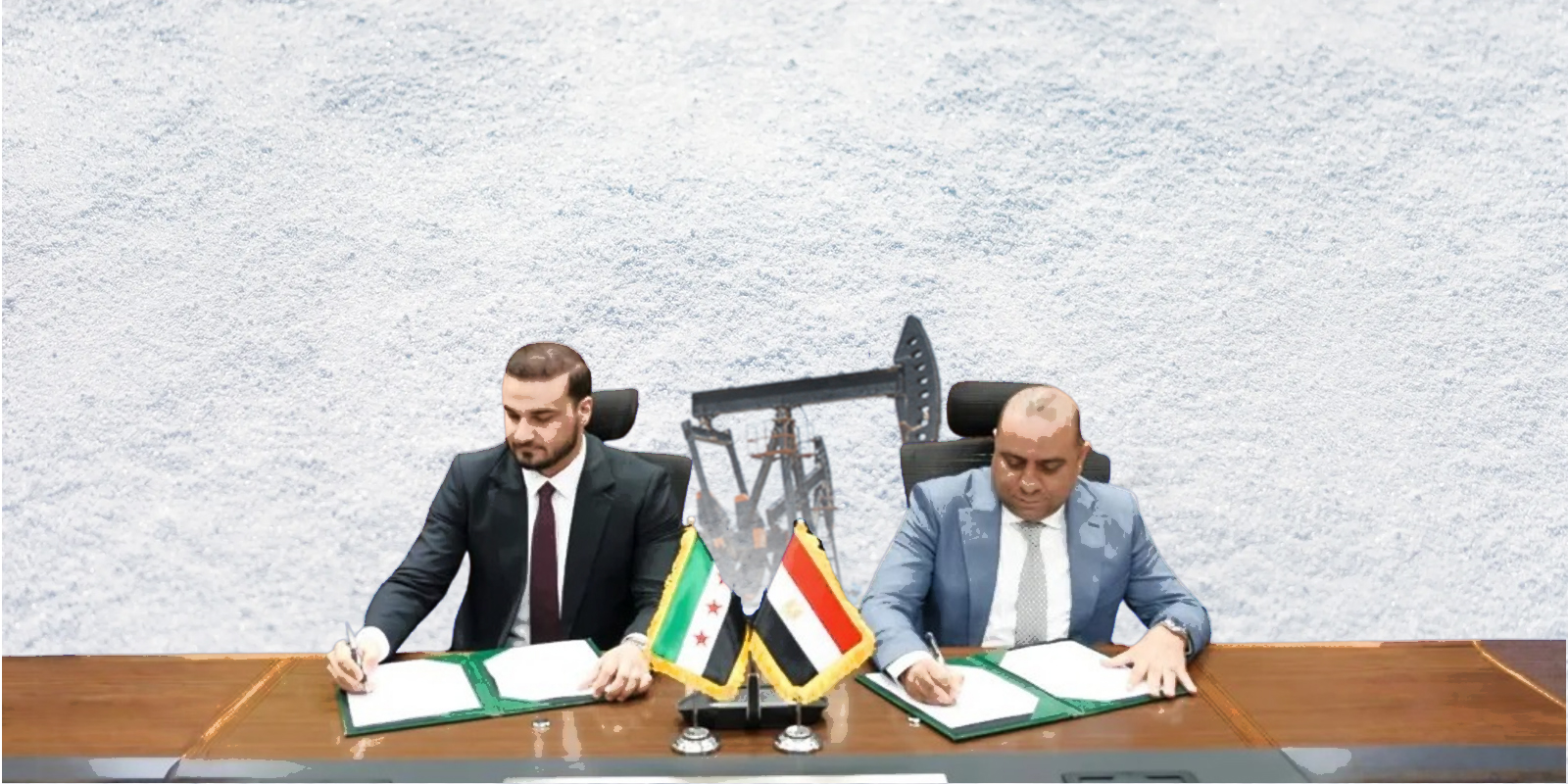
The signing of two memoranda of understanding between Egypt and Syria in the energy sector did not take place within a purely technical framework. Rather, it marked a step with clear political and economic dimensions, reflecting deeper shifts in how both states now view energy – not merely as a service commodity, but as an instrument of domestic stabilisation and regional repositioning. The issue at stake is not limited to natural gas deliveries or securing petroleum products, but extends to Syria’s gradual reintegration into the Arab energy system and the consolidation of Egypt’s role as a pivotal logistical hub in the Eastern Mediterranean and the wider Levant.
Energy as an entry point for re-anchoring the Syrian state
From a Syrian perspective, energy cooperation with Cairo is widely seen as a practical response to a severe and protracted energy crisis that has strained both society and the economy. At the same time, it represents a pathway towards restoring the state’s capacity to manage vital resources.
Dr Ahmed Qandil, Head of the International Relations Unit and the Energy Programme at the Al-Ahram Center for Political and Strategic Studies, argues in comments to +963 that this cooperation cannot be reduced to a temporary technical solution. Instead, he frames it as a geo-strategic entry point for reintegrating the Syrian state into emerging regional balances.
Qandil notes that Syria has endured what he describes as an “energy vacuum” in recent years – a condition that enabled the expansion of shadow economies and allowed non-state actors and external forces to penetrate service sectors, exacerbating security and social fragility. Re-centring energy management within a state framework, through regional supply systems underpinned by Egyptian infrastructure, could mitigate the structural risks associated with electricity and fuel collapse and reconnect essential services to state institutions.
This assessment is reinforced by Syrian academic and economic expert Imad al-Din Musbah, who tells +963 that energy in Syria has ceased to be a matter of service improvement alone and has become a direct tool of economic and social stability. Regular electricity and fuel supply, he argues, lowers production, transport, and service costs, eases public pressure, and grants the state greater manoeuvring space in managing the early stages of reconstruction.
Despite these strategic dimensions, Musbah cautions against underestimating the technical constraints. Expanding electricity generation is not solely contingent on gas availability, but also on the readiness of power stations and internal grids. Adding roughly 1,000 megawatts to Syria’s network – a meaningful increase capable of producing tangible impact – would require between 162 and 231 million cubic feet of gas per day, depending on plant efficiency. This wide range underscores the scale of the technical challenges involved.
Accordingly, Musbah stresses that energy agreements must be accompanied by concrete infrastructure rehabilitation programmes, as Syria’s energy crisis is multi-layered and cannot be resolved through fuel supply alone.
Egypt as a regional energy hub
On the Egyptian side, cooperation with Damascus fits within a broader strategic vision aimed at entrenching Egypt’s position as a regional energy hub. Qandil explains that this approach reflects an intersection of economic, geopolitical, and security considerations.
Economically, it allows Egypt to maximise the added value of its advanced infrastructure – from liquefaction and regasification facilities to gas transport networks – transforming them from static national assets into a cross-border regional platform that generates revenue through transit, storage, and re-export services, without resorting to costly subsidy schemes or high-risk supply commitments.
Geopolitically, Egypt’s positioning as an energy logistics centre provides Cairo with effective balancing tools against regional actors seeking to monopolise energy routes or weaponize them politically. This role acquires particular significance in the Syrian context, where Egypt is viewed as an organised Arab actor with lower polarisation and broader international acceptability than other regional players.
Added to this, Qandil notes, is the security dimension of energy. Egypt possesses accumulated institutional expertise in securing critical infrastructure and supply routes – a decisive factor in a region characterised by fragility and persistent instability.
Trade, integration, and the Arab dimension
From a strictly economic standpoint, Dr Osama Qadi, Senior Adviser at Syria’s Ministry of Economy and Industry, tells +963 that the agreement offers a genuine opportunity to enhance bilateral trade, which has remained modest over recent years. In 2024, trade volume did not exceed approximately USD 30 million and never surpassed USD 300 million at its peak – figures that fall short of the historical depth of relations and the economic potential of both sides.
Qadi highlights energy – particularly natural gas – as the strategic core of the agreement, recalling the Arab Gas Pipeline linking Egypt to Jordan, Syria, and Lebanon. With a designed capacity of around 10 billion cubic metres annually, the pipeline has been utilised only marginally. Reactivating it could strengthen Arab energy integration and open wider cooperation horizons, including cost savings for Lebanon if Egyptian gas transits through Syrian territory.
He considers the agreement historically significant, as Syria would become the first Arab state to import gas from Egypt. Previous obstacles, he notes, were largely linked to sanctions imposed on Damascus. With the easing of these restrictions and Syria’s gradual return to its regional and international environment, this strategic option has regained viability – albeit subject to Syrian–Lebanese understandings on outstanding issues such as financial deposits, detainees, and border management.
Read also: Kirkuk–Baniyas and Egyptian Gas: Syria’s Lifelines of Energy and Hope for Economic Recovery
Calibrated cooperation and political limits
Despite its positive implications, many observers characterise the current Egyptian–Syrian relationship as calibrated cooperation rather than full political normalisation. Qandil emphasises that Cairo approaches the Syrian file pragmatically, maintaining a relative separation between technical cooperation in vital sectors – foremost energy – and the broader political stance tied to the transitional process and complex security realities.
This view is echoed by former Egyptian ambassador to Damascus Hazem Khairat, who tells +963 that the agreement falls squarely within economic cooperation, grounded in Egypt’s standing as a regional energy supplier and the expertise Syria urgently requires. Khairat stresses that such cooperation does not necessarily signal a comprehensive political breakthrough, given ongoing reservations and expectations regarding territorial unity, civil peace, and counter-extremism commitments.
An open-ended horizon
Even with these constraints, analysts agree that the energy sector offers a politically low-cost testing ground for mutual benefit and confidence-building. Over time, it may open pathways to broader roles – from reconstruction to Syria’s integration into energy transition trajectories, including renewables and green hydrogen.
In this sense, the two memoranda of understanding are not merely agreements on gas and fuel supply. They represent a link in a wider process through which Cairo and Damascus seek to use energy as a tool for repositioning, preventing service collapse, and constructing more stable regional balances in a Middle East whose political and economic maps remain in flux.











