At a time when Syria is searching for realistic paths to emerge from its prolonged economic crisis of more than a decade, cross-border energy projects traversing its territory are reemerging as potential economic arteries that could restore some of its lost geopolitical and financial vitality. Among these projects, the Kirkuk–Baniyas oil pipeline and the Egyptian gas pipeline to Lebanon via Syria stand out as two central pillars in the new regional energy equation. Regional and international economic circles are closely watching these two strategic routes, which could restore part of Syria’s pivotal role as an “energy transit gateway” to the Mediterranean, reviving its position as an “energy transit hub” in the Eastern Mediterranean. This would give Damascus greater negotiating leverage with regional and international players.
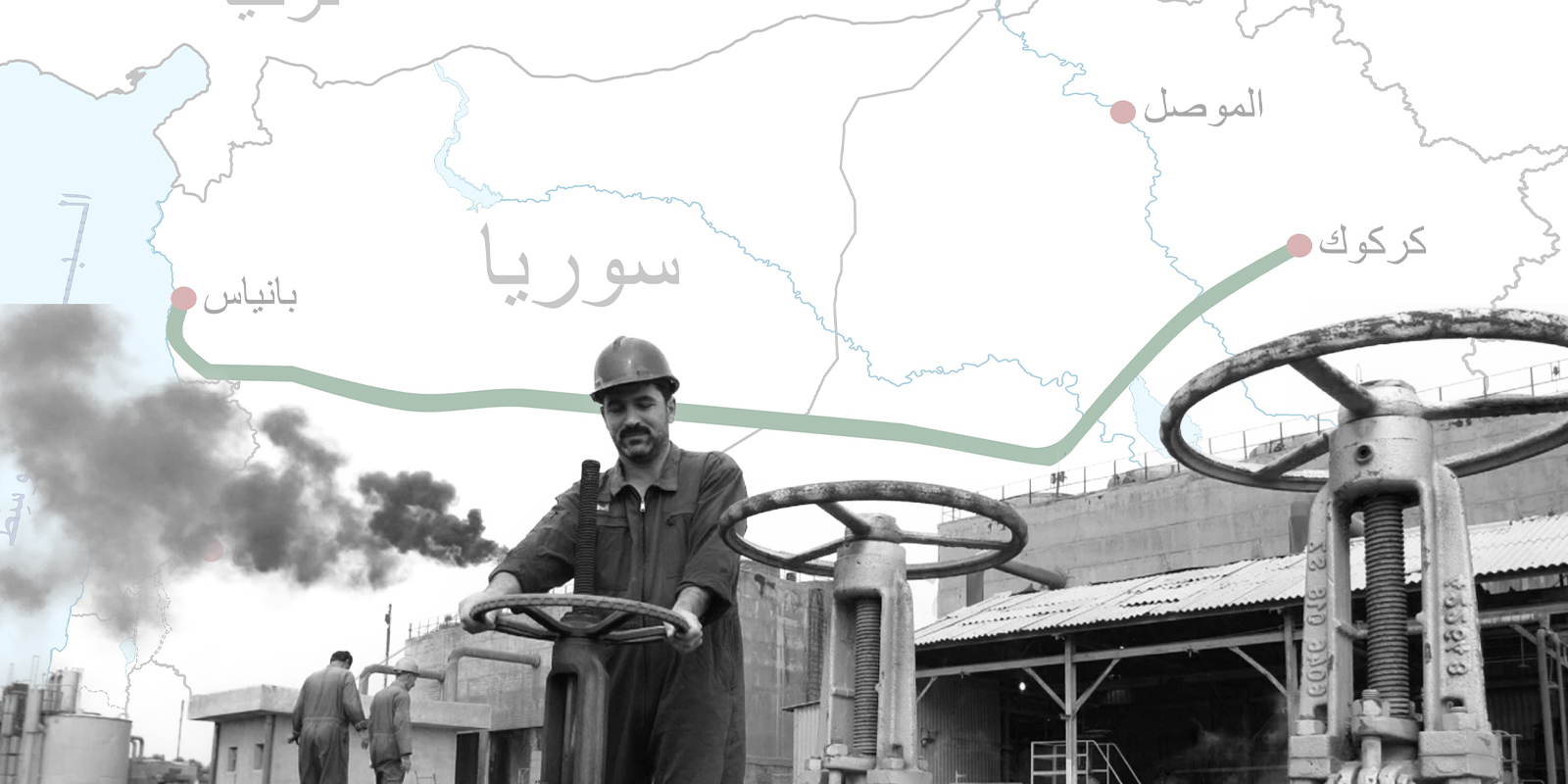
Breaking part of its political and economic isolation, the Kirkuk–Baniyas oil pipeline, originally built in 1952 over 800 kilometers to transport Iraqi oil from the north to Syria’s coast but suspended for more than two decades due to political and security tensions, and the Egyptian gas pipeline to Lebanon via Syria, are resurfacing as crucial projects. In the face of immense challenges to economic recovery, these are not merely commercial deals; they represent a wager on stability, investment attraction, and the generation of much-needed hard currency. They also seek to strengthen regional economic relations. The projects are expected to foster closer ties between Syria, Iraq, Egypt, Jordan, and Lebanon, potentially paving the way for joint ventures and expanded trade exchange.
Kirkuk–Baniyas Pipeline: The Pipes of Hope and the Return of an Old Lifeline
The Kirkuk–Baniyas pipeline is not a new project; its history dates back to the 1950s, when it was one of the main routes for Iraqi oil exports to the Mediterranean. The line has been inactive since 2003 following the Iraq War and suffered severe damage during the Syrian conflict. However, its revival today carries major economic implications, according to economic expert Adnan al-Jassim.
He stated in comments to +963: “Reactivating the pipeline would grant Syria substantial benefits as a receiving state, including transit fees estimated at around 150–200 million US dollars annually, in addition to the employment opportunities it creates and the activation of energy and transport infrastructure. These transit revenues would provide Syria with steady foreign-currency income that could help finance the public treasury. The line would also enable Syria to obtain Iraqi oil at preferential prices, reducing energy import costs, stimulating the local market, and supporting oil refining operations at the Baniyas refinery.”
Through this route, energy could be secured at lower costs while giving Syria direct access to a share of Iraqi oil, which would ease the country’s heavy import bill and reduce transportation expenses. This would alleviate pressure on Syria’s needs for vital petroleum derivatives required to operate essential facilities, according to al-Jassim.
Reviving the pipeline would further strengthen Syria’s position as a vital energy corridor in the region, activating its ports and expanding trade relations with Europe. The Baniyas port and its associated storage capacities would experience renewed activity, generating local investment and employment along the pipeline’s path and at pumping and maintenance stations. The port’s relatively ready infrastructure for oil export and storage enhances Syria’s status as a maritime energy corridor.
Moreover, al-Jassim highlights the geoeconomic significance of the project, expecting it to restore Syria’s historical role as a strategic energy transit hub. It would provide Iraq with an additional, shorter, and more efficient export outlet compared to alternative routes, deepening economic integration between the two countries. For Iraq, it diversifies export channels and secures oil exports at lower costs and higher efficiency, particularly as the country increases production.
The Importance of the Egyptian Gas Pipeline to Lebanon via Syria
Egyptian academic Mohamed Salah stated in comments to +963 that the agreement to deliver Egyptian gas to Lebanon through Syria is part of a broader Arab cooperation framework aimed at supporting stability and energy supply in both Lebanon and Syria. The project provides a sustainable and continuous natural gas source, helping Lebanon meet its energy needs while contributing to economic and social development in participating countries. It also revives Syria’s role as a facilitator in reactivating the Arab Gas Pipeline, potentially benefiting its economy through transit fees and the stimulation of gas-related infrastructure. The project could ease Lebanon’s energy crises and enhance regional integration within the energy sector.
Salah believes that both projects will impact investment, development, and economic recovery in Syria. Together, they represent significant economic lifelines to support reconstruction and growth plans by stimulating the energy sector, creating jobs, and boosting government revenues. Improved energy availability would enhance the investment climate and encourage new industrial and logistical ventures. The revitalization of Baniyas Port and surrounding industrial zones would reinforce Syria’s capacity to act as a regional hub for trade and energy in the Mediterranean. Furthermore, cooperation with neighboring countries in these projects would stabilize Syria’s economy and strengthen its regional economic ties.
Main Obstacles
Al-Jassim warns that political and security tensions in the region, especially in Syria and Iraq, undermine the stability required to implement and develop such projects. External threats, including potential military strikes within Syrian and Iraqi territories, contribute to instability. Some regional actors continue to oppose Syria’s reintegration into the regional energy network, setting political conditions for cooperation. Moreover, international sanctions, particularly the Caesar Act on Syria, complicate financing and the shipment of necessary equipment and services. High-level technical and logistical coordination among the involved countries is also required to ensure infrastructure readiness and schedule alignment.
There is also an urgent need for large-scale investment to rebuild roads, railways, ports, and various transport stations, amid shortages of equipment and skilled technical personnel. The conversion of some key facilities into military sites during the conflict has resulted in significant infrastructure destruction. Heavy reliance on single-source pipelines or routes also increases vulnerability to disruptions.
Al-Jassim stresses the need to renegotiate transit fees and costs, particularly concerning the Kirkuk–Baniyas pipeline between Iraq and Syria, to enhance profitability and ensure sustainability. Ultimately, these two projects represent vital economic arteries for Syria’s recovery phase, providing strategic energy supplies and investment opportunities. Yet, they face political and technical challenges that must be overcome to ensure their sustainability and the realization of their intended developmental and economic benefits. These projects remain, however, part of a longer process requiring genuine financial, administrative, and legislative reforms to attract investment and secure long-term returns.
Salah, in turn, highlights ongoing security and geopolitical challenges. The uncertainty of Syria’s political and security environment affects the stability of project implementation, while the risk of a resurgence of terrorist groups such as ISIS in areas along the routes threatens both project safety and worker security during construction and operation.
The Kirkuk–Baniyas pipeline, in particular, crosses regions that have experienced security unrest, raising concerns about protecting the line and ensuring uninterrupted oil flow. Moreover, regional power balances among the project’s stakeholders, namely Iraq, Syria, Lebanon, Egypt, and Jordan, reflect diverging political interests. Technical and financial challenges also persist, as the long-inactive Kirkuk–Baniyas line requires comprehensive technical evaluation and potentially new or alternative pipelines, with initial costs amounting to billions of dollars.
He adds that rehabilitation and operational work will require substantial financing, which may be difficult to secure under current economic conditions, alongside the need for long-term and reliable contracts to guarantee feasibility. In conclusion, the revival of the Kirkuk–Baniyas pipeline and the completion of the Egyptian gas pipeline do not constitute a magical solution to all of Syria’s problems, but they offer a powerful lever for economic recovery. The success of these projects depends on the ability of the involved parties to overcome security, financial, and political challenges and to develop regional and international mechanisms that exempt humanitarian and developmental energy projects from the repercussions of political tensions and sanctions. If effectively directed toward development rather than political entanglement, these pipelines may prove to be more than just conduits for energy, they could indeed become pipelines of hope.