


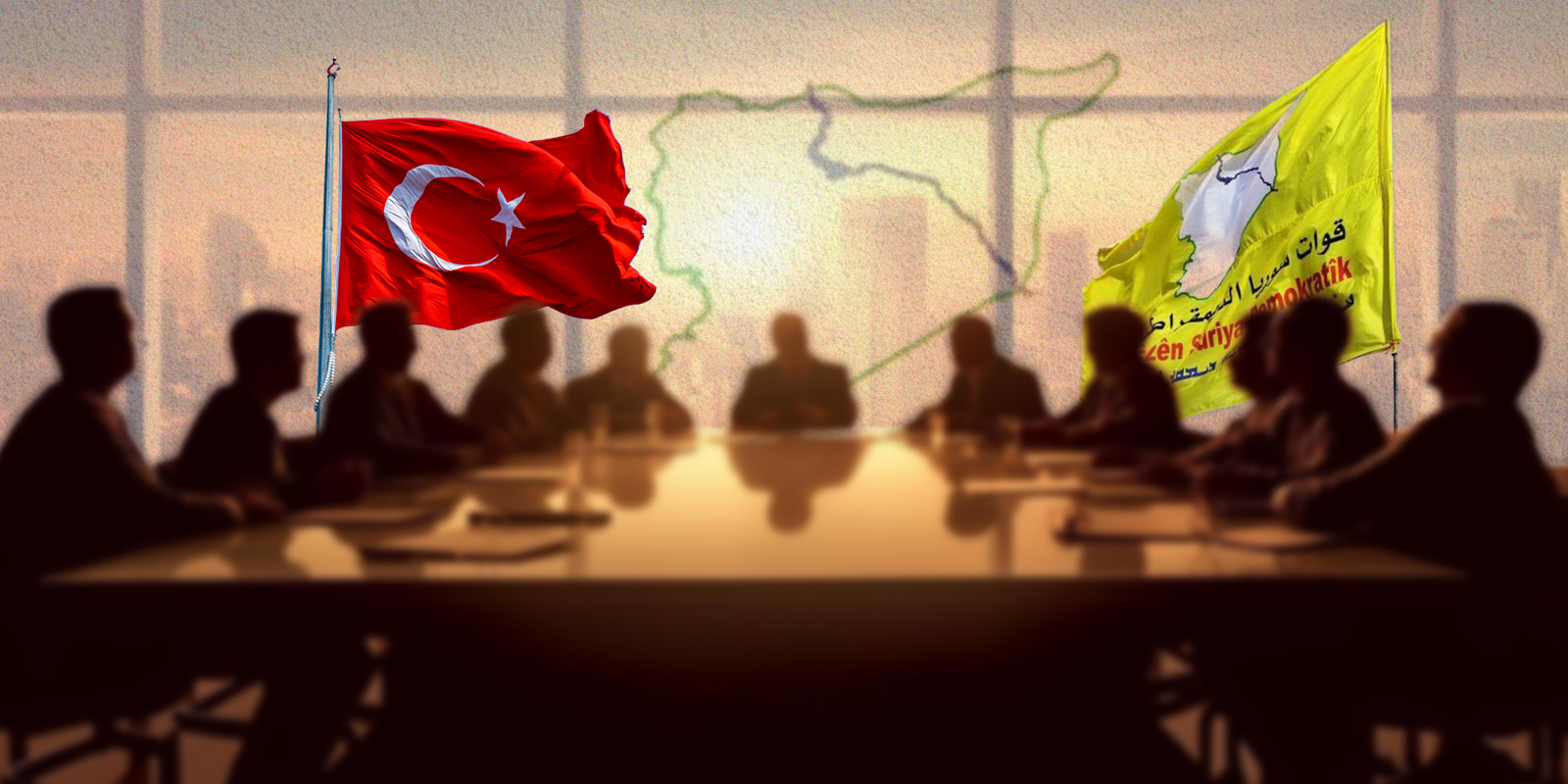
Recent leaks and reports suggest that high-level meetings have taken place between Turkey and the Kurdish-led Syrian Democratic Forces (SDF), sparking questions about whether these talks could bring lasting change to Northeast Syria; a region long at the centre of Syria’s most complex conflicts.
U.S. Special Envoy to Syria Thomas Barrack confirmed last week that direct discussions are underway between SDF commander Mazloum Abdi and Turkish Foreign Minister Hakan Fidan, with the backing of President Recep Tayyip Erdoğan and the involvement of senior officials such as Ibrahim Kalin. The stated goal: building trust and avoiding renewed clashes.
According to U.S. reports, the dialogue covers highly sensitive issues, including the fate of ISIS detainees, the future of the U.S. presence in Northeast Syria, and the possibility of integrating SDF forces into a new Syrian army.
Motives and Implications
Dr. Asif Melhem, director of the GSM Research Center, told +963 that Turkey has threatened military action if the SDF fails to implement the March 10 agreement. Yet Ankara also knows that any large-scale offensive would meet firm U.S. opposition; especially given recent signs of greater American flexibility.
This, Melhem argues, is what pushed Ankara to pursue direct talks with the SDF; to avoid clashes that could complicate not only its relations with Syrian Kurds but also with Washington.
He adds, “Turkey is portraying the SDF’s refusal to join a new Syrian army as the main obstacle to a political settlement. But this is more of a pressure tactic, since the SDF is unlikely to accept integration without strong guarantees, especially after years of massacres against Syrian minorities, including Druze and Alawites.”
Damascus, Malham notes, is watching these talks closely and may try to exploit any rift between Ankara and the SDF. Yet the regime remains the weakest player in a game dominated by Washington, Moscow, Israel, and Turkey; each competing to protect its interests in Syria. He highlights growing Russian interest in eastern Syria following the Caucasus conflict, which may align with Israeli aims but clash with U.S. and Turkish priorities.
Ultimately, Malham concludes, “Turkey’s stance on the Kurdish question has not fundamentally changed; Ankara still seeks to disarm and weaken the Kurds politically, fearing that any organized Kurdish power in Syria will inevitably spill over into Turkey. The rhetoric of ‘political solutions’ and ‘stability’ is, in his view, a cover for this strategic goal.”
Still, he believes the dialogue will not collapse so long as Washington remains directly or indirectly involved, since the U.S. can pressure all sides; including Damascus; toward compromise and prevent escalation.
Also read: Turkey and the Syrian Kurds: Toward a New Chapter of Strategic Cooperation?
A Different Reading
Syrian political analyst Iyas al-Khatib offers a different interpretation. He argues that Turkey is now more compelled than ever to sit at the table with the SDF, for two main reasons.
First, increasing Israeli pressure leaves Ankara with only two options; a final peaceful settlement or direct military confrontation; something Turkey can ill afford. Second, Turkey’s local proxies in Syria, including Islamist factions dominant in Damascus, have suffered serious losses, most recently in Suwayda. As a result, Ankara has realized that its proxy strategy has failed and that the international community is moving to phase them out.
Al-Khatib says Turkey can no longer stall or rely on half-measures. Yet Ankara still approaches negotiations with a tone of superiority, always brandishing the threat of military action. This posture, he warns, could drag Ankara back to square one, risking direct confrontation with an SDF backed by the U.S.-led coalition and Israel.
A “New Reality”?
Al-Khatib stresses that the SDF itself is no longer what it once was; it has matured politically and militarily through its institutions; the SDF and its political wing, the Syrian Democratic Council. It is unwilling to accept piecemeal solutions or temporary deals, instead demanding concrete guarantees for its autonomy and recognition of its self-administration.
Short-term fixes, he argues, no longer protect the Kurdish project. This makes a decisive outcome unavoidable, while Turkish reliance on delay tactics and pressure has become outdated.
He warns that if Ankara continues its condescending approach, while threatening military action, it will only suffer repeated setbacks in Syria; and may even see its entire regional project collapse.
Should Turkey return to “square one,” it could face direct confrontation with a disciplined force backed by the U.S.-led coalition, while other global powers remain deliberately silent, increasingly eager to sideline Ankara’s Syrian proxies. This, al-Khatib suggests, could accelerate broader change in the Syrian political order, entrenching new realities of division and self-rule.
Between Settlement and Confrontation
The trajectory of Ankara–SDF negotiations appears caught between two paths: the possibility of compromise or the risk of confrontation. Analysts broadly agree that the outcome hinges on whether Turkey can adapt to rapidly shifting geopolitical realities, or whether it clings to policies that may ultimately cost it dearly in the Syrian conflict.











