


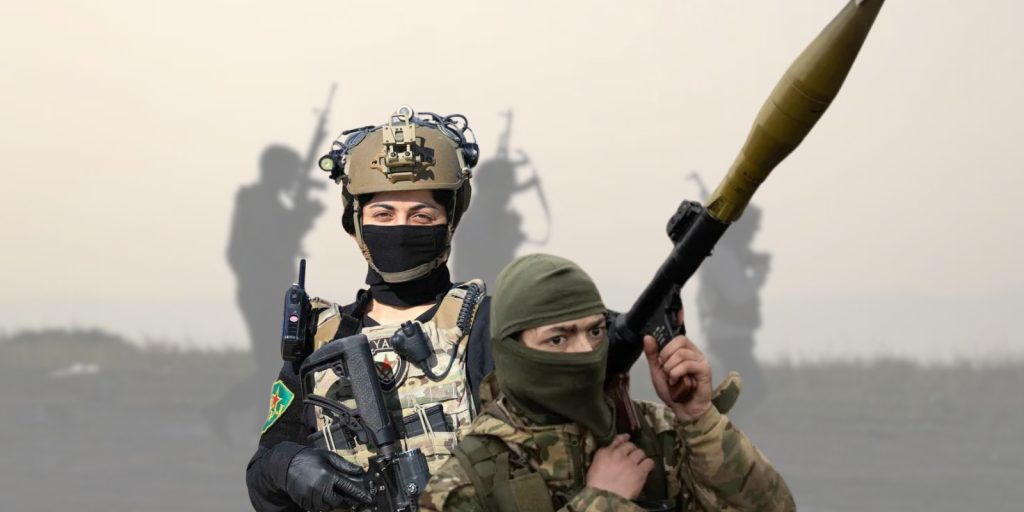
Syria’s formal decision to join the international coalition against ISIS during the visit of interim President Ahmad Al-Sharaa to Washington on 10 November marked a pivotal moment in the country’s post-war trajectory. The step came more than a decade after the coalition was formed and began operating on Syrian territory, primarily in cooperation with the Syrian Democratic Forces (SDF), its key local partner.
Syria’s accession paves the way for a new phase in the fight against ISIS and the pursuit of its remaining cells. It also raises broader questions about whether this development could help unify Syrian decision-making on counter-terrorism and unlock other stalled political and security files that have shaped the country’s crisis for more than 14 years.
Following the meeting between Trump and Al-Sharaa in Washington, US Special Envoy to Syria Thomas Barrack said in a post on X that Syria had officially joined the international coalition. He described the move as a historic framework symbolising Syria’s transition from a source of terrorism to a partner in combating it. Barrack added that the interim government would actively help dismantle ISIS cells as well as other networks, including the Iranian Revolutionary Guard, Hamas and Hezbollah, positioning Syria as a committed partner in global efforts to promote stability.
The SDF, which defeated ISIS militarily in its last stronghold in eastern Deir ez-Zor in 2019 alongside the coalition, welcomed Syria’s decision to join the alliance. The group reaffirmed its commitment to pursuing ISIS cells and preventing the organisation from reorganising, stressing its readiness to enhance cooperation with all parties fighting terrorism in the interests of regional and international security.
It is hoped that Syria’s membership in the coalition could help resolve other unresolved issues, including the 10 March agreement between the transitional government and the SDF. The agreement envisions the SDF’s integration into the Syrian army, allowing the state to benefit from the group’s accumulated experience in fighting ISIS over the past decade. The United States has repeatedly argued that integrating the SDF into Syrian state institutions is a crucial step towards transforming the fight against ISIS into a comprehensive national effort.
Integration as a national interest
Journalist and political researcher Hussam Najjar, based in Poland, told +963 that integration between the Syrian army and the SDF is first and foremost in Syria’s national interest. He argues that while fighting terrorism is not an end, it is a necessary and temporary objective aimed at clearing Syrian territory of extremist threats and allowing the country to focus on development and regaining its geopolitical role.
Najjar stresses that integration should not be hindered by procedural details but rather viewed as a foundation for rebuilding and protection. He adds that unification would create a strong front against ISIS, given the coordination between two forces that have both fought the organisation at different levels. Proper sectoral deployment and prior assessment of ISIS tactics, he says, would significantly improve efforts to eliminate sleeper cells.
Read also: Has the War Against ISIS Changed?
Unifying forces against terrorism
Kadar Berri, director of the “Kurds Without Borders” Foundation, emphasises to +963 the importance of unifying Syrian forces in the fight against terrorism. He notes that the SDF possesses substantial operational capabilities in this field and that cooperation should begin with intelligence-sharing between the SDF and the transitional government.
However, Berri warns that the government currently lacks the capacity to combat terrorism effectively on its own, pointing to what he describes as internal vulnerabilities, including figures and groups still classified as extremist. He argues that intelligence cooperation with the SDF could help build confidence between Syrian parties and lay the groundwork for a future national army representing all Syrians.
Last week, US Central Command (CENTCOM) launched a major military campaign against ISIS in Syria under the name Operation Eagle Eye. The operation targeted more than 70 ISIS sites across Deir ez-Zor, Raqqa and Homs provinces, using fighter jets, helicopters and artillery to strike infrastructure and weapons depots with precision.
Understandings and defining the relationship
Wael Alwan, a researcher at the Jusoor for Studies, believes that the fight against terrorism could help facilitate understandings between the interim government and the SDF – or at least lead to a more normalised working relationship. However, he argues in a statement to +963 that counter-terrorism alone is insufficient to achieve genuine unity or full integration between the two sides.
Alwan explains that cooperation in this field would strengthen joint mechanisms and communication channels, all under full US supervision. In his view, Washington will remain the key actor regulating the pace and scope of cooperation. While counter-terrorism efforts could reinforce broader negotiations, particularly those linked to the March 2025 agreement, he stresses that full integration requires progress across multiple political and institutional tracks.
Najjar, meanwhile, argues that the Syrian army’s participation in the coalition significantly strengthens efforts against ISIS. He says the organisation is now being pursued by all sides, limiting its ability to hide or manoeuvre. The coalition’s strength, he adds, lies primarily in intelligence-sharing, logistical support and air-assault operations in difficult terrain – capabilities that could facilitate closer coordination between the army and the SDF.
Read also: Adnan Al-Kinani to +963: ISIS on Its Last Breath in Syria
Positive repercussions
Berri notes that the interim government has been clear from the outset that it cannot fight terrorism alone on the ground and will rely on intelligence cooperation. He believes this approach could have positive spill-over effects on other files, including the full implementation of the 10 March agreement, not only the clause on SDF integration but also broader questions related to the shape of the Syrian state.
CENTCOM said last week that US forces and their Syrian partners have carried out around 80 counter-terrorism operations since July, resulting in the arrest of 119 individuals and the killing of 14 ISIS members. CENTCOM commander General Brad Cooper said these operations were critical to preventing ISIS from reorganising and posing a renewed global threat, pledging continued cooperation with Syrian partners.
For its part, the SDF announced that it had dismantled an ISIS cell in the village of al-Hassan in western Deir ez-Zor, citing precise intelligence and sustained monitoring. In a statement published on Facebook, the group praised US and coalition air and missile strikes during Operation Eagle Eye, describing them as a decisive blow to ISIS hideouts in eastern Syria.











