


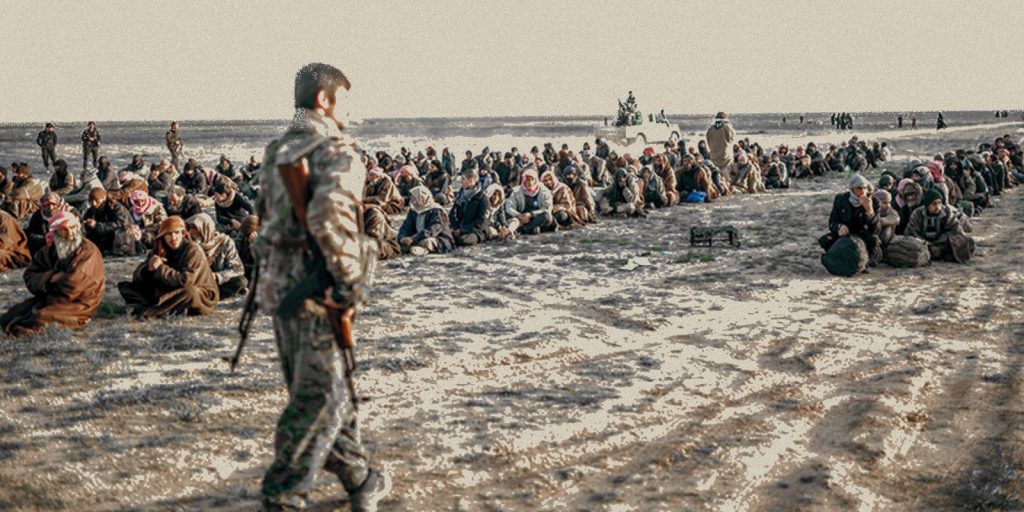
More than a decade after the rise of ISIS and the collapse of its so-called “caliphate”, the group has not disappeared from the Syrian landscape. Instead, it has returned in a different form – quieter, but more complex. By late 2025, the confrontation with ISIS appears to have entered a new phase, marked by the group’s shift from territorial control to network-based activity, and from open battles to hit-and-run attacks. This transformation has been enabled by Syria’s open geography, security fragmentation, and the political transition underway following the fall of the former regime.
In recent months, Syria’s central desert and steppe regions – particularly around Palmyra – have seen a noticeable increase in ISIS attacks and ambushes, one of which killed American and Syrian soldiers. These developments prompted the United States to launch a large-scale air campaign under Operation “Hawkeye Strike”, targeting dozens of ISIS sites. At the same time, Syrian forces and security agencies intensified operations inside cities, aiming to prevent sleeper cells from expanding into populated areas.
Yet these military and security actions are unfolding within a broader and more complex context. Syria’s new administration is attempting to rebuild state institutions, unify armed factions, and redefine its relationship with the international coalition and regional actors. This raises a central question – are security strikes enough to contain ISIS, or has the battle become inseparable from the deeper challenge of state-building and political stability?
The limits of a security-only approach
Dr Rami al-Khalifa al-Ali, journalist and researcher in political philosophy at Paris University, tells +963 that relying on security measures alone will not be sufficient to eliminate ISIS. He argues that the confrontation cannot be reduced to a purely security dimension but must involve a comprehensive approach operating on several levels.
ISIS, he explains, benefited greatly from the absence of the state and from the weakness and collapse that followed the dismantling of the Iraqi state after the invasion, alongside other contributing factors. A strong and just state, combined with political stability, remains essential to fully dismantling extremist ideology – including ISIS itself.
From a similar perspective, Egyptian researcher and terrorism specialist Mostafa Amin Amer stresses that regional cooperation lies at the heart of the battle. He tells +963 that eliminating ISIS and extremist elements in Syria cannot be achieved without genuine regional coordination, particularly in the sensitive issue of foreign fighters, which requires broad cooperation among neighbouring states.
US military operations: continuity rather than change
Regarding the American role, al-Ali argues that current operations do not represent a sharp break with the past. Air strikes and occasional ground operations targeting wanted radical figures have long been part of US policy and were primarily carried out by Washington even in earlier phases of the conflict.
He adds that the recent US strikes against ISIS reflect continuity rather than a fundamental shift in strategy.
Amer provides a more detailed assessment, noting that the United States has not altered its reliance on air power as a central tool. Ground presence remains limited to targeted raids, such as those that led to the killing of Abu Bakr al-Baghdadi and his successors. The recent escalation, involving dozens of air strikes, came primarily in response to the killing of US soldiers. He adds that the publicly announced figures serve domestic American opinion, while details about damage and casualties on the ground remain unclear.
Read also: Does the International Coalition Have a Strategy to Fully Defeat ISIS?
Political shifts: from isolation to engagement
Alongside the military track, political developments are emerging as a decisive factor reshaping the confrontation. Al-Ali points to a notable shift at the political level, namely renewed cooperation with Damascus.
He explains that such cooperation was impossible under the previous regime but has become feasible due to the pragmatic approach adopted by Ahmad al-Sharaa in managing the current phase. According to al-Ali, recent political changes have significantly altered Syria’s position, and without them, Syria would not have re-entered the regional and international arena.
He adds that Syria’s decision to join the international coalition against ISIS fits within a broader effort to reintegrate into the Arab world and the international community, and to rebuild the country in cooperation with regional partners, particularly Gulf states.
Unifying factions: a difficult internal test
Internally, Al-Ali links the success of the fight against ISIS to the broader process of institution-building. He notes that Syria has begun taking serious steps to move away from factionalism towards a state-building project.
This includes efforts to change conflict dynamics by containing and dissolving armed factions through their integration into a unified Syrian army and unified security forces. He argues that recent measures by the new administration indicate progress in this direction, and that this path could significantly reshape Syria’s cooperation with external actors and strengthen its role in confronting ISIS and extremist ideology.
Regional roles: cooperation gaps and conflicting interests
Amer, however, offers a more critical view of the regional landscape. He argues that Turkey’s role in the conflict is not neutral or objective but driven by specific interests. According to him, Ankara approaches the conflict less from a counter-terrorism perspective and more to weaken Kurdish forces within Syria.
He also points to Turkey’s influence within Syrian armed formations through allied factions. By contrast, Amer describes Iraq and Jordan as key actors – Iraq due to its direct experience fighting ISIS, and Jordan because of its strategic and logistical importance, particularly in southern Syria.
On ISIS’s own behaviour, Amer argues that recent political developments have reinforced the group’s determination to expand its operations inside Syria. He says that the new Syrian administration’s decision to join the international coalition has provided ISIS with additional motivation to escalate its attacks.
According to Amer, ISIS is now operating on two parallel tracks – one involving intelligence cooperation aimed at dismantling its cells, and another marked by the expansion of its operations and tactics. He warns that the group is redeploying its networks across much of Syria and retains the ability to carry out future attacks, including by recruiting lone-wolf actors from within security institutions.
He concludes by warning that Syria’s fragile security structure remains vulnerable to infiltration and radicalisation, making the next phase of confrontation more complex and potentially more dangerous.











