


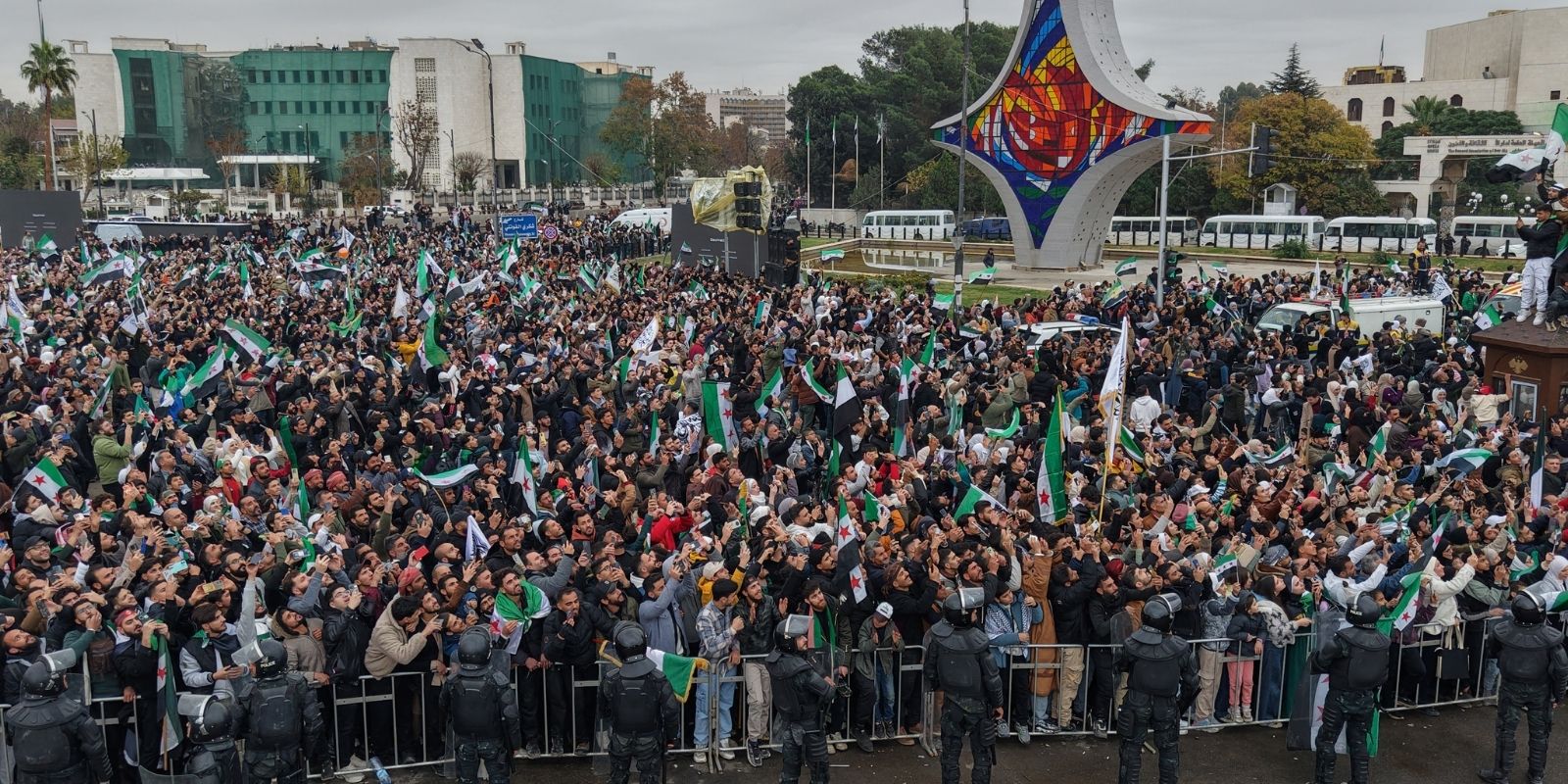
Damascus. Syrians mark today, Monday, the first anniversary of the fall of Bashar al-Assad’s regime on 8 December 2024, an event that represented a significant turning point and the beginning of a new chapter in the country’s history after decades of Assad family rule and more than fourteen years of war that destroyed much of Syria’s resources, claimed hundreds of thousands of lives, and left millions displaced or seeking refuge. Yet the country remains in a transitional phase confronting major challenges on all levels.
Public celebrations
“Umayyad Square” in the Syrian capital Damascus, the city of Aleppo in the north, and several districts in central Homs witnessed gatherings of hundreds of citizens on Sunday evening to commemorate the first anniversary of the regime’s fall. The capital and numerous other cities are expected to see celebratory marches, one year after Assad fled to Russia and the opposition, led by current interim president Ahmad al-Sharaa, seized control of Damascus. Al-Sharaa visited the Great Umayyad Mosque in the capital at dawn on Monday and delivered a speech before a large crowd of citizens while wearing military attire.
Military operations under the name “Deterrence of Aggression,” launched by Hay’at Tahrir al Sham (HTS) along with allied Syrian opposition factions, led to the collapse of Bashar al-Assad’s regime on 8 December. These operations had begun on 27 November 2024 from the countryside of Idlib and Aleppo, advancing into Aleppo, Hama, Homs, and the capital Damascus.
Deep divisions
Despite a year having passed since the fall of Bashar al-Assad’s regime, the country continues to face profound social and military divisions. The transitional phase has yet to evolve into full stability amid a wide array of challenges and a web of complex and overlapping issues, compounded by delays in producing solutions or defining a clear national framework for matters such as transitional justice, economic recovery, reconstruction, participatory governance, and the shape of the political system.
The Autonomous Administration of North and East Syria issued a statement on Sunday marking the anniversary of the regime’s fall, calling for the entrenchment of justice, freedom, equality, and democracy, and for launching a serious and comprehensive national dialogue among all representatives of the Syrian people, ensuring the safe return of the displaced and refugees, and activating rapid mechanisms to achieve the aspirations of Syrians across all fields.
It said that “the current phase requires all Syrian parties and the international community to intensify efforts so that Syria becomes a genuine platform for freedom, democracy, justice, and equality,” stressing “the need to adopt an inclusive and participatory national policy that guarantees the building of a new homeland deserving of all Syrians without exception.” This came after a previous statement in which it had prohibited celebrations in areas under its administration due to potential security threats.
The Syrian Democratic Council (SDC) issued a statement on Monday declaring that “the fall of the Baathist regime was a historic event and marked a major turning point in the trajectory of Syria and its people.” It emphasized “the immediate need to begin a clear and binding democratic transition in accordance with international resolutions, foremost among them Resolution 2254 and Resolution 2799,” and stressed that “the success of Syria’s democratic transition requires broader participation from the forces of society.”
Read also: A Year of Tests After “Deterrence of Aggression” Battle
Constitutional declaration and a government
Nearly four months after the regime’s fall, the Syrian interim president formed the interim government of twenty three ministers in late March, following the issuance of the constitutional declaration earlier that month. This marked the launch of a new phase for Syria, which, according to government officials, is based on opening up to the region and the world and pursuing balanced policies away from alliances. However, this new orientation faces major challenges that place on the country even greater responsibilities, amid cautious Western openness toward it and the start of lifting economic sanctions in preparation for reconstruction.
Indicators suggest that Syria has begun to gradually regain its regional standing after the regime’s collapse, yet it continues to suffer from numerous internal issues and remains a site of regional and international competition for influence. This complicates its full reintegration into the international community, especially with the continued delay in concluding a security agreement with Israel, ongoing Israeli military strikes, expanding Turkish influence, and the Russian presence at two military bases along the Syrian coast.
On the occasion of the first anniversary of Bashar al-Assad’s fall, UN Secretary General António Guterres issued a statement affirming that “the future of Syria is not limited to political transition but represents an opportunity to rebuild shattered communities, heal divisions, and construct a homeland in which every Syrian can live regardless of ethnicity, religion, or gender.”
Guterres said that “the challenges in Syria are significant but not insurmountable, as the past year demonstrated the possibility of real change when Syrians are empowered and supported to lead the transition themselves.” He noted the “continued immense humanitarian needs in Syria,” yet highlighted “remarkable progress in essential services, expanded humanitarian access, and the preparation of pathways for the return of refugees and displaced persons.” He urged the international community “to stand firmly behind this Syrian led transition by respecting Syrian sovereignty, removing obstacles to reconstruction, funding humanitarian appeals, supporting economic development, and ensuring that the benefits of transition reach the Syrian people in tangible ways.”
Last Saturday, Ghazal Ghazal, head of the Supreme Alawite Islamic Council in Syria and the diaspora, called for a nationwide general strike across all sectors for five days from 8 to 12 December. In a statement posted on Facebook, he said that “the transitional Syrian government seeks to celebrate replacing an unjust regime with one more unjust,” arguing that “the pressures imposed on civilians, from threats to livelihoods to dismissals from work, arbitrary transfers, coercion, and intimidation, are aimed at forcing people to participate in celebrations held over the blood and suffering of victims while blatantly ignoring the deep wounds inflicted over the past years.”
Violence
During the year following the regime’s fall, Syria witnessed scattered incidents, shifting dynamics, and acts of violence that hindered progress in rebuilding the state and deepened social divisions. The most prominent were acts of violence in coastal areas that resulted in the killing of more than one thousand civilians from the Alawite community, following an attack by former regime loyalists on security and government sites that left several members of the Interior Ministry’s internal security forces dead.
The southern province of Suwayda also witnessed military operations and similar acts of violence after an assault by forces of the Ministries of Defense and Interior of the transitional government in July, which resulted in the killing of more than one thousand civilians and the displacement of hundreds of families. This was accompanied by Israeli interventions and airstrikes on Syrian areas including the General Staff headquarters in Damascus, before a ceasefire agreement was reached under American and Jordanian auspices.
A year after the fall of the regime, Syrians hope to embark on a new stage of political, security, and economic recovery, the restructuring of a national army, and the building of an integrated economy, especially after the United States, the European Union, and several other countries lifted sanctions imposed since the era of the deposed regime. The United States Congress is also moving toward a complete lifting of the “Caesar” sanctions after incorporating a bill to this effect into the upcoming year’s defense budget.











