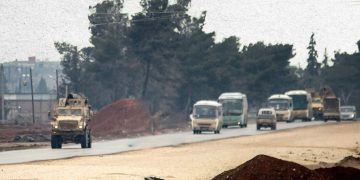



For many Syrians, the year that followed the “Deterrence of Aggression” battle, that was launched by Hay’at Tahrir Al-Sham in Idlib in northwestern Syria and led to the collapse of the former Syrian regime under Bashar Al-Assad in Damascus, has turned into a political, social and military test for the new system of governance, and for the ability to transform a major military moment into a unifying national path. Between the promises of a new phase and the reality that emerged later – marked by delays in building effective governance institutions capable of holding together a fractured geography – a central question has resurfaced: what remains of that moment, which was presented as a founding step for a new Syria?
The question is raised as an attempt to assess a full year in which the interim authority has struggled to produce a political project capable of forming a clear social contract or establishing shared rules for managing the country. At the same time, it is impossible to ignore that the challenges facing Syria today are cumulative, the product of years of fragmentation, and larger than any single government or faction. Still, it remains entirely legitimate to evaluate the performance of the transitional authority from an institutional perspective – especially when it comes to state-building.
Over the past year, military structures have emerged as one of the most sensitive issues. Instead of turning the results of the operation into leverage for unifying military decision-making, differences and overlapping authorities have appeared, with occasional dual command structures, particularly in highly sensitive areas such as the coastal region last March, or in Suwayda in July.
In the north-east, the security environment continues to operate through complex arrangements built over many years, where local structures coexist with an institutional and political legacy that has not yet been redefined within a national framework. This situation reflects not a problem unique to one region, but rather the absence of a central vision capable of integrating all these structures into a unified security system. In the south, efforts to reorganise the scene are still incomplete, while the coast is marked by social unease stemming from a gap between popular expectations and what is realistically available in terms of governance and services. All these challenges point back to the lack of a national formula regulating the relationship between the regions and the new authority.
Read also: Fragile Calm, Regional Pressures, Rising Risks: What Lies Ahead for Syria?
These dynamics also reveal a broader reality that goes beyond military capacity: the absence of an integrated vision for rebuilding the security sector. This is the core of the problem. The first year should have been an opportunity to establish a new, transparent security architecture able to integrate local forces into a national framework. Instead, the reality has been the continuation of decision-making within narrow circles, far from any genuine restructuring.
Politically, the country is still being run through a closed decision-making model. The interim government has not launched a clear path for participatory governance, nor has it presented any comprehensive constitutional vision defining the role of society and civil actors in the new landscape. Although Syria has emerged from a highly centralised system, the absence of a political centre capable of producing a new source of legitimacy has turned the first year into crisis management rather than state-building.
This gap reflects a deeper structural challenge. No transitional authority can achieve stability without setting agreed-upon rules that govern the relationship between society and state institutions. Because these rules have not taken shape, Syrian politics has remained circular – daily files are managed, internally and externally, without a long-term national project.
In the north-east, administrative and security structures continue to operate under long-standing arrangements that have not yet been reintegrated into a national formula. This is not due to the weakness of these structures, but to the absence of a clear political vision for how to move toward a more balanced model of governance. In the south, there is a clear need for economic and administrative models that allow local communities to regain their role within a defined national framework. On the coast, there is a growing expectation that the promises of change should translate into concrete policies that improve daily life.
Despite their differences, all these regions share a common demand: a new political vision orientated toward a carefully designed decentralisation – one that strengthens the state by giving local communities more space to manage their affairs while keeping Syria unified. This need arises not from regional fragility, but from a growing realisation that the traditional centralised model is no longer capable of accommodating the country’s diversity and complexity.
A political void remains unaddressed by the interim authority. What is required is not a stronger centre, but a more balanced state that redistributes powers in a thoughtful way and builds institutions capable of transforming Syria’s social diversity from a point of tension into a source of strength.
One year after “Deterrence of Aggression,” the need is clearer than ever: to turn that moment from a slogan into an approach. The military operation that unified public rhetoric at the time now requires institutions that can unify action – and a political vision that goes beyond emergency logic. What also remains is the clear truth that Syrians are capable of rebuilding their country, provided that spaces for participation are opened, that clear mechanisms for accountability are introduced, that the security sector is restructured, and that decentralised local governance is activated within a national framework.
The first year did not lay sufficient foundations, but it did reveal what must be done. The essential question today is whether the lessons of the “Deterrence of Aggression” experience can be transformed into a new founding moment – one based on participation, transparency and building the state from the bottom up.
This question assigns no individual blame but rather places everyone before a shared responsibility: there is no future for Syria without a unifying national project – and no unifying project without a state capable of representing all its people.
The opinions expressed in this article do not necessarily reflect the views of +963.