


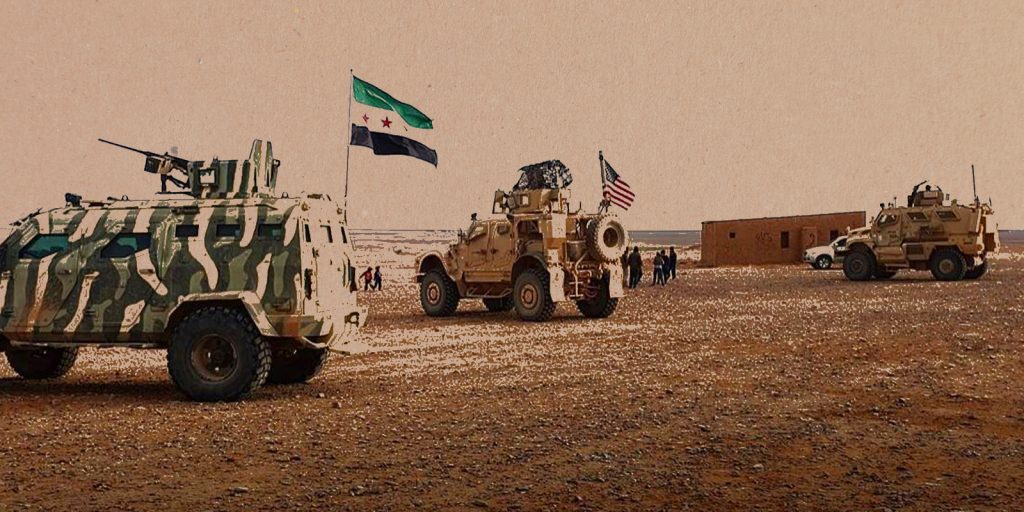
Official and media sources have announced that Syria’s engagement with the international coalition’s efforts against the Islamic State has witnessed notable diplomatic and security movement in recent weeks. News reports indicated that Damascus has signed a declaration expressing its readiness to coordinate with the international coalition for the purpose of combating the extremist organization. Western parties and analysts have regarded this as an important diplomatic step within the broader effort to reintegrate Syria into regional and international security institutions.
In what appeared to be a decisive shift in the official United States position toward Damascus, signals from American and official sources suggested the existence of commitments and understandings on mechanisms of cooperation in combating the remnants of terrorist groups. Washington is said to be assessing potential cooperation based on criteria relating to field capabilities and obligations concerning the prevention of financing violence and the movement of foreign fighters.
The White House had earlier issued procedural measures in June related to reviewing classifications and sanctions connected to Syria. These were framed as political and legal steps that could open the door to broader cooperation if specific conditions are met.
On another front, United Nations and diplomatic sources asserted in official statements that any meaningful Syrian participation in the coalition’s efforts cannot succeed without a comprehensive approach that includes restoring state control over territory, integrating local forces under unified military and security institutions, and ensuring the reliable and immediate exchange of intelligence information.
A Security Council presidential statement pointed to the obligations of relevant states regarding the ongoing issue of foreign terrorist fighters and the accompanying regional security implications.
In parallel, reports cited internal Syrian military and security movements that included raids and preemptive operations against cells allegedly linked to the Islamic State. These developments were interpreted as an attempt by Damascus to demonstrate field readiness that bolsters the credibility of its calls for international cooperation. Media sources confirmed that these operations preceded high-level meetings held unexpectedly between Syrian officials and international actors.
Read also: Syria in the Global Coalition: Partnership Against Terror or Political Containment?
Operational and Military Requirements
Waiel Olwan, a researcher at the Jusoor Center for Studies, told +963 that the Syrian government, with its political positioning and security capabilities, is today able to become the primary ally of the United States and the international coalition against terrorism. He added that there is alignment between the government’s priorities and those of the coalition, since the government, long before it began advancing from Idlib to retake areas once controlled by the regime, had been working for years to counter terrorism, particularly that of the Islamic State.
He noted that the government has extensive security experience in countering the Islamic State and maintains coordination, albeit unofficial or indirect, with the international coalition through its partnership with Turkey in combating terrorism. He also pointed out that numerous security operations were carried out in northwestern Syria, leading to the targeting of Islamic State leaders, and that the Syrian government at the time was an active local contributor to pursuing the group and its security leadership.
He affirmed that the operational and military requirements expected by the coalition from Syria already exist. However, he clarified that the coalition, through this partnership, would support the development of the Syrian government’s security and military system, particularly as the new government is working to build its military and security institutions. According to his view, this means it would greatly benefit from coalition support in fighting terrorism, whether on the logistical level or otherwise.
He added that there are no major internal or external obstacles preventing Syria’s engagement with the international coalition. On the contrary, he explained that there is a psychological readiness within the new state structure to assume this position within the coalition against the Islamic State and terrorism in Syria.
He further stated that the Syrian government presents itself as a local partner in combating terrorism, not only since assuming power but even before, as it had been combating terrorism and demonstrating positive cooperation in counterterrorism operations inside Syria.
He noted that he does not believe current divisions constitute a source of concern or a significant challenge. He explained that the government has overcome this through numerous measures taken since its presence in Idlib. He added that a significant differentiation has since taken place between radical elements that refused engagement with actors in northwestern Syria, such as the former Salvation Government and factions of the National Army, and those who rejected this shift and aligned themselves with the Islamic State, and who were subsequently pursued in northwestern Syria or elsewhere.
The researcher affirmed that Syria’s accession to the international coalition will be a factor of stability in the country and will influence power balances and the regional diplomatic framework.
He added that this step carries important implications, as the Syrian government would benefit from becoming the regional partner, in addition to being the national partner, in counterterrorism. This would remove this card from non-state structures with which the coalition had previously dealt. This, in his view, means that a Syrian government is now prepared to be the local partner in counterterrorism.
He also noted that the international coalition, particularly the United States, will benefit as well. Washington had been conducting counterterrorism operations without a partnership with the Syrian government, relying on armed factions in northeastern or southern Syria, a matter that lacked consensus within the American establishment, especially within the legislative branch, according to his assessment.
He emphasized that moving from engagement with unofficial local actors to coordination with a legitimate government is something the United States needs. He argued that this would lead to higher quality and greater efficiency in counterterrorism efforts, as well as strengthen the legitimacy of the American presence and operations inside Syria.
Read also: Syria, Washington and Israel: What Al-Sharaa’s Visit Changes
Diplomatic Motivations
Dr. Ghazi Faisal Hussein, a professor of international relations residing in Jordan, told +963 that the principal political driver is the lifting of sanctions and the fundamental shift in United States policy toward the Syrian transitional government, which would allow formal cooperation between Washington and Damascus.
He stated that the international coalition against terrorism views the new government as capable of effectively combating extremism, especially after Hay’at Tahrir al-Sham (HTS) succeeded in confronting the Islamic State internally, having conducted joint operations with the coalition in October 2025.
He observed that the focus on integrating Syrian armed forces and excluding foreign fighters reinforces security stability. He also underlined that the Syrian government’s priorities include combating terrorism to achieve internal stability, a goal that aligns with the coalition’s objectives. However, he cautioned that lingering ideological Islamist roots could conflict with the coalition’s secular approach.
Hussein added that operational requirements include participation in joint operations, intelligence sharing, and countering terrorism financing. He noted that coalition forces have already conducted operations with the Syrian government against the Islamic State, with an emphasis on training and equipping government forces. He explained that military requirements entail providing bases or logistical support and participating in air or ground strikes.
He also pointed out that the Syrian interim authorities have established the National Counterterrorism Committee and carried out successful operations demonstrating an ability to combat the Islamic State. He noted that the new Syrian army may require external support to reach full readiness, while the United States views the government as capable of meeting its commitments but still insists on additional reforms for sanctions relief.
Hussein warned that Syria faces internal and external obstacles that may hinder full integration. Internal obstacles include sectarian and ethnic divisions, such as the challenge of integrating the Syrian Democratic Forces, which control the northeast, into the Syrian army, a step the coalition seeks to accelerate. External obstacles include relationships with conflicting allies such as Turkey, which supports Hay’at Tahrir al-Sham (HTS), as well as Israeli concerns over the lack of disarmament in southern Syria and international pressure related to transitional justice for past war crimes.
He added that Syria’s accession to the international coalition could significantly shift regional power dynamics. It would strengthen United States influence in the Middle East as Syria transforms from adversary to ally, weaken what he described as the Iranian terrorism network, and reduce both Russian and Iranian influence. It could also deepen relations with countries such as Saudi Arabia and Turkey, and open avenues of cooperation with China on counterterrorism.
He concluded that this shift would help enhance stability through combating the Islamic State, facilitate the lifting of sanctions, and support the economy and reconstruction efforts. However, it could increase internal tensions if integration fails or lead to the resurgence of extremism if ideological issues are not properly managed. He considered the step a potentially transformative political shift, but one that depends on implementing reforms to avoid failure.











