


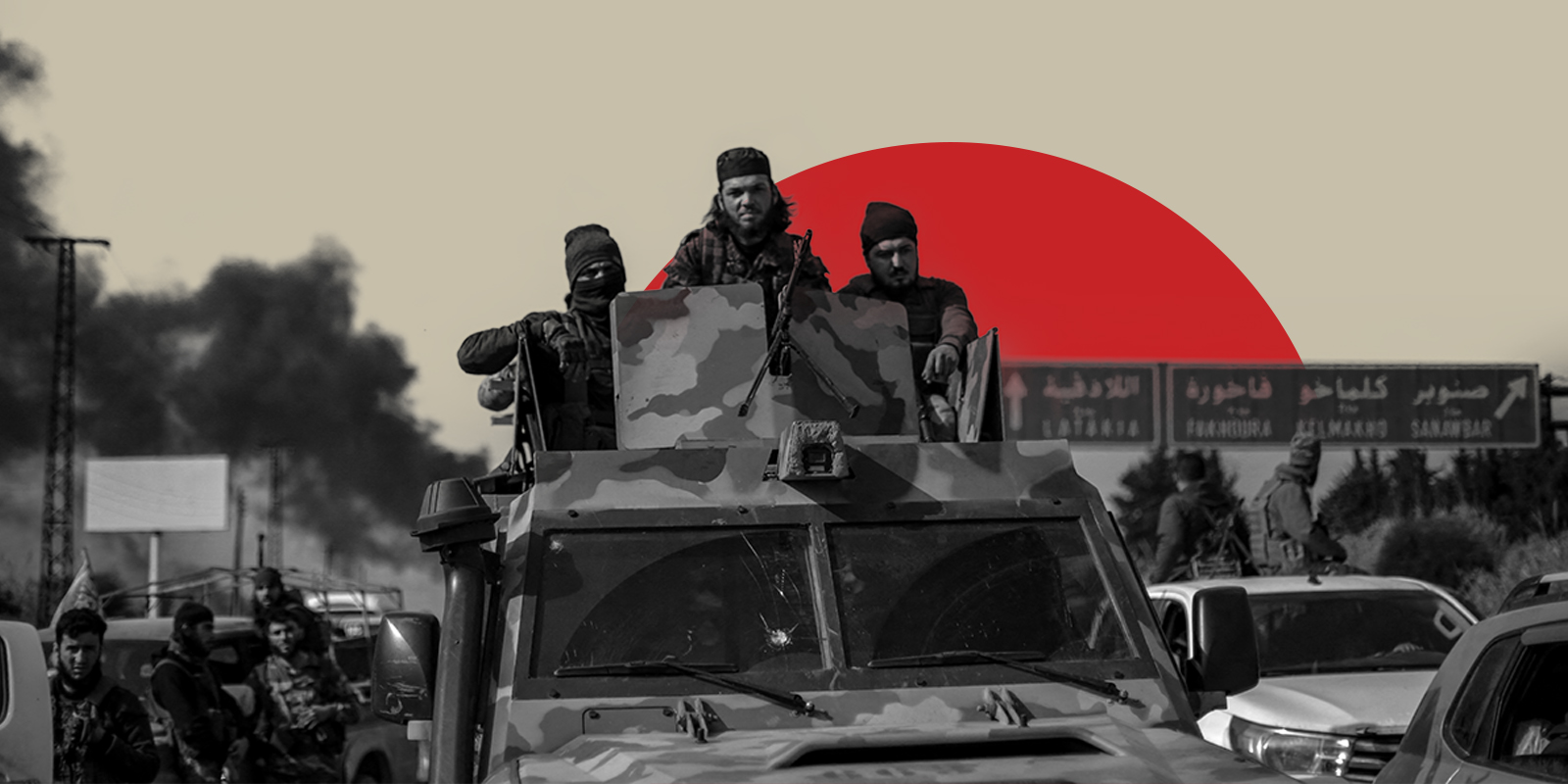
As major military operations in Syria recede and arrangements for transitional governance begin to take shape, one of the most complex issues in the Syrian landscape has re-emerged: the question of foreign fighters. After years of combat within multiple factions, these fighters now face an uncertain future that ranges between forced deportation, rehabilitation and reintegration, or remaining in their zones of influence under conditional security supervision.
The events of recent days in north-western Idlib, particularly in the so-called “French Camp” near the city of Harem, have once again drawn attention to this sensitive file, which combines interlocking security, humanitarian, and political dimensions. On 22 and 23 October 2025, the camp witnessed violent clashes following a security operation carried out by the transitional government to arrest the French-Senegalese commander Omar Omsen, leader of the “Ghuraba Brigade”, after the kidnapping of a young girl. The operation involved the use of medium weapons and drones, causing material damage before it ended through local mediation – a scene observers saw as proof of mounting tension between the authorities and foreign fighters resisting their authority.
Security leaders in Idlib described the operation as a “judicial” one aimed at handing over individuals wanted for justice, following complaints from camp residents and neighbouring communities about “serious violations”. A circulated video showed the aftermath of shelling and destruction of buildings within the camp, raising fears that civilians – particularly women and children – had been caught in the crossfire. Local monitoring groups reported that the clashes lasted for several hours and involved medium and heavy weapons, as well as occasional drone strikes, before a temporary truce was reached.
The internal security forces targeted the group known as the “Ghuraba Brigade”, led by Omar Diaby, also known as Omar Omsen, who entered the Syrian field in 2013 and became known for recruiting French volunteers to fight in Syria. Omsen is internationally wanted for his alleged involvement in recruitment and jihadist activities and has previously been detained and confronted by local factions.
The “Ghuraba Brigade” emerged as a unit mainly composed of French-speaking fighters, operating with a simple military structure and a field command centred around figures such as Omsen. Its goal has been to mobilise European volunteers to fight under extremist ideological frameworks while maintaining operational independence from some local factions at different periods.
The clashes between the internal security forces and Omsen’s group saw the use of light and medium weapons inside the camp. Reports also indicated limited drone and artillery attacks that hit residential buildings, turning what was once a family settlement for fighters’ relatives into a dangerous combat zone that exposed women and children to direct harm, internal displacement, and long-term psychological trauma.
Read also: Ibrahim Maleki to +963: Foreign Fighters Are a Pressure Factor on Syria’s State-Building Project
Growing Threat
The escalation of violence has heightened concerns among Idlib’s residents living near the camp, who fear the actions of armed groups operating inside it. Some local commanders have reportedly imposed strict rules on residents, while neighbouring communities have complained that their safety and access to basic services are jeopardised whenever fighting breaks out within the camp. Videos from inside showed families sheltering indoors and damaged buildings, while local officials said there was growing pressure to hand over suspects to local courts to ease tensions, according to Lebanon’s An-Nahar al-Arabi.
The presence of foreign groups – French, Uzbek, Turkistani, and others – continues to worry residents and officials in north-west Syria. Some of these groups are temporarily allied with local factions or have reached ad-hoc agreements with actors such as Hay’at Tahrir al-Sham, while others retain varying degrees of independence, making them an unpredictable element in the regional and local balance of power. The diversity of nationalities and ideological backgrounds has produced a complex web of loyalties and competition for influence and resources.
The recent developments in a camp hosting foreign fighters represent a dual threat – internal and regional. The new Syrian government has found itself in a dilemma: it seeks to demonstrate its legal authority but wishes to avoid a full-scale confrontation that could trigger a new wave of displacement or external intervention. The latest clashes prompted local security factions to deploy additional forces around sensitive sites and activate mediation channels with faction leaders to contain the crisis. However, experts warn that any failure to resolve the foreign fighter issue comprehensively could spark further flashpoints.
The Syrian government is attempting to address this challenge through a combination of “integration, monitoring, and judicial” measures designed to assert control while satisfying external actors seeking stability along the borders. Russia continues to play its traditional role in supporting the restoration of political and security control, while Turkey remains wary of any moves that could trigger new refugee flows or disturb the delicate balance along its frontier – a dynamic that makes the issue diplomatically sensitive and open to regional power bargaining.
Organisational Independence
Ali al-Amin, a writer and political activist based in Sweden, told +963 that the camps housing foreign factions have functioned as “mini-emirates” within areas controlled by Hay’at Tahrir al-Sham (previously Jabhat Al-Nusra, was led by the current president Al-Sharaa), maintaining their own laws and internal systems. He explained that these factions have long coordinated with Turkish intelligence and HTS, becoming part of a complex web of influence in northern Syria.
He noted that the foreign factions were once the striking arm of HTS before the fall of the Assad regime. Following the regime’s collapse and the emergence of the foreign fighter problem within HTS, the transitional government decided to integrate these fighters into the “New Syrian Army”, citing humanitarian and ethical justifications.
Regarding the recent events, al-Amin described the confrontation between the transitional government and the French fighters as a “theatrical” episode that ended peacefully. He argued that it was a media show designed to present the government as willing to rid itself of foreign fighters, while no genuine conflict existed between the two sides.
He added that foreign combat organisations enjoy clear structural independence and hold considerable authority in northern Syria. Their political and military strength, he explained, stems from direct Turkish support. These groups are also financially better off than local Syrian factions, with most of their members living in better conditions than the surrounding population.
Read also: The Mirage of Reform and the Split Between Domestic and Foreign Agendas
International and Local Positions
Al-Amin stressed that the recent events will not affect overall stability, since there are no genuine tensions on the ground and because Turkish intelligence, which supports both the transitional government and the foreign factions, maintains control. He added that the dispute between the government and Omar Omsen was resolved easily and without arrests or warnings.
He pointed out that France’s policy is to prosecute its citizens involved in acts of terrorism in the same places where those acts occurred, ensuring fair and transparent trials. Paris, he said, does not seek their return to France nor their physical liquidation, as they are “living and mobile treasures of security information”.
Al-Amin further argued that both Damascus and Ankara regard the foreign fighters as the “shield of the ruling authority” and among its most loyal elements. He said both governments strive to appease international powers critical of the presence of foreigners in the Syrian army. Russia, meanwhile, shows no objections towards any faction due to its strong ties with Ankara.
He explained that the camps hosting foreign fighters are seen as special zones, and locals do not usually view their residents as extremists or terrorists – whether out of fear of expressing such opinions or from perceiving them as mujahideen. There are, he added, no open plans to limit the spread of their ideology nor any clear governmental strategy to confront it, as doing so would amount to “the government turning against itself and its wartime allies to please the West”.
He concluded that the government plans to naturalise foreign fighters and incorporate them into the Syrian army, having already integrated more than 4,000 of them into the 84th Division led by a Turkistani commander. He added that the government might later hand over some wanted individuals to international powers under political pressure, though trials or executions of these fighters by the transitional authorities remain unlikely.
Influence, Outcomes, and Scenarios
Khadija Mohammed Naamah Shuqruq, a member of the Syrian Women’s Council in rural Idlib, told +963 that camps hosting foreign fighters have witnessed multiple violations such as abductions and extortion, leading to recurrent security tensions and clashes between foreign combatants and security forces.
She explained that the foreign groups operating in northern Syria include jihadist and Islamist organisations such as Hay’at Tahrir al-Sham, alongside other factions supported by Turkey. The recent incidents inside the camps, she noted, have had a significant impact on security in Idlib and along the Turkish border, where they could heighten terrorist activity.
Shuqruq said that the French government has taken the issue of its citizens fighting in Syria seriously, issuing arrest warrants for several of them, including Omar Omsen, who is accused of recruiting French nationals to join the conflict. France, she added, is pursuing legal action against these fighters, potentially trying them in absentia or repatriating them for prosecution.
She noted that Damascus and its allies approach the foreign fighter issue in a complex and multifaceted way. The new Syrian government seeks to integrate some foreign fighters into the national army and grant them citizenship as part of efforts to build a strong and diverse force. This decision, however, has raised international concern, particularly among Western states worried about the impact of these fighters on regional stability and security.
She also highlighted the dire humanitarian conditions faced by women and children in the camps, who suffer from acute shortages of basic services such as food, water, education, and healthcare, as well as from violence and severe psychological distress caused by their traumatic experiences.
In conclusion, Shuqruq stated that the possible future scenarios for foreign fighters in Syria include several options: deportation to their countries of origin, rehabilitation programmes aimed at changing extremist beliefs and reintegrating them into society, or prosecution for crimes committed during their time in Syria.











