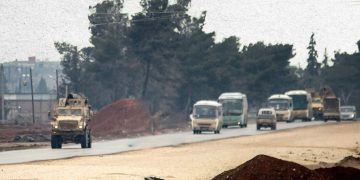

The issue of foreign fighters has once again come to the forefront after a series of clashes erupted between the Internal Security Forces and French combatants overseeing Al-Firdan camp in rural Idlib. This was followed by video statements from Uzbek and other foreign fighters declaring their support for their “French brothers,” believing that the Syrian government intends to gradually eliminate them.
However, this incident represents only a small fragment of a much larger problem, the challenge of maintaining security control over foreign nationals who had fought alongside Hay’at Tahrir al-Sham (HTS). These fighters constituted a significant number of military units in Idlib until the regime’s fall on December 8 of last year. Added to this are the pressures and international scrutiny faced by Ahmad al-Sharaa, head of the transitional phase, who pledged to integrate the fighters, despite the fact that eliminating them had been a major American condition for lifting sanctions on Syria.
“ISIS” and the Foreigners
The file of foreign fighters represents a double-edged weapon for the new administration and one of the most significant challenges in al-Sharaa’s political trajectory. He preserved their status out of loyalty to their past support within HTS and to prevent them from turning against him or being recruited by rival factions if abandoned. Yet at the same time, the international community continues to exploit this issue as leverage against him, as demonstrated in the case of the French fighters’ camp. The French combatants interpreted the security operation as being directed by French intelligence. Thus, the path toward containing this complex and multinational file is riddled with obstacles.
Since the announcement of HTS’s self-dissolution and its transition toward a unified state governed by law and institutions, despite the “weakness of implementation”, subtle signs of discontent have emerged among foreign fighters who adhere to a transnational jihadist ideology and consider themselves “muhajirun” (migrants). This mirrors the doctrine of ISIS, which has begun appealing to these fighters to defect from the new administration, accusing it of abandoning its jihadist course.
In response, al-Sharaa introduced an emergency plan to integrate foreign fighters into the Syrian army within the 82nd Division, in an attempt to prevent ISIS from luring them away. Nevertheless, there remain deep concerns about ideological infiltration by ISIS among these integrated forces.
An International Threat
Foreign fighters have become an international and regional threat centered in Syria. They represent an acute security challenge to their countries of origin, which have labeled them as terrorists, notably Russia, China, the European Union states, and the United States.
Among the most pressing challenges is the group formerly known as the Turkistan Islamic Party, composed of Uyghur fighters from China, numbering around 2,500. It remains the most prominent foreign military faction in Syria. Consequently, China, a permanent member of the UN Security Council and a veto power, is exerting pressure on the new Syrian administration to combat this group. Some observers have linked this pressure to the recent arrests of several Turkistan leaders, including “Abu Dujana.”
Russia, on the other hand, fears Chechen jihadists and potential retaliation against its coastal bases. Hence, Moscow is working closely to neutralize these risks near its Syrian installations. The same applies to the group once known as Hurras al-Din, which includes fighters from Jordan, Morocco, Tunisia, Egypt, and Turkey, as well as the Mujahideen al-Ghuraba Battalion, composed of Tajiks, Uzbeks, and fighters of French and Arab nationalities.
It has therefore become apparent that the government seeks to prune controversial leaderships in line with foreign sensitivities while quietly integrating rank-and-file fighters into the military establishment, but without granting them senior command positions.
Constitutional Rights
As the new Syrian administration proceeds with the integration of foreign fighters into the ranks of the Syrian army, this move has been interpreted as a constitutional prelude to granting them citizenship. Military service is often considered a primary qualification for naturalization in many countries. Yet the absence of a clear legal framework governing the naturalization of foreign fighters and the ambiguity surrounding their constitutional status heighten their sense of insecurity, especially amid ongoing international pressure and their countries’ refusal to repatriate them, given their classification as terrorists.
The lack of transparency in the government’s naturalization process further complicates matters, particularly in the absence of a functioning legislative authority. Estimates suggest there are more than 5,000 foreign fighters, not including their families, and this number is expected to rise over time. Such a development could create a serious demographic imbalance in Syria if not addressed with legislative precision.
It is clear that the interim Syrian government’s choices regarding foreign fighters are perilous, akin to holding a blade by both edges. Nonetheless, there is a discernible governmental inclination toward quietly integrating these fighters into the army’s structure without allowing their presence to transform into military leaderships, as happened in the French camp under “Omar Omsen,” who militarily resisted the General Security forces. Similarly, media appearances by figures like “Abu Dujana al-Turkistani” are being curtailed.
Ultimately, the option of military action and detention remains on the table for anyone who refuses to comply with the directives of the new administration.
The views expressed in this article do not necessarily reflect those of +963 association.