


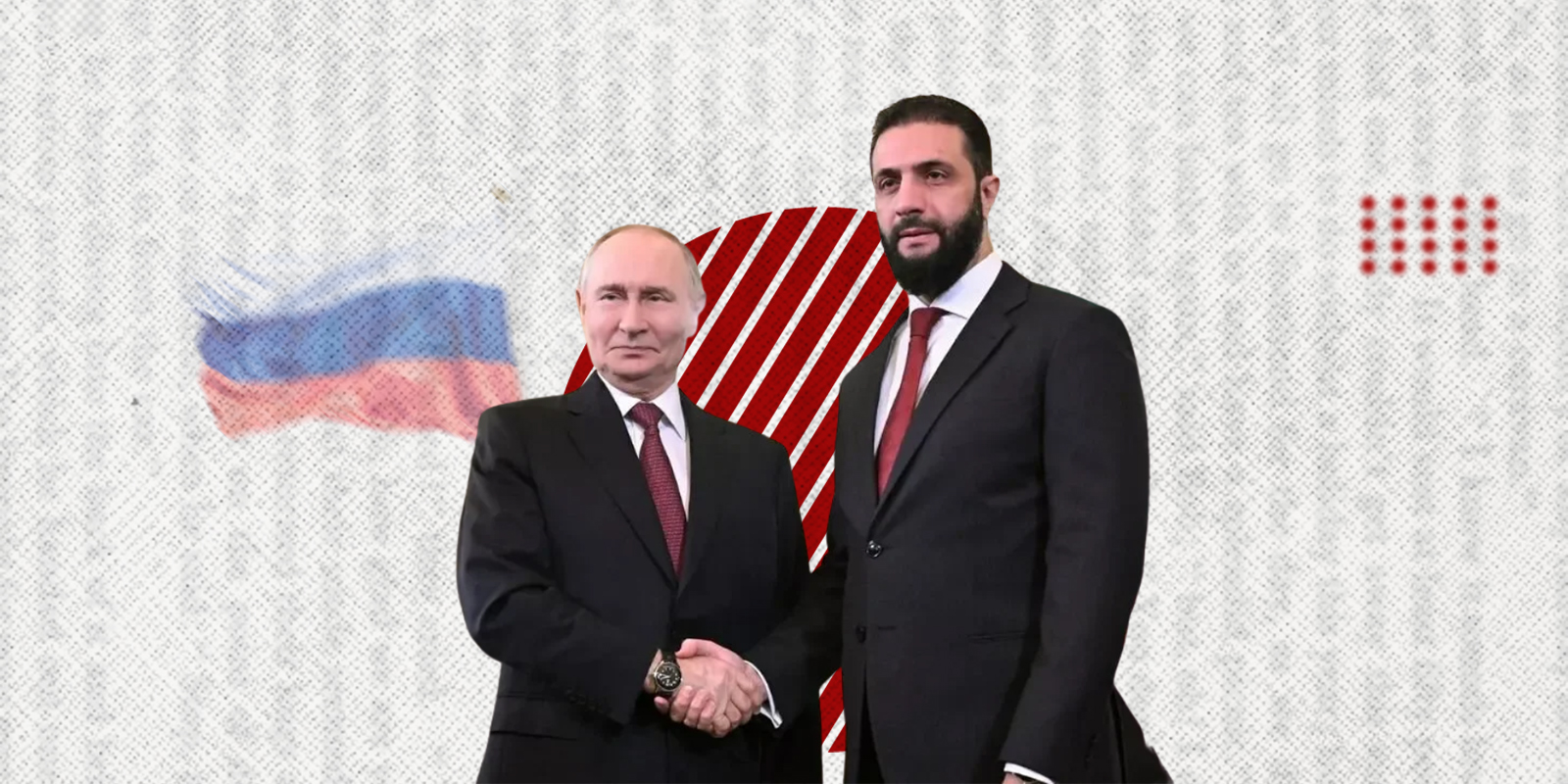
Days after Syrian interim president Ahmad al-Sharaa’s visit to Moscow in mid-October 2025 – described as a “turning point” in Syrian-Russian relations – the diplomatic scene in Damascus entered a period of confusion and inconsistency. What began as a strategic move to reset ties with Moscow soon turned into a series of contradictory public statements between the president and his foreign minister, revealing multiple centres of decision-making inside Syria’s new administration.
Economic Sovereignty, Not Aid
The first signs of this divide appeared when Syria’s interim foreign minister, Asaad al-Shaibani, made notable comments just days after al-Sharaa returned from Moscow.
Al-Shaibani stressed that lifting US and European sanctions on Syria was a “humanitarian and economic necessity,” insisting that the country “seeks economic sovereignty based on partnership, not aid.” He also said that Damascus was committed to international agreements and to the 1974 Disengagement Accord – a message seemingly aimed at the West and Israel more than at Moscow.
Although his statements did not directly contradict the president, their tone differed. While Al-Sharaa spoke of a “balanced strategic partnership” with Russia, al-Shaibani’s message focused on sovereignty, sanctions, and cautious openness to the West, giving the impression of two separate policy directions.
According to Dr Mustafa Khaled al-Mohammad, a political adviser close to the Kremlin, Al-Sharaa’s visit “was not purely a Syrian affair but had clear Turkish dimensions.”
He told +963: “Turkey is trying to acquire a defence system for Syrian territory because Israel would not dare strike such systems if Turkey deployed them. So Ankara turned to Russian systems that could be placed across Syria’s territory.”
Al-Mohammad added that the main purpose of the visit was “to agree on defence systems and weapons, treating Damascus as a partner in the purchase,” and confirmed that both Syrian defence and foreign ministers were involved. “An agreement was signed,” he said, “but many technical details remain unresolved.”
He noted that the visit also carried a message to Washington: “Any rift between Washington and Damascus will push Syria further towards the eastern camp; Moscow and Beijing.”
Negotiation, Not Disagreement
Al-Mohammad explained that differences between Moscow and Damascus were not deep disputes but “negotiations over influence and interests.”
He said: “The Russian bases in Syria are essential for Moscow, and it insists on keeping them. Damascus, in turn, wants to use these bases as leverage in talks on economic and political support.”
He added that the conflicting statements showed “genuine confusion,” noting that “al-Sharaa said the agreements would remain and be gradually amended, while al-Shaibani said no understandings had yet been reached – a clear contradiction.”
Al-Mohammad also mentioned that Moscow’s recent move to suspend scholarships for Syrian students was “an unfriendly signal,” despite Russia’s official support for Damascus.
The Ambassador Issue and Unspoken Details
One of the most striking issues raised by al-Mohammad was the status of Syria’s ambassador to Moscow, Bashar al-Jaafari.
“Moscow refuses to replace al-Jaafari even though he recently obtained political asylum status,” he said. “This removes his diplomatic immunity, as he is now considered persecuted by the current authorities. So technically, Syria has no official ambassador in Moscow.”
He added that the first topic discussed between Al-Sharaa and Putin was the ambassador’s position, and that proposals were made to open a new consulate in Krasnodar or Nalchik to serve Syrians there. He also confirmed that both sides agreed to keep military agreements confidential “for the security and interests of both parties.”
In a more sensitive comment, al-Mohammad spoke of “Iranian influence within Damascus and the Foreign Ministry,” saying: “I tried to establish independent channels with Russia, but found no cooperation, perhaps due to fear or marginalisation. There is hesitation and fear of direct contact with Moscow.”
He added that Russia rejects any mediation through Turkey: “Moscow does not want its ties with Damascus to pass through Ankara or any secondary channel.” These statements revealed genuine coordination problems between Syria and Russia and showed how Damascus’s links with Tehran and Ankara have complicated its diplomacy abroad.
Relations Under Test
Political researcher Bassam al-Sulayman, based in Damascus, offered a different view.
He told +963: “Politics between nations is based on interests, avoiding harm and gaining benefits. Russia plays a key role in trying to limit chaos.”
He noted that “strategic communication between Syria and Israel continues,” and that “Russia can play a positive role through food, wheat, infrastructure and military cooperation.”
According to al-Sulayman, “the visit was part of Syria’s new balanced diplomacy. The two presidents met for a long session and clearly reached some understandings, though no one knows exactly what they were,” adding that “these may concern military matters or food security, since our wheat comes from Russia. Economically, there are infrastructure projects with Russian funding. The meeting shows that Putin wants Russia to have a role in post-war Syria.”
Read also: End of UN Resolution 2231 Triggers a New Standoff Between Iran and the West
A Divided Voice
After the Moscow visit, Syria’s official rhetoric became fragmented. President Al-Sharaa speaks of balanced partnership; Foreign Minister al-Shaibani highlights sovereignty and lifting sanctions; Moscow-aligned advisers talk of negotiations over bases and influence; while researchers in Damascus admit that no one really knows what was agreed.
Analysts see this as a sign of a deeper issue: the lack of a unified diplomatic vision within Syria’s transitional administration. The country, still trying to reposition itself after years of war, now faces a double challenge – how to preserve its alliance with Moscow without losing sovereignty, and how to reopen to the West without angering its allies in the East.
Between Al-Sharaa’s visit to Moscow and al-Shaibani’s statements in Damascus, Syria’s diplomacy appears trapped in a moment of real confusion.











