


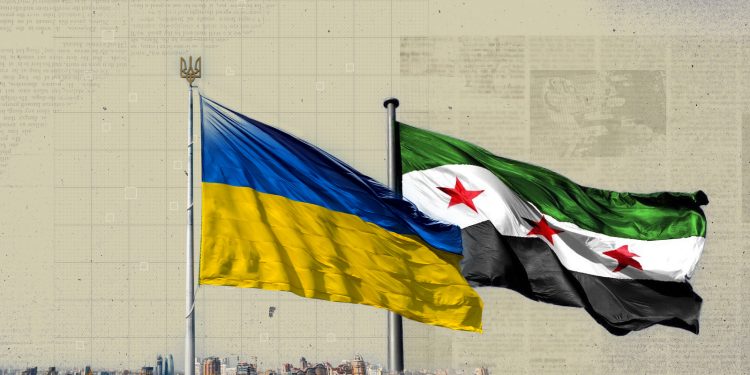
As the war in Ukraine continues, U.S. President Donald Trump has relayed to his Ukrainian counterpart Volodymyr Zelensky and European leaders a Russian proposal for ending the conflict. The plan, reportedly conveyed by Russian President Vladimir Putin, involves Ukraine surrendering Donbas, Crimea, Kherson, and Zaporizhzhia. Zelensky has fully rejected it, according to diplomatic sources.
A summit between Trump and Putin was held in Alaska under the banner of “Pursuing Peace.” Afterward, Trump stressed that Ukraine must reach a deal with Russia, citing the imbalance of power between the two countries. He revealed that both sides agreed to pursue a settlement without the precondition of a ceasefire.
According to media reports, Putin demanded that Ukraine abandon its NATO ambitions, restrict the alliance’s eastern expansion, and that Washington formally recognize Russia’s annexation of the four disputed regions and Crimea. Some reports suggested Putin was more flexible on Sumy and Kharkiv.
Meanwhile, Trump reportedly told European leaders he was willing to offer Ukraine security guarantees, including military and financial backing, but no U.S. boots on the ground, activated only if Russia launched a future offensive. These guarantees, however, would not include NATO membership.
During Trump’s meeting with Zelensky in Washington, discussions touched on “security guarantees for Ukraine” and “territorial swaps.”
European leaders and NATO Secretary-General Mark Rutte also met with Trump before the summit. They warned against underestimating Putin, rejected territorial concessions, and stressed that a ceasefire should precede any deal, coupled with solid security guarantees for Ukraine.
European capitals fear that any settlement ignoring their strategic interests could undermine the continent’s security and reshape regional power balances. This raised a broader question: what does this mean for Syria’s future?
Read also: Russia’s Role in Syria: Symbolic Support, Strategic Coordination with Israel
Prolonged War and Stalled Peace Efforts
Dr. Saeed Sallam, Director of the Vision Centre for Strategic Studies in Kyiv, told +963 that Russia’s war on Ukraine, which began in 2014 and escalated into a full-scale invasion on February 22, 2022, continues with no clear end in sight.
“Russian forces currently hold the battlefield initiative but are advancing slowly,” he explained, noting they captured just 25 square kilometres last week. “Altogether, Russia gained roughly 1% of Ukraine’s territory in 2025, at enormous cost in equipment and manpower.”
At the same time, Ukraine wages an asymmetric war, striking deep inside Russia and targeting its logistics and economy.
Despite U.S.-led diplomatic efforts under Trump, Sallam says little progress has been made: “Moscow refuses to compromise on its central demands, recognition of the annexed territories, while blaming Kyiv for rejecting a permanent peace.” Ukraine insists on full withdrawal and restoration of sovereignty as a non-negotiable condition.
“The Kremlin won’t even agree to a Putin-Zelensky meeting without prior concessions,” Sallam added. “The obstacles are massive, and escalation remains the default.”
The Syrian Dimension
Sallam argues the Ukraine war has weakened Moscow’s hand in Syria, “The Russian invasion triggered unprecedented Western sanctions and isolation. The military and economic drain on Russia undermined its ability to sustain its Syrian presence, directly contributing to the fall of Bashar al-Assad’s regime in 2024.”
With Moscow’s influence diminished, Washington seized the opportunity to strengthen regional alliances and counter Iran, whose own Syrian foothold had long depended on Russian backing.
“The U.S. doubled down on supporting anti-Assad forces, which led to shifting the balance in Syria,” Sallam noted.
Although Trump has since sought quick diplomatic “deals” with Putin to stabilize the Middle East, Sallam says deep mistrust over Ukraine keeps these efforts limited.
“Overall, the Ukraine war and Assad’s fall reshaped Syria’s geopolitical map,” he explained. “The U.S. gained ground, while Russia struggles to reclaim lost influence.”
Also read: In Southern Syria: Russia’s Return Isn’t Enough; Warlords Must Be Stopped First
Ukraine’s Fate and Syria’s Future
Salam believes that ending the Russian war on Ukraine would significantly impact the Syrian file, given the interconnectedness of the regional and international conflicts in which Russia is involved. If the war were to end, Russia could reallocate the military and economic resources drained in Ukraine, potentially enabling it to attempt to regain influence in Syria.
This could also mean strengthening its alliance with Iran, still a key regional actor despite its diminished role in Syria or even rebuilding ties with various Syrian “factions” to reestablish a foothold. Such a move, however, could trigger new tensions with the United States, which has expanded its presence in Syria by supporting forces opposed to both Iran and Russia.
“On the other hand, if the war continues, Russia will face tremendous difficulties in maintaining any effective role in Syria, leaving the field open for the United States and Turkey to expand their influence. Turkey, with U.S. backing, could work to strengthen its control over northern Syria, while Washington would seek to curb Iranian influence. Thus, whether the Russian war in Ukraine ends or drags on will directly shape the balance of power in Syria, with varying consequences for all regional and international actors involved.” Salam adds.
The View from Moscow
Dr. Mahmoud Al-Afandi, an academic and political analyst based in Moscow, views the Russia- Ukrainian war in the same context as a war of attrition between Russian power and Western power; one that will only end through a military solution.
He argues that the political initiatives Trump is attempting to impose to end the conflict will not succeed. However, he points out that Russia has already achieved one of its main objectives: the withdrawal of the United States from direct involvement in the conflict, which dispelled fears of a potential Third World War.
Speaking to +963, Al-Afandi stresses that only a military solution can bring the war to an end, particularly as Ukraine itself is suffering from attrition. He predicts the war will conclude within the coming months with Ukraine’s surrender. In his view, the conflict “will not be settled in political corridors, only the battlefield can stop it,” especially given what he describes as a “European and Ukrainian elite that pursues militarization rather than politics.”
In contrast to the earlier analysis, Al-Afandi believes the Russian- Ukrainian war will not negatively impact relations between Moscow and Washington, given the U.S. withdrawal from the conflict. He notes that the Trump administration’s statements align closely with the Russian perspective. He even goes further, suggesting that the war “brings Russia and the United States closer together.” He highlights the Alaska summit between the two presidents as “a meeting to reach understandings and deals, part of which involved Middle Eastern issues, particularly Syria.”
He adds that the Russian- Ukrainian war “will not affect the Syrian file,” explaining that the Russian forces stationed in Syria “operate outside the framework of the military campaign against Ukraine.” He notes that Moscow has recognized Syria’s new authorities and has begun working to develop relations with them.
Al-Afandi points out that Russia is building ties with the new Syrian government and will not alter its political stance toward Damascus. At the same time, he stresses that the new rulers face “a major challenge in state-building.” He concludes that the issue “depends on Damascus, not Moscow, when it comes to relations between the two countries, which are tied, in one way or another, to the existence and construction of a state that still lacks clear contours.” He closes by saying: “Russia will build relations with this government, or any other, that serve its interests.”











