


Salah Qirata
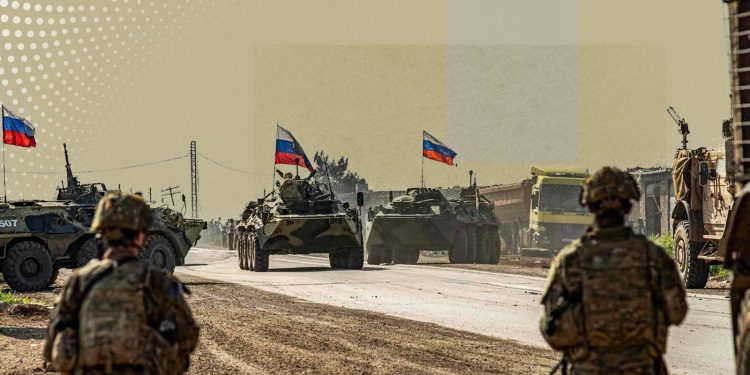
The Syrian government behaves as if bringing back Russian military police to the south will open the gates of paradise; restoring order with just a few armoured patrols. But anyone in Daraa, Quneitra, or Suwayda knows the truth: the real crisis isn’t about the absence of Russian vehicles, it’s that southern cities have long been hijacked by warlords who turned themselves into the region’s true rulers.
Since Assad’s collapse in late 2024, the security vacuum allowed every actor to carve out their share of territory. Israel quickly exploited the chaos, building a buffer zone along the occupied Golan under the banner of “national security,” when it was a cost-free opportunity to expand its influence.
Iran, for its part, never left. It simply reshuffled militia commanders, repositioned its forces, and kept its security networks alive through local proxies. Meanwhile, local factions once claiming to “protect the people” became the biggest predators; extorting residents, taxing trade, and seizing control of fuel, bread, and even drinking water.
In this landscape, Russian tanks won’t change much unless they are paired with a serious plan to dismantle militias and disarm them. Without that, Moscow’s return is little more than a cosmetic upgrade to a grim reality, or worse, a cover to preserve chaos under the label of “security coordination.”
Read also: Russia’s Role in Syria: Symbolic Support, Strategic Coordination with Israel
Today, the south is drowning in a web of interests:
- Weapons and drug smuggling across Jordanian and Israeli borders.
- A shadow economy built on looting and extortion.
- Political deals between warlords and regional powers that bypass the Syrian state.
- Heavy weaponry rivalling national armies, fully outside state control.
Yet the Syrian government acts as if these groups can be tamed with promises of jobs and positions. It ignores the hard truth: those who rule by the gun don’t hand it over willingly, and loyalties built on cash and weapons shift with the highest bidder.
Israel will not object to Russia’s return if it curtails Iranian influence. But it knows Iranian-aligned militias are masters of disguise; flying the Syrian flag by day, raising the Revolutionary Guard’s by night. No patrol, not even a full Russian brigade, can untangle that. Only a sweeping political and security effort can restore state authority to every inch of the south.
The Syrian government faces only two choices:
- Reproduce the south as a Russo-Israeli security protectorate with a thin Syrian façade, where militias keep their arms under a “permanent truce.”
- Enter a full confrontation with the warlords, no matter the cost, to return the south to state sovereignty within a real national project.
The fate of thousands of armed men controlling daily life across towns and villages is the key. Ignoring them makes every promise of stability a political illusion.
If the government lacks the courage to face the warlords, it should at least stop selling illusions through staged photos with Russian officers. Russian patrols, however polished they look on camera, won’t fix the south; at best, they’ll guard the rubble or coexist with it.
Southern Syria doesn’t need another foreign visitor watching its chaos. It needs a decisive national choice to cut off the war’s lifelines: illegal weapons, smuggling networks, and cross-border loyalties. Without that, every “return” will just be another act in a long-running play, paid for by the blood and pockets of ordinary Syrians, and enriched by the warlords who thrive on their misery.











