


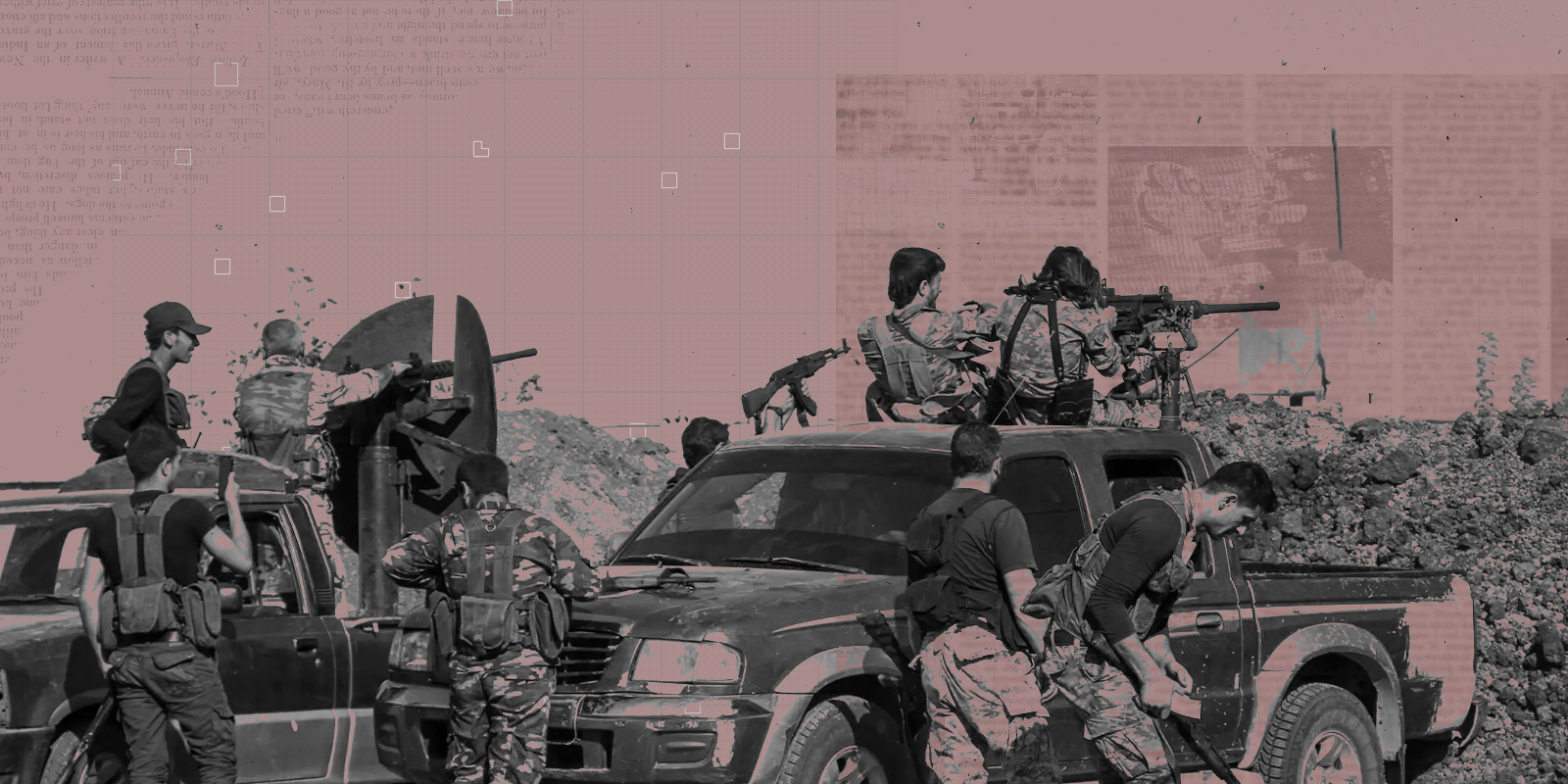
At the end of May, Syria’s Ministry of Defense announced that all armed factions had been merged into the new Syrian Army. Defense Minister Murhaf Abu Qasra said the ministry had met with around 130 different groups to discuss a new military structure, claiming the process had been a “major success” in building a professional army with a clear doctrine.
However, despite these official statements, reports suggest factionalism persists inside the ministry itself, reflected in events across areas such as the western coastal region and Suwayda in the south, where certain groups have been accused of misconduct. This raises doubts over how realistic the project of building a truly national army is, given the many obstacles ahead.
In a televised statement, the defence minister insisted that “no weapons will remain outside the authority of the state, because that does not help achieve stability.” He added that the ministry was working on a gradual transition from a revolutionary army to an institutional one. Strict criteria were introduced for joining the army, physical fitness, good conduct, and educational qualifications, with plans to open recruitment to the military academy after secondary school results are released. He stressed the army would be voluntary, not compulsory, so that only “loyal and committed soldiers” would enlist.
Rebuilding the Military Institution
Since the fall of Bashar Al-Assad’s regime, rebuilding Syria’s military on a national, non-sectarian basis has become a central issue. Such a step is seen as crucial for restoring security and controlling the spread of weapons. Yet with dozens of armed factions tied to foreign sponsors or ideological movements, the task is far from simple; especially given the failures of similar experiments in Libya, Sudan, and Yemen.
Among the groups that declared their integration during the “Victory Conference” in March were:
- Factions from the Turkish-backed Syrian National Army, including the Hamzat Division, the Amshat, and Al-Jabha Al-Shamiya.
- Groups within the National Liberation Front, such as Faylaq al-Sham, Ahrar al-Sham, Jaysh al-Ahrar, and Jaysh al-Izza.
- The Syrian Free Army, backed by the U.S.-led coalition and operating along the Syria–Iraq–Jordan triangle.
These groups have since begun deploying to new positions across Syria, from the north through the centre to Damascus and its countryside.
However, some of these factions, particularly the Hamzat and Amshat, have been accused of rights violations during the war, especially in northern Syria. Many of their commanders are under Western sanctions. Critics say their undisciplined behaviour was visible during unrest in the Syrian coast in March, underscoring the urgent need for careful restructuring if the merged army is to meet international standards of professionalism.
Read also: Rebuilding or Rebranding? The Illusion of Syria’s “New Army”
A Limited but Lingering Factionalism
Military expert Tariq Haj Bakri, based in Latakia, argues that “the factional state within the Syrian Army has become very limited after the creation of new divisions, brigades, battalions, and companies.” He says these are now being reorganized into proper hierarchical formations based on established military rules.
“Most factions have already merged, and their fighters redistributed,” Haj Bakri told +963. “But completely ending factionalism will take time. Steps are underway to reintegrate defected officers, revive military colleges on land, sea, and air, and ensure qualified officers lead the process. Only then can Syria build a truly national army whose mission is protecting the country without interfering in civilian life.”
A Fragile Alliance
Syrian lawyer Bassam Al-Aisami, based in Austria, sees the situation differently. He describes the army as “a fragile alliance of factions that lack a genuine state mindset.” In his view, the merger announced by the Ministry of Defense is “paper unity, not a real one,” since each faction still follows its own commanders.
“This is why we continue to see tensions and disputes over power-sharing,” Al-Aisami said. He believes the Syrian leadership is trying to cement its rule through authoritarian methods rather than by building a pluralistic state, deepening social divisions instead of healing them.
Analysts warn that many factions fear losing influence and hard-won gains from the past decade. Old rivalries and mistrust remain, and without guarantees, groups worry that disarmament could empower competitors. Some agreed to join the ministry only to secure political or military leverage inside the new institution, raising the risk that the merger could become another arena for factional competition, rather than a path toward national unity.
Read also: Can Syria Build a Cross-Sectarian Army?
Suwayda, SDF, and the Road Ahead
Factionalism is not limited to the north. In Suwayda, several local groups remain outside the new military structure. Among them are Men of Dignity, Al-Jabal Brigade, Ahrar Jabal al-Arab, and the Suwayda Military Council, alongside smaller factions such as Sheikh al-Karama and Quwat al-Ulya. Many of these groups trace their origins to the anti-Assad era and still answer to local Druze leader Hikmat al-Hijri.
Meanwhile, the Syrian Democratic Forces (SDF), backed by the U.S.-led coalition, control much of northeastern Syria. The SDF has insisted on joining the army as a single, intact bloc. This demand was included in the March 10 agreement signed between its commander Mazloum Abdi and transitional president Ahmad Al-Sharaa, which outlines the framework for integrating the SDF into the Syrian state.
For now, the process of merging Syria’s fragmented factions into a unified national army remains fragile and incomplete. Some steps have been taken, but lingering loyalties to ideology, region, or sect continue to obstruct progress. Experts agree that the Ministry of Defense must do more than announce mergers on paper. It must design a serious roadmap that prioritizes professionalism, inclusivity, and national identity, free from factional, sectarian, or foreign influence. Only then can Syria build the cohesive military institution it desperately needs.











