


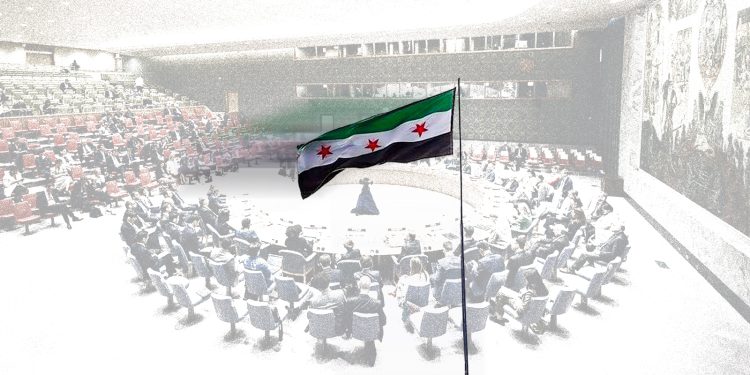
The UN Security Council has condemned all forms of negative interference in Syria’s political, security, and economic transition, warning that such actions undermine efforts to restore stability. It called on all states to refrain from measures that could further escalate tension and unrest.
In a recently issued presidential statement, the Council stressed the need for a comprehensive Syrian-led political process based on Resolution 2254, ensuring the protection of all citizens’ rights and enabling them to determine their future peacefully, independently, and democratically.
The Council reaffirmed the importance of the UN’s role, especially that of the Special Envoy, in facilitating Syria’s political transition, underscoring its commitment to the country’s sovereignty, independence, unity, and territorial integrity. It urged all international actors to respect these principles.
The statement comes amid fast-moving political and military developments in Syria, while the political solution remains stalled. The ruling authority continues to adopt a policy of denial and bets on dominance, while international momentum is growing to reactivate Resolution 2254 as the primary reference point for peace.
In the statement issued last Sunday, the Council voiced concern over the surge in violence in Suwayda province, urging the protection of civilians and unhindered humanitarian access, as well as holding perpetrators accountable. While the statement is political rather than legally binding, it reaffirms the UN’s central role in supporting a negotiated settlement.
The Council also welcomed the Syrian government’s statement condemning recent violence and its pledge to launch transparent investigations in line with international standards. The Ministry of Defense announced the formation of a committee to verify the identities and backgrounds of those involved, stressing that justice and reconciliation are key to lasting peace.
The presidential statement also referenced the 1974 disengagement agreement between Syria and Israel, calling on all parties to respect its provisions and avoid escalation in the buffer zone, while reaffirming support for UN peacekeeping forces stationed there. It further addressed ongoing security threats from ISIS and al-Qaeda, warning of the persistent danger posed by foreign fighters and the need for continued global counterterrorism efforts.
Read also: How Failure in Transitional Justice Fuels Division in Syria
Major hurdles to implementation
Implementing Resolution 2254 faces formidable challenges; chief among them the deep divisions among Syrian parties, reluctance by some actors to adopt political solutions, persistent foreign interventions, and the complexity of security and humanitarian crises. The absence of an effective enforcement mechanism and the continuation of violence further obstruct the political transition.
A viable solution will require a serious international commitment to ensuring implementation, coupled with regional cooperation to halt external interference. Trust-building among the Syrian through an inclusive dialogue that safeguards the interests of all components is essential.
A test for the government
Ismat Mansour, journalist and political analyst, told +963 that “this resolution puts the Syrian authorities to a real test to prove that Syria, its new system and new era, belongs to all Syrians, providing safety, care, and partnership to everyone regardless of affiliation, sect, or background.”
He emphasized, “This is a genuine test of the government’s commitment. The fact that the matter has reached the Security Council and prompted a presidential statement marks an important moment in Syria’s political trajectory. It could be a turning point toward progress, rather than regression, if managed wisely. However, contradictions, interventions, conflicts, regional conditions, and the dire living situation make the challenges more volatile and combustible.”
Mansour added that “the most important aspect of Resolution 2254 is the emphasis on Syria’s sovereignty and territorial unity. This is the core principle now under threat amid the changes Syrians are enduring. Preserving unity is crucial for Syria’s recovery, stability, and progress. Without it, conflicts will deepen, and foreign ambitions will grow.”
He identified Israel as “the most intrusive external actor in Syria, seeking to manipulate internal divisions, impose military occupation over parts of the country, and assert guardianship over various parties. Therefore, curbing Israeli interference is the first and most essential step toward Syria’s advancement. While international organizations bear responsibility, ultimately Syrians themselves, and any future Syrian leadership, must understand that without inclusivity, Israel will continue exploiting contradictions.”
Read also: Syrian Judiciary Struggles Between Chaos and Political Control
International consensus and legal foundations
Tariq Wahbi, a Paris-based international relations researcher, told +963 that “this statement reflects an international consensus on the need to advance the political process. It pressures local and regional parties to de-escalate and engage in negotiations. While not legally binding like a resolution, it sends a clear message that the status quo is unacceptable and that the international community may later push for binding measures.”
Wahbi described Resolution 2254, passed in December 2015, as “a legitimate international foundation for Syria’s political solution. It stipulates a nationwide ceasefire, UN-mediated negotiations between the government and opposition, drafting a new constitution, and holding UN-supervised elections.”
The repeated reference to this resolution, he noted, “signals that the UN does not recognize any parallel track outside its framework, even if there are regional or bilateral arrangements. While the UN cannot block every alternative agreement involving the current Syrian government, this underscores its continued presence in the file.”
Wahbi argued that after the fall of the regime in Syria, priorities shifted “from a transitional process involving the regime to rebuilding state institutions and filling the political vacuum.” This would likely require “an annex or amendment to 2254 to outline a temporary governing structure, whether a transitional government or a sovereign council.” However, here the question arises: Can the United Nations stand against the will of the current president, Ahmad Al-Sharaa?
He also stressed the need for “a rapid, well-planned strategy to restore security and services, a realistic electoral timetable with security guarantees, and broader legal participation for civil society and local forces; not just the traditional opposition.”
“The core of Resolution 2254 ‘constitution, elections, and UN oversight’ will remain,” Wahbi said, “but the idea of negotiating with the ousted regime may become disused. As for the Council’s stance on internal violence, it routinely condemns civilian-targeted violations by all actors but avoids assigning direct blame unless the major powers agree.”
On Israeli involvement, Wahbi explained that “the Council’s position is divided due to the U.S. veto, making direct condemnation nearly impossible. References to Israeli strikes are often couched in general terms like ‘concern over violations of Syrian sovereignty,’ without concrete action, unless linked to broader regional escalation. The current Israeli occupation is particularly dangerous because Syria’s fragmented internal scene and destroyed military infrastructure make any claim to reclaim sovereignty appear, from Israel’s perspective, as a threat to its national security.”











