


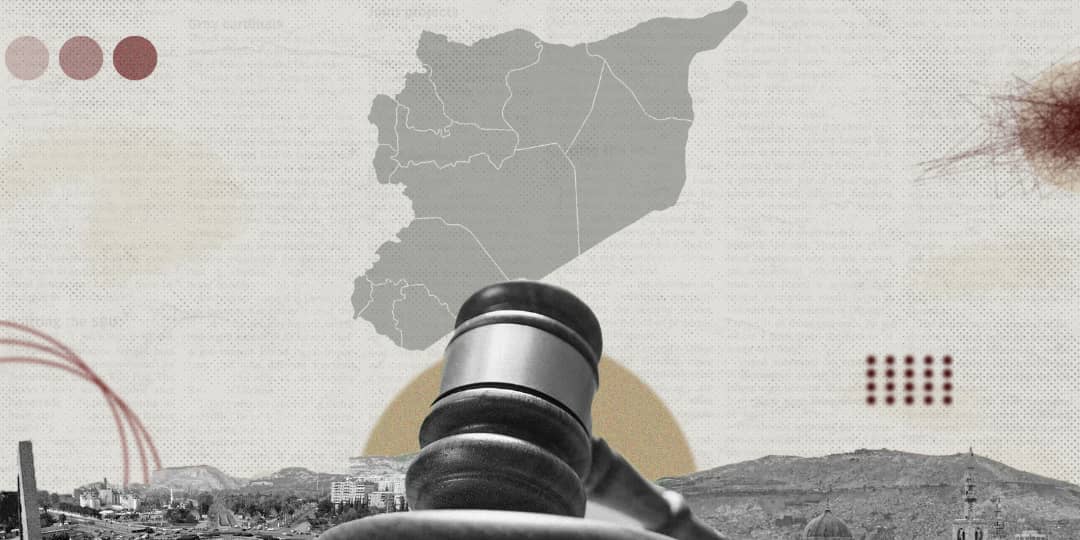
Since the outbreak of conflict in Syria in 2011, the country has witnessed grave human rights violations and war crimes documented by both international and local organizations. Yet, despite the fall of the previous Syrian regime, the long-sought justice has not been achieved to this day. This failure has inflicted profound negative consequences on Syrian society, entrenching sectarian divisions, unravelling the social fabric, and impeding recovery, stability, and reconstruction.
Violations and Numbers
In Syria, the violent incidents and abuses that occurred in the coastal region and in Suwayda, in addition to the explosion at Mar Elias Church in Damascus, have placed the Syrian government in a true test; to prove, both domestically and internationally, that it can deliver transitional justice, reunite Syrians, uphold citizenship, and counter attempts to incite sectarian strife.
Justice Minister in the Syrian government, Mazhar Al-Weis, announced that a committee of seven members, including judges, lawyers, and a military official, will investigate the circumstances surrounding the Suwayda events. The committee is expected to present its final report within three months of its formation, according to Syria’s official news agency, SANA.
A preliminary report by the Syrian Network for Human Rights (SNHR) documented the killing and injury of more than 1,700 people in Suwayda province in southern Syria since July 13. According to the report, at least 814 people were killed, including 34 women, 20 children, six medical personnel, and two media workers, while 903 others were injured during the violence in Suwayda.
Read also: Between Identity and Reconciliation: Which Path Leads to Stability in Syria?
While the fact-finding committee on the Syrian coast events revealed in its final report that 1,426 people were killed, including 90 women and several former soldiers who had undergone reconciliation agreements, during clashes in March.
The committee stated in a Damascus press conference that it identified 298 individuals suspected of committing violations, as well as 265 members of “remnants” from the deposed regime accused of similar acts. It noted that it had visited 33 sites, examined several mass graves, and collected over 936 testimonies from witnesses and officials, including accounts of killings, torture, and armed threats.
Challenges to Achieving Justice in Syria
Speaking to +963, Fadel Nofal, a member of the General Secretariat of the Syrian Democratic Committees based in Berlin, explained that the goal of transitional justice is to achieve national reconciliation after years of war by holding accountable those responsible for massacres and killings of civilians.
In Syria, as elsewhere, transitional justice faces serious challenges, according to Nofal: “The absence of the necessary infrastructure for transitional justice at this stage – such as independent courts, impartial judges, and a conducive political environment – remains the primary obstacle.”
For his part, Fadel Abdul Ghani, Director of the SNHR, argued that the government-appointed fact-finding bodies investigating the coastal and Suwayda events lack independence. “The path so far is neither genuine, nor effective, nor serious,” he said, noting that some international actors have exploited the Syrian file for narrow political gain, further shrinking the chances for real accountability.
The Consequences of Absent Justice
Abdul Ghani warns that the absence of justice in political representation and accountability will push communities to fall back on their sectarian identities rather than embrace the state and citizenship. This could lead to a rise in revenge attacks, harm security, the economy, social cohesion, and ultimately block reconstruction and stability.
He stresses that without transitional justice, crises will deepen, divisions will widen, and peace efforts will falter; since it is an essential component of any sustainable peace process.
Nofal echoes this view, saying: “Instead of creating a participatory political environment and establishing courts to begin applying transitional justice, the current authorities have widened the rift between Syria’s social components, fuelling sectarianism and feelings of hatred and revenge.”
The lack of justice, he adds, has entrenched a deep sense of injustice among victims and their families, while impunity has emboldened all warring parties to commit further crimes without fear. This has led to social disintegration and the erosion of trust in state institutions.
Nofal further asserts that “the current authority bears full responsibility for massacres committed under sectarian pretexts, first in the coastal region against Alawites, then in Jaramana, Sahnaya, and Suwayda against Druze communities. What we see now is a cycle of vengeance and lawlessness.”
In his view, replacing transitional justice with retaliatory justice undermines citizenship, fuels sectarian fragmentation, erodes trust in the state, and escalates communal hostility; all of which heighten the risk of civil conflict and even separation.
Read also: Investigative Committees in New Syria… Under Scrutiny!
Solutions and Proposals
In mid-May, Syrian President Ahmad Al-Sharaa issued a decree forming the National Authority for Transitional Justice. According to the decree, the body’s mandate is to document grave violations committed by the deposed regime, hold those responsible accountable, and provide reparations to victims.
Nofal argues that the decree is flawed and incomplete, as it focuses solely on violations committed by the Assad regime against Syrians, without addressing abuses carried out by armed factions affiliated with the Ministry of Defense in the coastal region and Suwayda.
“If the current authority truly wants to achieve transitional justice, it must first hold accountable factions that were part of Hay’at Tahrir al-Sham, as they deserve prosecution just as much as the former regime for massacres and killings committed throughout the war,” he says.
In his assessment, solutions are now “almost impossible” due to the deep social rift and lack of trust in the new government. “If transitional justice is to happen,” he insists, “the current authority itself should be the first to stand trial for the atrocities committed by its affiliated factions against minorities shortly after it took power.”
For Abdul Ghani, transitional justice measures must go beyond prosecutions and judicial reform to include recognition, reparations, and memorialization for all victims without political, religious, or ideological selectivity. Civil society must be involved in monitoring and accountability.
He explains that the process should have two tracks; legal (prosecuting perpetrators) and political (integrating all components into the political process). Citing legal scholar Ruti Teitel, he emphasizes the need for a specialized national body formed by parliament, composed of competent, impartial, and experienced figures representing all segments of society.
Abdul Ghani concludes that success will require a collective commitment from all stakeholders, victims and survivors, state institutions, civil society organizations, and the international community. “No single actor can achieve transitional justice alone, and none of its four pillars – criminal accountability, truth-telling, reparations, and institutional reform – can be effective in isolation.”
In Syria’s complex political and security landscape, neglecting justice will not freeze the conflict; it will deepen sectarian divides, corrode public trust in the state, and obstruct reconstruction and stability. Transitional justice remains the only path to building a unifying national identity that transcends narrow affiliations.











