


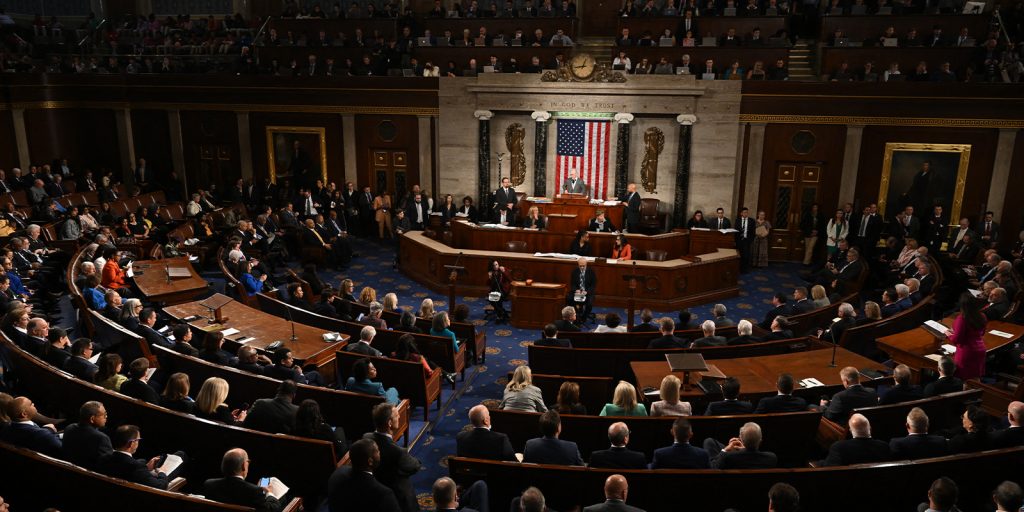
Washington – The U.S. House of Representatives on Tuesday advanced legislation to amend and extend the Caesar Syria Civilian Protection Act sanctions for an additional two years, reversing earlier efforts by some lawmakers to repeal the law altogether.
The bill, titled the Syria Sanctions Accountability Act, passed the House Financial Services Committee with 31 votes in favor and 23 opposed.
Introduced by Rep. Michael Lawler, chair of the Middle East and North Africa subcommittee, the bill focuses on reviewing financial restrictions and strengthening anti–money laundering enforcement.
It proposes to extend the waiver granted in May 2024, initially for 180 days, to a full two-year period, with the possibility of full termination of the Caesar Act if the Syrian government meets certain human rights and governance conditions for two consecutive years.
Among the bill’s stipulations is a requirement for the U.S. administration to regularly brief Congress on regulatory exceptions granted to the Central Bank of Syria.
The legislation must still pass the House Foreign Affairs Committee, secure a full House vote, and move through the Senate before becoming law.
Read also: U.S. Envoy: Syrian Government Must Be Held Accountable for Suwayda Violence
Republican Congressman Joe Wilson, one of the most vocal opponents of the Caesar Act, criticized the committee’s move. He stated that the new bill “does not reflect President Trump’s vision for Syria” and called for a full repeal to promote regional stability.
On the other hand, supporters argue the bill balances the need for targeted pressure on Damascus with flexibility for humanitarian assistance and counter-narcotics coordination.
Key benchmarks for lifting the Caesar Act include:
- Cessation of aerial attacks on civilians
- Unhindered access for humanitarian aid
- Release of political prisoners and access to detention centres
- Non-discrimination against religious minorities
- Verified steps to combat the Captagon drug trade
As deliberations continue, the future of the Caesar sanctions remains a focal point of U.S. policy toward Syria amid growing international debate over the effectiveness of broad-based economic penalties.











