


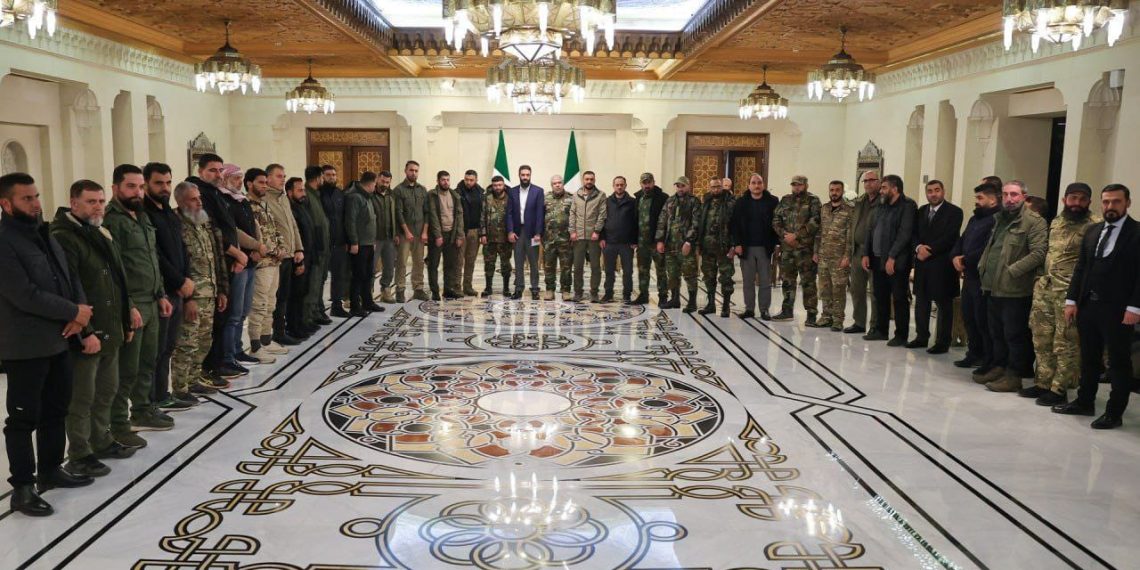
In a move that has drawn sharp criticism from human rights advocates and U.S. officials, Syria’s Ministry of Defense announced the appointment of Brigadier General Ahmad Ihsan Fayad Al-Hayes, better known by his nom de guerre, “Abu Hatim Shuqra”, as commander of Division 86. The ministry framed the decision as part of a broader restructuring effort to “reinforce field leadership with seasoned military professionals.”
Al-Hayes, a native of Shaqra in western Deir Ezzor and a member of the Bu Maish clan of the Bakara tribe, rose to prominence during the early stages of the Syrian uprising in March 2011. Initially active in peaceful protests in Damascus and Deir Ezzor, he later joined the armed opposition, leading the Ahrar al-Sharqiya faction for several years. He subsequently served as deputy commander of the Liberation and Construction Movement, a key component of the Turkish-backed Syrian National Army (SNA), before being named deputy commander of the SNA’s First Corps in August 2023.
Read also: U.S. Calls for Accountability Over Recent Violence in Syria
A Controversial Figure with a Troubled Record
Despite his prominent role in opposition military ranks, Al-Hayes is a deeply polarizing figure. In July 2021, the U.S. Department of the Treasury sanctioned him for alleged involvement in grave human rights abuses, including extrajudicial executions, torture, abductions, and incorporating former ISIS fighters into his faction.
He has also been linked to the 2019 assassination of Kurdish politician Hevrin Khalaf, co-chair of the Future Syria Party, who was executed alongside her driver, Farhad Ramadan, on the M4 highway. Media reports and circulated images placed Al-Hayes at the scene of the incident, where Khalaf and her entourage were forcibly removed from their vehicle and summarily executed.
U.S. Response: Warning Against Legitimizing Abusers
Following Al-Hayes appointment U.S. Ambassador to the United Nations Dorothy Shea issued a strong rebuke, stating, “We expect all perpetrators to be held accountable, especially those in leadership roles or who are high profile.” She warned that such appointments undermine the principles of justice and reconciliation and send the wrong message to the Syrian people.
In an earlier statement from April, Shea confirmed that “The Syrian people deserve leadership that is transparent, accountable, and fully committed to a more peaceful and prosperous future after 54 years of ruinous rule under the Assad regime.” She warned that involving individuals tied to terrorism or foreign influence could threaten the legitimacy of the new government.
Read also: Is ISIS Making a Comeback?
Human Rights Advocates: A Blow to Transitional Justice
Ibrahim Sheikho, Director of the Human Rights Organization in Afrin, told +963 that Al-Hayes’ appointment represents “a culmination of a policy of imposing facts on the ground by force, sidelining national figures who played key roles in the revolution.”
According to Sheikho, the elevation of sanctioned individuals to senior leadership positions signals “a complete failure to respect the principles of transitional justice.” He cited other controversial figures, including Mohammed Jassem (Abu Amsha), Ibrahim Issa, and Saif Abu Bakr, who have also been promoted despite being implicated in human rights abuses. “This is not reform; it’s a power-sharing deal between warlords,” he said. “It reflects an utter lack of political will to pursue accountability.”
Sheikho urged the international community to move beyond observation and take concrete steps toward launching a credible political process, expelling foreign actors, and excluding individuals accused of war crimes.
Persisting Influence of Warlords
Political analyst and journalist Abdel Halim Suleiman, speaking from Qamishli, argued that the appointment reflects “deep-rooted power dynamics” within Syria’s evolving military apparatus. “Warlords continue to dominate on the ground, while the state lends them a veneer of legitimacy,” he said.
Suleiman believes Al-Hayes’ promotion was heavily influenced by regional actors, particularly Turkey, which retains substantial influence over certain Syrian factions. “This complicates the new government’s efforts to earn international credibility,” he noted.
In addition to Khalaf’s killing, Al-Hayes is accused of involvement in looting, extortion, and sectarian violence in Tel Abyad, Afrin, and villages along Syria’s coast. “These appointments recycle old patterns of rule,” Suleiman said, “but they’re increasingly at odds with international legal norms.” He added that the decision has sparked anger among Kurdish communities and political elites in northeast Syria, who see it as a step backward for justice.
Feminist and Kurdish Backlash
Roksan Mohammed, spokesperson for the Women’s Protection Units (YPJ), condemned the appointment on X, writing:
“We strongly condemn the appointment of mercenary Abu Hatim Shaqra, involved in crimes against women, Yazidis, and the assassination of Hevrin Khalaf and her driver Farhad Ramadan. This decision institutionalizes impunity and reinforces violence against women and indigenous communities. Our struggle for justice continues.”
Human rights activist Nada Hussein Malaki echoed that sentiment, calling the appointment a “shock” to the Kurdish public. Speaking to +963, she stated:
“The Autonomous Administration of North and East Syria has formally rejected the appointment and called for Al-Hayes’ dismissal and prosecution. His record disqualifies him from holding any national position.”
“These decisions run counter to the idea of national reconciliation,” she added. “They perpetuate our marginalization and normalize impunity.” Malaki vowed that once a new Syrian state stabilizes, civil society would pursue legal action both domestically and internationally. “Justice has no expiration date. The blood that was spilled will not be forgotten.”
SDF-State Integration Pact
The timing of Al-Hayes’ appointment is particularly sensitive. On March 10, Syrian interim leader Ahmad Al-Sharaa and Syrian Democratic Forces (SDF) commander Mazloum Abdi signed a landmark agreement to integrate SDF institutions into the Syrian state apparatus, including control over oil fields, border crossings, and the Qamishli airport.
Read also: Ilham Ahmed to “+963”: U.S. Support for the SDF is Independent of Any Deals with Russia
According to Malaki, the deal, brokered with international support, was meant to limit the influence of external actors like Iran and Turkey. “Mazloum Abdi’s presence in Damascus aimed to strengthen the agreement,” she said. “But the inclusion of figures like Al-Hayes undermines trust and threatens the process.”
An SDF military source, speaking anonymously to +963, offered a blunt assessment:
“Crimes do not expire. Anyone who committed atrocities against our people, regardless of title or rank, will be held accountable.”











