


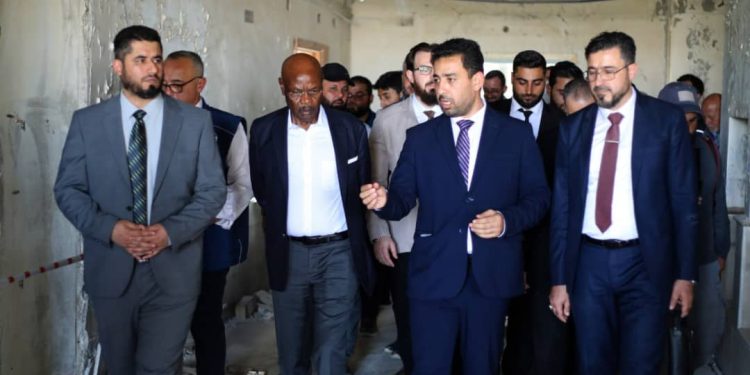
The United Nations Coordinator in Syria, Adam Abdel Mawla, confirmed on Sunday, June 29, that cooperation between the United Nations and the Syrian government is witnessing significant progress across various sectors.
He stated that the relationship between the United Nations and the Syrian government is “very positive,” encompassing humanitarian, societal, and economic domains, with a central focus on supporting stability and promoting societal peace.
Abdel Mawla explained that all international organisations operating in Syria are cooperating effectively with the Syrian government and backing its efforts to reintegrate into the global banking system. He emphasised that this reintegration is crucial for facilitating financial transactions and enhancing economic openness, describing it as a necessary step to stimulate development and reconstruction, according to the Syrian Al-Ikhbariya channel.
He noted that international organisations are also supporting the Syrian government’s community reconciliation programs and initiatives aimed at strengthening social cohesion. Building civil peace, he said, is one of the United Nations’ priorities in Syria in the coming period.
The UN official stated that the United Nations had suspended its development activities in Syria since 2012 due to security and economic conditions. However, he indicated that the current phase would focus on expanding humanitarian efforts while increasingly supporting reconstruction projects and improvements to infrastructure and basic services.
He added that it is in the interest of European donor countries to invest in Syria’s stability, security, and the well-being of its people. Such investment, he stressed, would help reduce waves of asylum and illegal immigration and contribute to greater stability in the region.
The United Nations Coordinator in Syria called on the United States Congress to permanently repeal the Caesar Act, instead of continuing to suspend it every six months. He explained that the legislation constitutes a major obstacle to reconstruction and economic recovery efforts in Syria.
He further stated that the United Nations has repeatedly condemned ongoing Israeli violations of Syrian territory and reaffirmed the international organisation’s commitment to the principles of international law, particularly respect for Syria’s sovereignty, unity, and territorial integrity.
On Saturday, June 28, the United Nations High Commissioner for Refugees, Filippo Grandi, expressed concern over the German government’s decision to suspend family reunification for refugees with subsidiary protection status.
Grandi warned of the consequences of exerting pressure on Syrian refugees to return, given the continued fragility of Syria’s security and economic conditions.
“The Syrians got rid of Bashar al-Assad’s regime, but the new government lacks experience, and the situation is still unstable,” Grandi said, according to the German newspaper Frankfurter Allgemeine Zeitung.
He emphasised that most of those who have returned to Syria are internally displaced persons, while returns from Europe remain almost non-existent due to the worsening conditions inside Syria compared to host countries.
Grandi called on the German government to reconsider its decision to suspend family reunification, highlighting the importance of supporting the most vulnerable refugee groups and transforming aid into development investments that promote self-reliance and social integration.
The UN High Commissioner for Refugees reiterated the organisation’s position that the return of Syrian refugees must be voluntary, safe, and dignified, warning against any forced deportation measures that could expose returnees to further violations or inhumane living conditions.











