


DAMASCUS
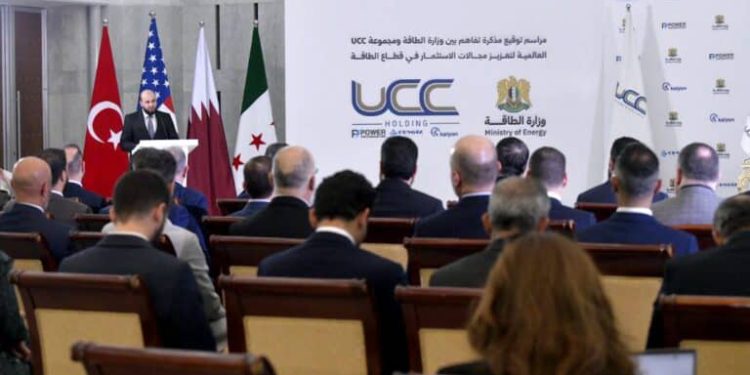
On Thursday, May 29, the Ministry of Energy in the Syrian Transitional Government signed a landmark agreement aimed at boosting international investment in Syria’s electric power generation sector, with a total estimated value of $7 billion.
According to the state-run Syrian Arab News Agency (SANA), the agreement includes the development of four combined-cycle gas turbine (CCGT) power stations. The facilities will be located in Deir ez-Zor Governorate, Mharda and Zizoun in the Hama countryside, and Trivawi in the rural areas of Homs.
The total generation capacity of these four stations is projected to reach 4,000 megawatts, utilising American and European technologies. In addition, the deal includes the construction of a solar power station with a capacity of 1,000 megawatts in the Spring Valleys region in southern Syria.
Read more: EU Sanctions Syrian Militia Leaders, Lifts Most Sanctions on Damascus
The agreement was signed with a consortium of international companies, including Qatar’s UCC Holding and Orbacon, Türkiye’s Kalyon GES Energy Yatirimlari and Cengiz Energy, and Power International USA.
“This is a historic moment for our country,” said Syrian Energy Minister Muhammad al-Bashir. “It marks a turning point in our energy and electricity sector, laying the groundwork to rebuild critical infrastructure that has long suffered from neglect and destruction.”
Al-Bashir emphasised that the agreement not only strengthens regional cooperation in the energy domain but also encourages clean and renewable energy development in Syria. The minister added that the 5,000 megawatts of combined capacity will significantly increase the hours of power supply across the country and improve daily life for Syrians.
Ramez Al-Khayyat, CEO of Orbacon Holding, described the deal as the beginning of a new phase in Syria’s reconstruction efforts. “This agreement is about more than energy, it’s about building self-sufficiency across sectors and supporting a sustainable national revival,” he said.
Al-Khayyat added that the participating companies plan to deploy state-of-the-art equipment for the projects, which are expected to create over 50,000 direct jobs and an estimated 250,000 indirect job opportunities.
The agreement follows a separate energy accord reached last week between Minister al-Bashir and Turkish Energy Minister Alp Arslan Bayraktar, covering investments in energy, mining, and phosphate sectors.
During a joint press conference in Damascus, Minister Bayraktar announced that Türkiye would supply Syria with 2 billion cubic meters of natural gas to support electricity generation. This gas supply, he said, will enable the production of up to 1,300 megawatts of electricity.
Bayraktar also revealed that Ankara had already begun providing Syria with 1,000 megawatts of electricity and outlined plans for short- and long-term energy projects within Syrian territory.
As part of their cooperation, al-Bashir and Bayraktar confirmed work is underway to complete the gas pipeline linking Kilis in southern Türkiye with Aleppo in northern Syria, expected to be operational by June.
Al-Bashir stressed the importance of increased coordination between Damascus and Ankara, particularly to facilitate the entry of Turkish firms into Syria’s energy, mining, and phosphate sectors. The two sides also agreed to form technical committees to advance the implementation of the agreements, according to Syrian state television channel Al-Ikhbariya.











