

As Syria undergoes significant political and constitutional changes following the fall of the Assad regime, there is a growing need to reassess the legal, legislative, and constitutional foundations of the state, particularly the Constitutional Declaration.
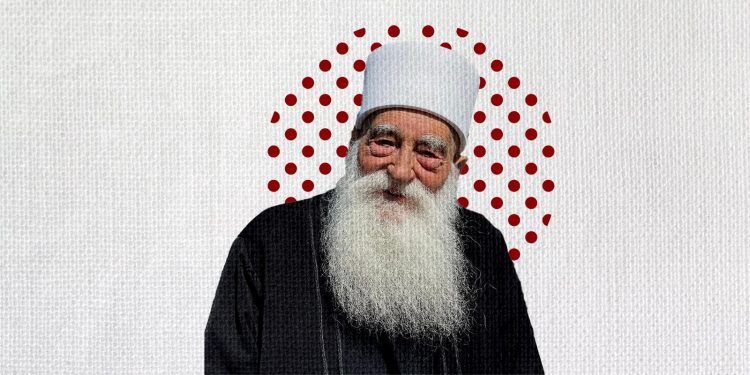
In this context, Sheikh Hamoud al-Hanawi, Sheikh Akl of the Unitarian Druze Community in Syria, shares his perspective in the fourth issue of the printed edition of +963. He emphasizes the importance of unity in shaping Syria’s future, working toward the public good, and upholding the principles of full citizenship for all components of Syrian society to foster national stability.
Sheikh al-Hanawi affirmed that the people of al-Suwayda reject any attempt to drag them into conflicts that do not serve the national interest. He stressed that Suwayda remains an integral part of Syria and that patriotism is a matter of honour, dignity, and unwavering principle. “We see all Syrians through the same lens: shared patriotism,” he stated.
In this exclusive interview, Sheikh al-Hanawi outlines his vision in this critical period and discusses several pressing issues, including constitutional reform and the role of religious leadership in supporting national consensus.
How can we talk about the context of dialogue with the government in Damascus?
Sheikh al-Hanawi responded, “We always welcome and seek dialogue. We have never closed the door to national understanding. We are the sons and daughters of this land, and the Syrian state is our reference. Any disagreement or inconsistency must be resolved through dialogue under the roof of the nation, not outside it.”
How far have the steps progressed in this regard?
He elaborated, “We speak only under the national umbrella and within the framework of full citizenship. What we ask for is what every Syrian demands: justice, dignity, and respect for individual rights. We do not fear the government in Damascus but rather the possibility of marginalization or infringement on our community’s unique identity. Reassurances must be constitutional and administrative, translated into practical measures rather than remaining mere slogans. The true guarantee always lies within the state when a national contract is upheld and monitored by constitutional institutions.”
How do you assess what has happened across the Syrian coast? Could it increase your hesitation to engage in dialogue with the government in Damascus before certain reassurances are provided?
Sheikh al-Hanawi expressed his concern, saying, “What has happened along the coast is deeply troubling and calls for a responsible stance. However, this does not mean the end of dialogue; rather, it serves as an additional reason to emphasize the necessity of a comprehensive national agreement that guarantees the rights of all.”
How do you assess your relationships with other Syrian components, specifically Christians and Kurds?
Sheikh al-Hanawi responded, “Our relationship with all Syrian components is built on mutual respect and cooperation. We are partners in both land and destiny. Christians, Kurds, and all communities have their rightful status and respect, and what unites us far outweighs what divides us.”
He continued by saying that Syria’s societal structure is founded on religious and national pluralism, and the Syrian people have consistently upheld the national cause that ensures unity. This principle has been enshrined in previous constitutions, and for the state to be rebuilt effectively, several steps must be taken:
- Learning from past mistakes that led to division and firmly rejecting any separatist projects.
- Ensuring that the Syrian people’s relief from oppressive laws and injustices is not squandered by reverting to the same suffering and conditions that once devastated Syria.
- Recognizing that the Syrian people, by their nature, do not accept unilateral governance, authoritarian rule, or domination based on religion, nationality, party, or sect.
- Drafting a national constitution that upholds the dignity of all citizens, protects their rights, and respects their b we eliefs and affiliations is achievable only through impartial governance and the safeguarding of national unity.
- Addressing past grievances by rectifying the injustices inflicted by previous regimes through arbitrary laws while ensuring fair compensation for those affected.
How could the Syrian Constitution express all Syrian components with full, undiminished citizenship?
Sheikh al-Hanawi explained, “Since independence, Syrian constitutions have acknowledged Islamic, Christian, and other communities, with laws enacted to guarantee their rights, thereby reinforcing national unity. However, despite the strength of constitutional texts, violations have occurred throughout various eras. A ‘divide and conquer’ strategy has often been used to incite sectarian conflicts, leading to division and strife—something history has repeatedly demonstrated.”
He added, “We have lived through these experiences, and we now hope that a conscious and just vision will emerge in Damascus—one that eliminates the fears of different communities and minorities. Achieving this depends on the awareness and approach of the current leadership in Damascus.”
What about some outsiders’ attempts to exploit the name of the Unitarian Druze Community?
“It must be emphasized that our community rejects foreign interference and will not serve the interests of any external party or entity. We have never acted in a way that harms national unity. Above all, we are Syrians, and the Unitarian Druze Community has always been an integral part of Syria’s national fabric. We have never extended our hands to outsiders. Our community is peaceful and respects all Syrian components, but we will not allow our dignity or sovereignty to be undermined.”
What are your aspirations for the future of the Unitarian Druze Community in Syria?
“We do not see ourselves as a minority, but rather as a majority in our patriotism, morality, faith, and respect for others. Belonging to one’s homeland is an honour for every citizen, and we hope all Syrians share this sentiment. Unfortunately, sectarianism persists in certain circles, including among those considered part of the majority. This is reflected in attempts to discredit or diminish the beliefs of others, a painful phenomenon that stems from the erosion of religious tolerance.”
How would you like to conclude your words?
“We await concrete steps from Damascus to lift the injustices suffered by the Syrian people. This can only be achieved through drafting a new constitution that aligns with the aspirations of the people. We also recognize the majority’s right to lead and have never challenged this principle. However, we believe in the necessity of proportional representation that ensures fair participation for all components of Syrian society.”
Sheikh al-Hanawi was born on 1 January 1943 in the village of Suhu Balata. He grew up in a society that values and seeks knowledge in every way, within a family that was one of the most resilient against Ottoman and French colonialism. His grandfather, the poet, sheikh and commander Abu Ali Kassam al-Hanawi embodied these qualities in his roles. He served as the Sheikh Akl of the Unitarian Druze Community in Syria, a position that was later passed down to his son.
His mother, Sukariya al-Hanawi, was credited with his education. She was one of the few women who attended primary school in the village of Dhabi, then continued her secondary school in the village of Mazraa and high school at Dar al-Hakma in the city of Suwayda. She graduated as a teacher in 1963, worked for 14 years teacher in Deir ez-Zor, and later moved to teach in schools in the villages of Kafr and Suwayda.
During his mandatory military service which lasted almost five years, al-Hanawi studied at the Faculty of Arts, Department of Arabic Language, and graduated in 1975. He then travelled to the United Arab Emirates, where he worked as an Arabic language teacher. He also worked in the Bayan and Gulf newspapers.
Sheikh al-Hanawi has been entrusted with the duties of Sheikh Akl of the Unitarian Druze Community in Syria, a position he continues to hold until today.
This article was published in the Third issue of the weekly printed edition of +963, published on Friday, March 28, 2025.
You can download the Third issue of the printed edition of +963 here