


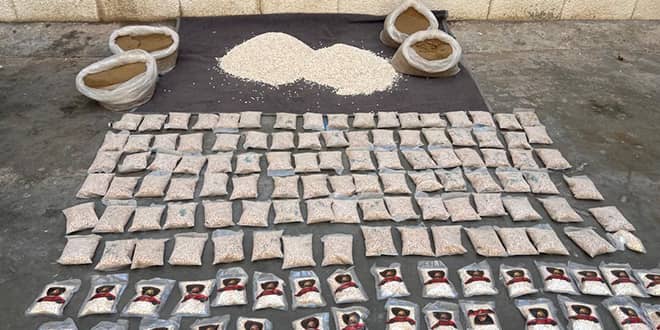
The Syrian Ministry of Interior under the transitional government announced the seizure of three million Captagon pills and 50 kilograms of cannabis in the countryside of Damascus.
According to a report by the official Syrian Arab News Agency (SANA) on Friday, June 27, the Anti-Narcotics Branch in the Damascus countryside, in cooperation with the Internal Security Directorate in the Nabek area, intercepted a major drug smuggling operation.
SANA stated that the seizure came following an intensive surveillance campaign targeting a smuggling network operating between Lebanon and Syria. The confiscated narcotics included approximately three million Captagon tablets and 50 kilograms of cannabis.
Brigadier General Khaled Eid, Director of the Narcotics Control Department in Syria, said the operation was the result of continuous monitoring of the network’s activity through illicit border crossings in the al-Jarajir area along the Syrian–Lebanese frontier. An ambush was set up on a route frequently used by the smugglers.
Read more: With Only Three Planes Left, Syria Looks to Build New Airports
According to Eid, a confrontation broke out between the security forces and members of the smuggling group. The suspects managed to flee the scene, abandoning the vehicle they were using.
A subsequent search of the vehicle uncovered the large drug shipment. Eid confirmed that a formal seizure record was documented and that legal proceedings against the suspects had begun. Efforts to apprehend the fugitives are ongoing.
“The Syrian territory will not be a corridor or haven for drug trafficking and distribution,” Brigadier General Eid stated.
The operation comes just one day after the United Nations Office on Drugs and Crime (UNODC) released its annual World Drug Report, which reaffirmed Syria’s central role in the production and distribution of Captagon across the region.
The report noted that despite recent security crackdowns following the fall of the former regime last December, Syria remains a major hub for Captagon production.
According to the UN, the deposed regime had long relied on the Captagon trade as a key source of income during the war years, generating billions of dollars despite international sanctions and diplomatic isolation. The regime and its allies reportedly leveraged the narcotics industry to bolster their finances and influence.
Since coming to power, the Syrian transitional government has adopted a more aggressive stance against drug trafficking. It has publicly destroyed large quantities of seized Captagon and reiterated its commitment to dismantling smuggling and production networks, the UN report stated.
Nevertheless, the report warned that Captagon shipments continue to move out of Syria, especially across the border with Jordan. It added that “active smuggling networks and criminal groups are still exploiting ongoing security instability to profit from the trade.”











