


Malek Al-Hafez
The concept of a national doctrine in any army is the foundation that grants it legitimacy and the ability to represent society. Such a doctrine is usually built on the values of defending the homeland and sovereignty, transforming the soldier into a bearer of a shared idea that reflects collective belonging. In Syria, however, this concept gradually eroded and ultimately collapsed with the outbreak of the 2011 revolution. The army was summoned not to defend borders but to suppress popular protests. In doing so, the notion of the homeland in military doctrine became reduced to the ruling authority, rather than the society from which legitimacy should stem.
This absence of a national doctrine deeply damaged the relationship between the army and society. First, it shattered trust: citizens began to see the military as a direct threat rather than a guarantor of rights. Second, it fragmented belonging: military service ceased to be seen as a unifying national duty and instead became a burdensome tie to a repressive machine. Third, it deepened social division: the army turned into a top-down institution detached from an increasingly marginalized society.
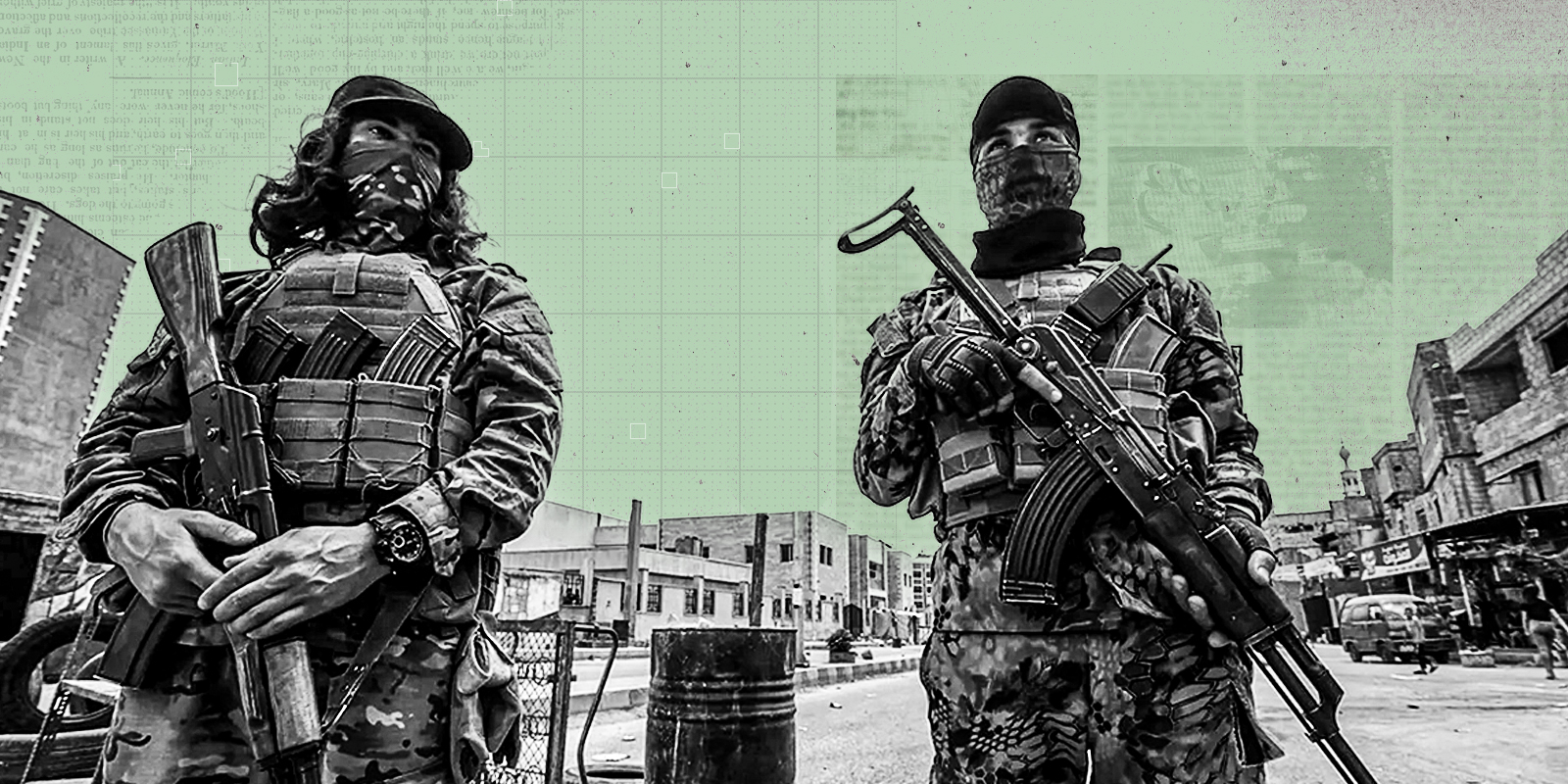
Despite the fall of the former regime, with its long legacy of militarizing against the people, the army under the current authority has failed to transcend that repressive heritage or articulate a new national doctrine. Within mere months of the new leadership, it became evident that the military institution still operates with the same logic: obeying political orders that view Syria’s diverse social components as threats to be crushed. The violations on the coast and subsequent crimes in Suwayda exposed how the new Syrian government has not redefined the army’s role but instead reproduced it as a tool for reasserting control through violence. This early turn in such a short timeframe highlights that the problem is no longer confined to the old regime but is equally rooted in the new authority’s unwillingness to reimagine the army as a unifying national institution.
Structurally, decades of policy turned the army into an extension of the security services rather than a professional national force. Its entanglement with intelligence agencies stripped it of professionalism, cementing its role as an apparatus of internal control. This model directly contradicts the principles of modern armies, which are supposed to be subordinated to elected civilian authority. In Syria, no such civilian oversight existed: the army was swallowed into a comprehensive security apparatus, making the protection of the ruling authority its ultimate mission.
The experience of Syria’s current government has provided a stark example of its inability to move beyond the army’s repressive structure. Ironically, this government came to power in a context that should have opened the door for a new social contract and a break with the logic of the security state. Yet its actions have revealed how quickly it resurrected the legacy of militarization to subjugate society once more. This exposes the fragility of its political legitimacy, which rests not on national consensus or a solid constitutional base, but on the hasty deployment of the army as an instrument of coercion. For Syrians, the outcome has been nothing but a reproduction of authoritarian violence under a new name.
The creation of the “new army” through the merger of armed factions was not merely a technical step in military restructuring; it was a profoundly political decision. Without a unifying national doctrine or clear professional standards for recruitment, promotion, and discipline, this army has become a magnified version of the militias from which it emerged. Partial loyalties remained intact, and its treatment of society continued to reflect a militia mentality rather than a national institutional one. The result is an army that cannot serve as the cornerstone of a state but rather poses an ongoing threat to it; an official framework for the perpetuation of unrestrained force.
Alao read: The Return of the “Syrian Army”: Should Anyone Still Be Waiting?
This dynamic puts any political authority depending on such a structure in a double bind: on the one hand, it faces a society that views the army as a continuation of factional abuses; on the other, it must contend with a network of conflicting internal loyalties that make institutional discipline nearly impossible. Maintaining this structure means cementing a new form of militarization in Syria, one without a national foundation, capable only of generating crises rather than resolving them. In this sense, today’s “new army” is less a safeguard for a future state than a permanent destabilizing force, embedding chaos within the trappings of an institution.
Theoretically, Syria’s case fits into the model of the “security state” described by political scientists, a state that militarizes its domestic sphere and derives its legitimacy from fear rather than a social contract. Michel Foucault spoke of disciplinary power that manifests through surveillance and punishment; a reality visible in Syria, where the army’s function has been reduced to coercive control. Similarly, in a “soft state,” public institutions lose their monopoly over legitimate violence to sprawling authoritarian agencies that operate without legal restraint.
The military repression Syrians have endured since 2011 has left a deep scar on collective consciousness. The army, once supposed to symbolize protection and national dignity, has become associated in the Syrian imagination with bombardment, arrest, and massacres. This psychological shift produced what can be called a “collective trauma,” in which the line separating external enemies from internal threats has vanished, and citizens see their own army as an existential danger rather than a source of security.
Socially, this repression, spanning from the early uprising in 2011 to the transitional phase and the events in the coast and Suwayda, has reshaped the relationship between individuals and the state. Citizens perceive the army as an instrument of domination. Repeated experiences have reinforced in collective memory the image of the military as a repressive machine directed inward.
Psychologically, this fosters a permanent sense of insecurity, erodes trust in any official institution, and drives people toward narrower identities – familial, sectarian, and regional – as substitutes for the lost idea of the state.
The longer-term effect of this shift is the weakening of national belonging itself. The army can no longer be imagined as a unifying institution embodying the nation, but only as a force estranged from society. This psychological–social fracture stands as one of the gravest challenges to any future attempt at state reconstruction: it is not just about rebuilding institutions, but about restoring collective consciousness and reimagining the army as a protector rather than a predator.
*The views expressed in this article do not necessarily represent those of +963 Media Association .











