


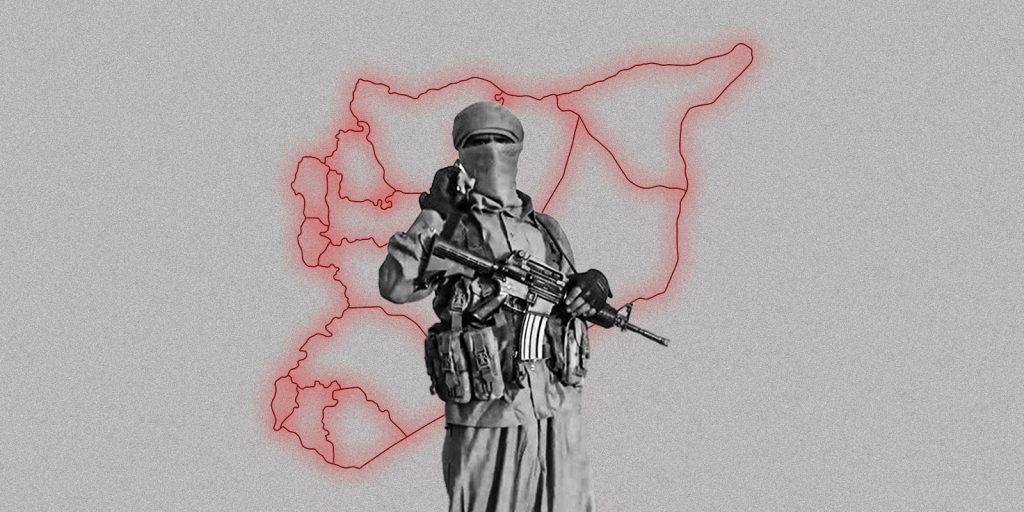
The recent bombing at St. Elias Church has reignited fears among Syrians, as ISIS shifts its operations toward more populated and vulnerable areas, posing a renewed threat to civil peace and stability. This attack underscores the challenges facing Syria’s transitional government in containing the extremist group’s resurgence.
During Sunday mass at St. Elias Church, a gunman, reportedly affiliated with ISIS, opened fire on worshippers, killing more than 20 civilians and injuring around 50 others. Although ISIS has not officially claimed responsibility, Syrian intelligence services announced the arrest of a cell linked to the attack and claimed to have prevented another planned bombing in the Sayyida Zainab area, seizing weapons and improvised explosive devices (IEDs).
The incident has raised pressing questions about how ISIS operatives are infiltrating government-controlled zones from the Syrian desert. Both local and international observers warn of the group’s growing threat, noting efforts to reorganize its ranks. Notably, the group’s rhetoric, structure, and tactics appear to be evolving.
Read also: Mar Elias Bombing: Will ISIS Reshape Its Presence Deep Inside Syria?
Adapting Tactics and Command Structure
Western intelligence documents indicate that ISIS has refined its tactical approach in Syria. Recent attacks have increasingly relied on locally manufactured IEDs using components smuggled across porous borders. The group has also adopted “silent attacks” employing knives or other melee weapons against security personnel, an approach that minimizes detection.
In Iraq, authorities report a structural transformation within ISIS following the deaths of many of its senior leaders. The organization now operates under decentralized “Shura Councils”, consultative bodies that emerged in the Syrian desert and rural areas bordering Iraq before the fall of Assad’s regime. Field commanders now enjoy broader autonomy, reflecting a shift from hierarchical to more networked operations.
Estimates from prior assessments suggest that between 5,000 and 8,000 ISIS fighters remain active across Syria and Iraq. Many had been concentrated in the strategically located desert regions between Al-Bukamal and the Iraqi border. Following the collapse of Assad’s regime, these operatives are believed to have moved into territories under Syria’s transitional government.
Read also: U.S. Evacuates Two More Bases in Syria and SDF Warns of Growing ISIS Threat
Geopolitics and Regional Exploitation
There are mounting concerns over how regional powers may be leveraging ISIS as a geopolitical tool. Reports suggest that Turkey has allowed limited ISIS movement in Idlib, while Iran is accused of using the group to exhaust U.S. forces in northeastern Syria. These complex dynamics further complicate counterterrorism efforts.
Syria’s fragmented landscape, home to myriad actors including the Syrian Democratic Forces (SDF), regime troops, and Turkish-backed militias, undermines coordinated responses to ISIS. The lack of shared intelligence between these groups has allowed ISIS cells to operate within “gray zones,” especially in Syria’s east, center, and northeast.
Research institutions have also highlighted ISIS’s increasing reliance on crypto-based financial networks and front companies, particularly in Turkey, as well as the use of unregulated border crossings to fund and sustain operations through illicit activities.
Changing Strategies and Low-Profile Operations
According to recent UN reports, ISIS has adapted its strategy in Syria over the past two years, with attacks increasingly concentrated near the Deir ez-Zor–Hasakah border, where security oversight is weakest.
Ahmad Sultan, an expert on regional security and terrorism, told +963 that ISIS is pursuing an indirect strategy aimed at rebuilding its capabilities, which were severely diminished in recent years due to intensive security operations and leadership losses.
“This new strategy depends on concealment and geographic dispersion,” Sultan explained. “ISIS is recruiting disaffected local youth in remote areas, capitalizing on economic hardship and lack of opportunity. It’s also turning to self-financing through illicit means, such as antiquities smuggling and extortion, making it less reliant on foreign funding than in the past.”
Sultan noted that while the group retains a nominal central leadership, real power now lies with decentralized regional commanders. “The caliphate title has become symbolic. The organization is now effectively managed by a delegated committee. However, this committee struggles to meet or coordinate, so day-to-day decisions fall to local emirs who liaise with regional ISIS offices.”
Read also: U.S. Urges Syria to Negotiate Non-Aggression Pact with Israel, Submit ISIS Detention Plan
He also highlighted growing internal divisions within ISIS over strategic priorities, some factions favor consolidating power in Syria and Iraq, while others push for expansion into Europe and Asia. “These disagreements further complicate decision-making,” he said.
Despite these issues, ISIS continues to exploit lawlessness in certain parts of Syria to establish clandestine training camps. It also uses encrypted messaging platforms to recruit new members and coordinate attacks, which makes detection and disruption by security forces much more difficult.
Sultan warned that the group now favors “soft targets” like religious sites or civilian gatherings. He cited the St. Elias attack as a case in point, even though a lesser-known group, Ansar al-Sunna, claimed responsibility, the claim was riddled with inconsistencies that cast doubt on its authenticity.
ISIS operatives are increasingly armed with light weapons, traveling in small, discreet cells that are hard to trace. Nonetheless, Sultan noted that several recent counterterrorism operations have successfully dismantled ISIS units.
He added that ISIS sleeper cells remain a significant threat, poised to launch surprise attacks when given the green light. These cells exploit security gaps in areas where local and international forces are preoccupied with broader geopolitical rivalries.
Controlled Operatives, Not Independent Leaders
Retired security expert Adnan Al-Kanani told +963 that ISIS has effectively been neutralized, ideologically and militarily, in Iraq, though some individuals with extremist views remain. In Syria, however, operatives often appear to be manipulated rather than ideologically driven leaders.
“In Iraq, cooperation between Baghdad and the Kurdish region, along with international support, has significantly reduced the threat. Syria, on the other hand, remains fertile ground for ISIS due to the multitude of actors and conflicting agendas,” Al-Kanani said.
He believes some ISIS elements in Syria are guided by intelligence officers operating within carefully defined roles assigned by external powers. “Many of these fighters are unknowingly being directed by officers planted by foreign intelligence agencies, who shape their movements and targets.”
Some intelligence agencies reportedly use ISIS as a bargaining chip in political negotiations or as a destabilizing force against rival factions, transforming the group from a coherent insurgent organization into a proxy tool.
Al-Kanani emphasized that confronting ISIS in Syria requires genuine international cooperation, both to curb its instrumentalization for political ends and to address the root causes of extremism, including poverty, exclusion, and systemic inequality.
Without such a unified effort, he warned, the cycle of violence is likely to persist.











