


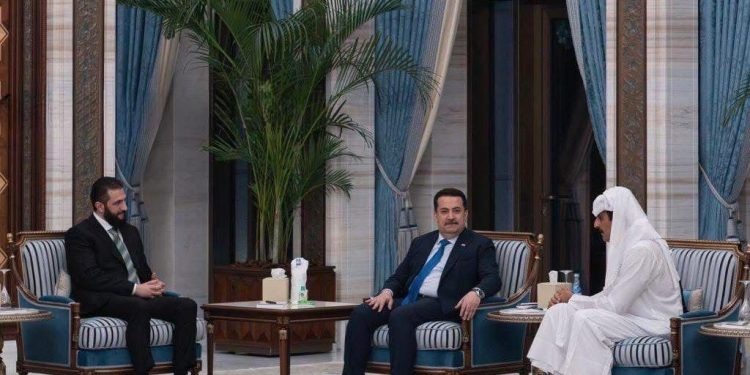
The meeting between Ahmed al-Sharaa and Muhammad Shiaa al-Sudani, arranged by Qatar, did not take place in a vacuum. Rather, it unfolded against a backdrop of shifting geopolitical dynamics and competing regional and international agendas.
In a notable and somewhat puzzling development, Iraqi Prime Minister Muhammad Shiaa al-Sudani’s visit to Qatar and his meeting with Ahmed al-Sharaa, the President of the Syrian Interim Government, marked a significant moment in the rapidly evolving regional scene.
Although the visit was not officially announced at the time, it was also not entirely secret. According to an Iraqi government statement, the encounter carried several implications, particularly in the context of mounting tensions and shifting power equations across the region, chief among them, Iran’s fluid and sometimes ambiguous stance.
The collapse of the Assad regime represented a critical turning point in the modern history of the Middle East. It paved the way for a new government in Damascus, led by Ahmed al-Sharaa, which is now working to reposition itself both within the Arab world and on the broader international stage.
Within this framework, the Qatari-brokered meeting between al-Sharaa and al-Sudani is best understood as part of a larger, complex geopolitical puzzle, deeply entwined with the ambitions and apprehensions of regional and global actors.
Read more: Exemptions: A Substitute for Lifting Sanctions on Syria or a Step Toward It?
Iran and the “Regional Patch”
Speaking to +963, Wijdan Abdul Rahman, an expert in Iranian affairs, noted that the relationship between Damascus and Baghdad is no longer shaped merely by geography and shared history. It has become increasingly subject to broader international tensions, primarily those involving Washington. According to Abdul Rahman, the United States plays a significant role in shaping the political and security landscape in both Iraq and Syria, either by pressuring the Iraqi government to curtail the influence of armed groups or through its undeclared military presence in Syrian territory.
Abdul Rahman added, “The presence of American forces is not solely aimed at combating ISIS. It serves as a strategic instrument for controlling cross-border movements and limiting Iranian influence, whether via Hezbollah or other allied factions”.
He further observed that the dispatch of an American delegation to Damascus signals a form of “political pragmatism.” This step, he clarified, does not necessarily indicate formal recognition of the new Syrian administration, but rather represents an effort to recalibrate strategic interests.
Abdul Rahman stressed that the Syrian-Iraqi border constitutes a “strategic artery for Tehran,” and that any move by the United States to assert control over this area effectively weakens Iran’s capacity to project power through its regional proxies.
“Security is a prerequisite for attracting investments,” he continued. “Both Syria and Iraq are in desperate need of reconstruction, but such efforts cannot succeed in an environment dominated by militias and foreign interference.”
He concluded by likening Syrian-Iraqi relations to a chessboard dominated by international actors rather than the two countries themselves. Nevertheless, he maintained that there remains a space for bilateral cooperation that could serve the interests of both peoples, provided these ties are shielded from external agendas.
Baghdad Explains the Meeting
In response to the uproar surrounding the meeting, particularly following the announcement by several Shiite members of parliament that they had gathered approximately fifty signatures demanding that Ahmed al-Sharaa be barred from attending the upcoming Arab Summit, the Iraqi government moved quickly to issue a clarification.
An official statement affirmed that the visit “was not secret, but it was agreed to announce it at a later time,” adding, “How can it be secret when there are documented photos of the meeting?”
Mustafa al-Naimi, a researcher and political analyst, interpreted the Syrian-Iraqi rapprochement as a direct consequence of “maximum international pressure on the Iranian axis,” particularly within Iraq.
Speaking to +963, he stated, “The division within the Coordination Framework government has become apparent, and it is likely to deepen under the weight of American and Arab pressure.”
He pointed to the abrupt dismissal of Brigadier General Yahya Rasoul, the spokesperson for the Iraqi Armed Forces, as further evidence that Prime Minister al-Sudani is implementing a “gradual plan to curtail Iran’s influence.” He added that “leaders within the Popular Mobilisation Forces will likely face similar measures.”
Al-Naimi continued, “Syria, for its part, is attempting to dismantle the web of international sanctions. It has made some progress and is now seeking to leverage its Foreign Minister’s visit to Washington in order to achieve gains extending beyond sanctions, namely in reconstruction efforts and a return to the international stage.”
Read more: From Silence to Expression: Syrian Culture in the Post-Regime Era.
Exploration or Restoration of Influence?
Iraqi researcher Muntadhar al-Qaisi offered a different perspective, rejecting the notion that the meeting between al-Sudani and al-Sharaa occurred without Tehran’s awareness. On the contrary, he suggested that it may have taken place with Iranian encouragement.
Speaking to +963, al-Qaisi argued that Iran might be seeking to restore its influence in Syria indirectly, using Iraq as a conduit, particularly given Damascus’s urgent need to reopen trade routes and its waning expectations regarding the lifting of international sanctions.
He further pointed out that Iraq’s underdeveloped banking infrastructure and its weak oversight of border crossings may facilitate the informal movement of money and goods, circumventing the scrutiny imposed by sanctions regimes.
In a related context, al-Qaisi added, “Iraq also depends on Syria for both security and economic reasons. Chief among these are the fight against ISIS, the reactivation of the Kirkuk–Baniyas pipeline, and the progress of the Development Road Project.”
He concluded by suggesting that the objections voiced by certain Shiite political forces are likely driven more by electoral strategy than by a principled position against the Iraqi government’s actions. “The state,” he said, “is primarily concerned with preventing the renewed collapse of Syria.”
Questions About Ahmad al-Sharaa’s Past
Writer and political analyst Wathiq al-Jabri raised a provocative issue regarding the past of Ahmad al-Sharaa, previously known as “Abu Muhammad al-Julani.” Al-Jabri told +963 that the crimes committed by al-Qaeda cannot be forgotten, and that al-Sharaa had once been a key figure within the organisation. “Iraqis remember well the days of ‘Bloody Saturday’ and ‘Bloody Wednesday’,” he said.
Nevertheless, al-Jabri emphasised that the Iraqi state approaches such matters from the standpoint of national interest. He noted that excluding the Syrian President from the Arab Summit could lead to unwanted complications.
Addressing the matter of an alleged arrest warrant, he remarked, “This issue remains within the realm of information. If such a warrant does exist, it is strictly a legal matter, and political interference is not acceptable.”
He concluded by stating, “Iraq’s position toward al-Sharaa is not connected to Iranian influence. Some factions aligned with Iran have begun to reconsider their stance due to growing public pressure.”
Tehran is Watching and Does Not Oppose
Meanwhile, Hadi Issa Dalloul, an advisor in international law and nuclear physics, confirmed that Iran has not expressed any objection to the legitimacy of the Syrian President, Ahmed al-Sharaa.
Speaking to +963, Dalloul stated, “Respect for the will of the Syrian people is the foundation of Tehran’s position. We have formally requested the opening of an embassy in Damascus, which constitutes an implicit recognition of Ahmed al-Sharaa.”
He underscored that Iraq remains a sovereign state and that the views of certain political factions are shaped by their direct experiences with ISIS. He also called on the Syrian government to demonstrate goodwill both domestically and on the international stage.
Dalloul concluded by saying, “Iran does not impose its policies on others. We supported the fall of Assad when the people demanded it, and that should speak for itself.”
The meeting between al-Sudani and al-Sharaa was not a mere protocol visit. Rather, it marked a pivotal moment that exposed the depth of change sweeping through the region and highlighted the vulnerability of longstanding alliances, even within Iraq’s political landscape.











