


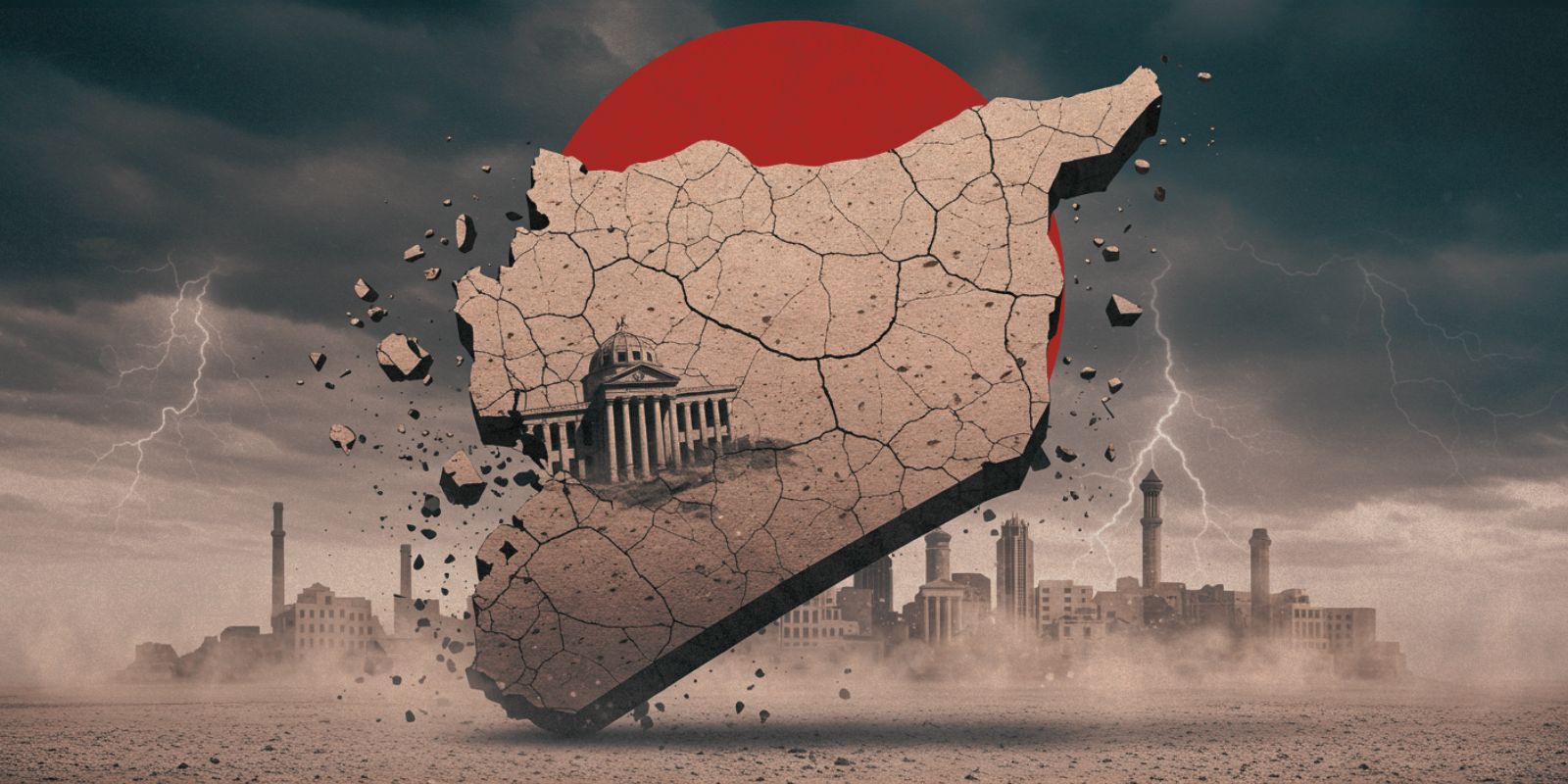
Syria’s transition under Ahmad al-Sharaa has opened a political vacuum and exposed a fragile state stripped of its former institutions. The collapse of central authority – coupled with simmering sectarian and ethnic tensions – has fuelled outbreaks of communal and regional violence, most visibly along the coast and in areas of direct contact. These developments have cast a long shadow over the role of the country’s intellectual and political elites.
An interim authority under strain
The Sharaa government, still finding its footing, faces enormous challenges in containing this violence. Local and regional actors have been quick to exploit the weakness of the state, turning every rift into a lever of influence. Against this backdrop, Syria’s elites face a stark choice: to resist the tide with a constructive cultural and political discourse, or to ride the wave and entrench the divisions for their own gain.
Dr Faiz Qantar, a Syrian academic and political researcher, told +963 that “the interim government bears full responsibility for the surge of sectarian violence and hate speech”, insisting that “the sidelined cultural elite cannot be blamed for a phenomenon rooted in political power”. He argues that the arrival of the interim government in Damascus was accompanied by a new media apparatus that stoked sectarian rhetoric, noting that the factions which formed its backbone were themselves mired in violent rivalries before they entered the capital.
Also read: Are We Handling Political Disagreement Well in the New Syria?
Paralysis or opportunism?
A large section of the intelligentsia has remained paralysed – a legacy of decades of repression, exile and political fragmentation. This has left them unable to articulate a unifying message or to challenge sectarian discourse effectively. Others, however, have chosen to capitalise on the climate – aligning with sectarian blocs, defending heavy-handed measures in the name of “stability”, or exploiting the turmoil to strengthen their own foothold in the new order. Such postures have only deepened the divisions and postponed the possibility of genuine reconciliation.
Qantar points out that some cultural and media figures have gone further still, actively adopting sectarian positions and, in doing so, fuelling the descent into civil conflict. He stresses the urgency of revising this approach, arguing that narrow communalism will lead only to disaster and that recognising the dangers of hate speech is vital to rebuilding Syria’s social fabric.
A fractured political class
Politically, the elites have oscillated between denouncing the old regime, fearing the spread of violence, and seeking opportunities in the emerging system. This ambivalence has betrayed a lack of vision and maturity. According to Syrian analyst Firas Allawi, the country is facing “a crisis of political elites who never managed to establish a real political process”. With no strong parties or blocs, most current figures have operated as oppositionists rather than statesmen.
Alawi adds that the transitional phase has so far failed to produce a class capable of leading a coherent national project. Passing a genuine political parties law, he argues, could provide a framework to gather disparate figures and put forward credible alternatives.
On the cultural front, the long shadow of authoritarianism continues to weigh heavily. Liberal and democratic traditions have withered, along with values of pluralism and tolerance. This intellectual contraction has made elites more inclined either to excuse violence or to adapt to it, rather than mount a principled resistance.
Abdication of responsibility
Syrian intellectuals are now under harsh scrutiny for their failure to build the kind of political and social institutions that might have steadied the transition. Instead of guiding the public towards stability, many appear to have withdrawn, leaving the field open to demagogues.
Journalist Jiwan Soz describes the performance of cultural elites, both loyalist and opposition, as “shameful” – out of touch with ordinary Syrians and their aspirations.
He notes that some who once opposed the old regime have swiftly thrown in their lot with the new authorities in search of advantage, with little regard for the public good. Their rhetoric, he says, has often been laced with incitement, deepening the rifts within Syrian society rather than healing them. For the most part, these elites remain confined to media platforms and social networks, far removed from the country’s lived reality.
Also read: Hate Speech in Syria: Political Legacy and Weapon of War
Looking ahead
The greatest challenge lies in the absence of capable figures at the helm. Poor strategic planning threatens both stability and development, leaving Sharaa’s interim authority to grapple with a crucial question: how to harness elites in shaping a lasting roadmap for Syria.
Allawi believes progress is possible if elites – whether in opposition or government – can commit to political engagement and turn away from violence. Only then, he argues, can a more stable political order emerge and provide the conditions for Syria’s fractured intelligentsia to play a meaningful role in the country’s future.











